“The Origins of Dislike” by Amit Chaudhuri, a review

Soni Wadhwa in the Asian Review of Books:

In his new book, The Origins of Dislike, Amit Chaudhuri unwraps several aspects of reading, writing, publishing, criticism, and thinking in general, mostly to dismantle the perceived virtuosity of these phenomena.

This collection of Chaudhuri’s talks and previously published essays scandalizes in the bubbles it bursts around commonplace notions of profundity and greatness that people use to speak about great books, especially novels. It also pleases with its insights into approaches of writing and interpretation.

Readers who thought they were reading books for pleasure would be shocked to discover that they are themselves an invention of the free market. In “The Piazza and the Car Park”, Chaudhuri says that publishing industry and its agents created the reader:

unburdened by intelligence; easily challenged by expressions of the intellect; easily diverted by a story, an adventure, a foreign place, or fairy tale, or an issue or theme of importance. This reader was transparent, democratic and resistant only to resistance, occlusion, and difficulty. Writing must assume the characteristics of the ‘reader’: the term for this process, in which literature took on a desirable quality was ‘accessibility’.

Chaudhuri takes things up a notch when he discusses popular myths among the readers about what goes into writing a novel.

More here.

Psychology Has a New Approach to Building Healthier Men

Amanda Mull in The Atlantic:

This week, the American Psychological Association, the country’s largest professional organization of psychologists, did something for men that it’s done for many other demographic groups in the past: It introduced a set of detailed guidelines for clinicians who treat men and boys. The 10 guidelines make suggestions on how to encourage fathers to engage with their kids, how to address problems that disproportionately affect men, like suicide and substance abuse, and how to steer men toward healthy behaviors. The guidelines’ development began in 2005, and has included input from more than 200 physicians and researchers.

This emphasis on understanding the issues men face comes at a crucial time, according to Ryon McDermott, a psychologist who helped the APA craft its new standards. Although people of all genders face no shortage of obstacles in America, “men are struggling,” he says. “The recession has hit men harder than women, men are less likely to graduate from college, men are more likely to complete suicide than women.” To help patients, the guidelines assert, psychologists need to understand what’s making their lives untenable. For a lot of men, it might be the harsh cultural expectations that can come along with manhood itself.

In providing standards for men in the same way that it previously has for womenLGBTQ people, and other demographic groups, the APA attempts to right an enduring wrong in a field that has long glossed over how being a man might impact a person’s experiences and well-being.

More here.

Is populism what’s really threatening democracy?

Steven Hahn in The Nation:

There is, many believe, a specter haunting the Euro-American world. It is not, as Marx and Engels once exulted, the specter of communism. Nor is it the specter of fascism, though some, including former secretary of state Madeleine Albright, have warned of this. Rather, it is the specter of what journalists, scholars, and other political observers now routinely call “populism.” To be sure, there are few, if any, self-described populist movements afoot: no “populist” parties seeking to mobilize voters and constituencies, no “populist international” attempting to harness discontent as it spreads across national borders. Nor is there any “populist” language, sustained “populist” critique of the status quo, or “populist” platform as there once was in the United States at the very end of the 19th century.

“Populism” is instead a term meant to encapsulate the rage often found among white and native-born voters across Europe and other parts of the Western Hemisphere, who regard themselves as victimized by established political institutions, the corrupt practices of politicians, and the influx of migrants from afar. Indeed, these “populists” appear to be united both by shared grievances and by a disposition to place the blame not on the workings of the economic system or the excesses of economic elites (though anti-Semitic currents suggest some of this), but on the threats posed by immigrants to the national culture and economic well-being.

In the current parlance, that is to say, populism is less a movement than a menace.

More here.

The Border Patrol has been a cult of brutality since 1924

Greg Grandin in The Intercept:

SINCE ITS FOUNDING in the early 20th century, the U.S. Border Patrol has operated with near-complete impunity, arguably serving as the most politicized and abusive branch of federal law enforcement — even more so than the FBI during J. Edgar Hoover’s directorship.

The 1924 Immigration Act tapped into a xenophobia with deep roots in the U.S. history. The law effectively eliminated immigration from Asia and sharply reduced arrivals from southern and eastern Europe. Most countries were now subject to a set quota system, with the highest numbers assigned to western Europe. As a result, new arrivals to the United States were mostly white Protestants. Nativists were largely happy with this new arrangement, but not with the fact that Mexico, due to the influence of U.S. business interests that wanted to maintain access to low-wage workers, remained exempt from the quota system. “Texas needs these Mexican immigrants,” said the state’s Chamber of Commerce.

Having lost the national debate when it came to restricting Mexicans, white supremacists — fearing that the country’s open-border policy with Mexico was hastening the “mongrelization” of the United States — took control of the U.S. Border Patrol, also established in 1924, and turned it into a frontline instrument of race vigilantism.

More here.

The crisis of globalisation: interview with Mark Blyth

Henning Meyer in Social Europe:

Towards the end of 2018, Henning Meyer, editor-in-chief of Social Europe, spoke to the expert on international political economy Mark Blyth, about the crisis of globalisation, populism, Brexit and other political disasters waiting to happen.

Henning Meyer: Mark Blyth, thank you very much for joining me today to discuss the crisis of globalisation and what political and economic consequences it might have. Let me ask you the first question. Basically, do you think there is a crisis of globalisation? And if there is one, in your opinion, what are its main characteristics?

Mark Blyth: It’s always a tough one. I hate using the word ‘crisis’, because I’ve been doing this stuff for about 30 years now, and when I went to graduate school I read books about crisis. Then we had a crisis. Then we had another crisis. A crisis of this and a crisis of that. There’s a danger that the term becomes meaningless. So I will try and put it in a slightly different cast.
Capitalism itself is usually quite a robust system. That is to say, it can not only deal with shocks—it can sometimes benefit from shocks, depending on the type of shock. What’s happened since 2008 is not the type of shocks that you’re robust to, nor do you benefit from. You have a giant real-estate bust, which tends to then accumulate, through the banking sector and the bail-out of the banking sector, into a series of public debt bail-outs, which then leads to greater fragility on that side.

The entire financial sector on the private side, whether it was corporates through corporate debt markets or whether it was consumers through consumer debt, are extremely levered. Wages aren’t growing, which is the real big problem. Inequality has literally never been higher in many cases. And we’re finally waking up to the fact that there’s an environmental crisis that is very, very serious and is going to hit us much sooner than we thought.

More here.

Economic Democracy, Human Rental, and Alternative Development

From Circular Conversations:

David Ellerman works in disparate fields, from economics and political economy, to social theory and philosophy, to mathematical logic and quantum mechanics. From 1992 to 2003, he worked, at the World Bank, as economic advisor to the Chief Economist (Joseph Stiglitz and Nicholas Stern). He has published numerous articles and books, among which The Democratic Worker-Owned Firm (1990), Property and Contract in Economics: The Case for Economic Democracy (1992), and Helping People Help Themselves: From the World Bank to an Alternative Philosophy of Development Assistance (2005). He is currently visiting scholar at the University of California, Riverside and the University of Ljubljana, Slovenia.
Hi David, it is a pleasure to host you for a talk in this convivial parlour. The first major topic I would like to touch upon during our conversation is democratic firms; a topic you have extensively dealt with and are an ardent proponent of. As an introductory question, how do the institutional design and governance arrangements of a democratic firm look like?

A democratic firm is a private democratic organization where the members or ‘citizens’ are the people working in the firm. A democratic firm—like, say, a democratic city—does not have owners, but has citizens. The members of the firm elect the board of directors who appoint the managers. The members may also supply capital to the firm in the form of a membership fee and retained earnings kept track of in an internal capital account, but their membership rights (i.e. voting rights and share of net income) are independent of the balance ‘in’ their internal capital accounts. These capital accounts are essentially a subordinate form of debt of the company to the members to be paid out over the years. There is no equity capital in a democratic firm any more than in a democratic municipality.

More here.

Absurdity and wonder: Heath Robinson at home

David Bennun in More Intelligent Life:

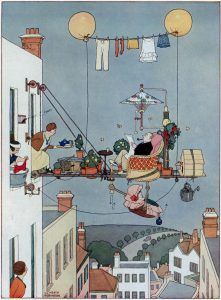
It’s one thing for an artist to establish a reputation, another for them to enter the dictionary. When the British want to describe a whimsical, improvised or over-elaborate mechanism, they call it a “Heath Robinson” machine, after the drawings of William Heath Robinson. (Americans have a direct equivalent in Rube Goldberg, whose creations, inspired by similar rapid changes in society and technology, are remarkably similar to those of his British counterpart.) A new exhibition of Heath Robinson’s work shows how he became a household name, in more ways than one.

…“Heath Robinson’s Home Life”, at the museum dedicated to him in the north London suburb of Pinner, where he lived, focuses on the work that cemented his fame: the fantastical illustrations of domestic scenes that he drew for magazines and books from the 1920s until his death in 1944. Heath Robinson was inspired by the rapid expansion of housing in interwar Britain. In the cities, blocks of flats were springing up, and suburbs – fed by new transport links and the rise in car ownership – were mushrooming. In total, 4.5m new homes were built in the 1920s and 1930s, and in London, by the start of the second world war, more flats than houses were being constructed. This period of transformation provided Heath Robinson with ample opportunity for satire. With a keen eye on the market, he collaborated with writer K.R.G. Browne on a bestselling series of spoof advice books, including “How To Live In A Flat” (1936), “How To Be A Perfect Husband” (1937) and “How To Be A Motorist” (1939). His wry yet affectionate pictures suggest he – like many other people in Britain – regarded the workings of this new era with a certain scepticism, yet also with considerable enthusiasm. To Heath Robinson, as to his many admirers, his was an age of both absurdity and wonder.

More here.

How Beauty Is Making Scientists Rethink Evolution

Ferris Jabr in The New York Times:

A male flame bowerbird is a creature of incandescent beauty. The hue of his plumage transitions seamlessly from molten red to sunshine yellow. But that radiance is not enough to attract a mate. When males of most bowerbird species are ready to begin courting, they set about building the structure for which they are named: an assemblage of twigs shaped into a spire, corridor or hut. They decorate their bowers with scores of colorful objects, like flowers, berries, snail shells or, if they are near an urban area, bottle caps and plastic cutlery. Some bowerbirds even arrange the items in their collection from smallest to largest, forming a walkway that makes themselves and their trinkets all the more striking to a female — an optical illusion known as forced perspective that humans did not perfect until the 15th century. Yet even this remarkable exhibition is not sufficient to satisfy a female flame bowerbird. Should a female show initial interest, the male must react immediately. Staring at the female, his pupils swelling and shrinking like a heartbeat, he begins a dance best described as psychotically sultry. He bobs, flutters, puffs his chest. He crouches low and rises slowly, brandishing one wing in front of his head like a magician’s cape. Suddenly his whole body convulses like a windup alarm clock. If the female approves, she will copulate with him for two or three seconds. They will never meet again.

The bowerbird defies traditional assumptions about animal behavior. Here is a creature that spends hours meticulously curating a cabinet of wonder, grouping his treasures by color and likeness. Here is a creature that single-beakedly builds something far more sophisticated than many celebrated examples of animal toolmaking; the stripped twigs that chimpanzees use to fish termites from their mounds pale in comparison. The bowerbird’s bower, as at least one scientist has argued, is nothing less than art. When you consider every element of his courtship — the costumes, dance and sculpture — it evokes a concept beloved by the German composer Richard Wagner: Gesamtkunstwerk, a total work of art, one that blends many different forms and stimulates all the senses.

This extravagance is also an affront to the rules of natural selection. Adaptations are meant to be useful — that’s the whole point — and the most successful creatures should be the ones best adapted to their particular environments. So what is the evolutionary justification for the bowerbird’s ostentatious display? Not only do the bowerbird’s colorful feathers and elaborate constructions lack obvious value outside courtship, but they also hinder his survival and general well-being, draining precious calories and making him much more noticeable to predators.

More here.

Friday, January 11, 2019

The Unsentimental, Darkly Elegant Stories of Ruth Prawer Jhabvala

Megan O’Grady in the New York Times:

Perhaps no author has made more art of dispossession than Ruth Prawer Jhabvala. The author of a dozen novels and twice as many screenplays — she’s the only person to have won both the Booker Prize (for her eighth and best-known novel, “Heat and Dust”) and an Academy Award (twice, for best adapted screenplay) — Jhabvala was 12 when she fled Nazi Germany with her family in 1939. After the war, when her father learned the fate of the relatives left behind, he killed himself.


But even before her “disinheritance,” as she would later call these fundamental losses, Jhabvala was writing stories — first in German, and after they had settled in London, in English. She was studying English literature when she met Cyrus Jhabvala, an architect, and in 1951, they married and moved to Delhi. India was her home and subject until 1975, when she moved to New York’s Upper East Side, buying an apartment near her friends and creative partners, Ismail Merchant and James Ivory, as her career as a screenwriter flourished. There, as if closing a circle, she wrote fiction inspired by the European émigrés she met, people who understood what it meant to be homesick for a way of life that no longer existed. In a 1979 lecture, Jhabvala described herself as “blown about from country to country, culture to culture,” a “cuckoo forever insinuating itself into other’s nests.”

In this country, she’s best known as the screenwriting talent behind so many Merchant-Ivory films, among them the sumptuous, Oscar-winning adaptations of E. M. Forster’s “A Room With a View” and “Howards End” (a film of her own novel “The Householder” was their first collaboration).

More here.

Implicit Attitudes Can Change Over the Long Term

From the website of the Association for Psychological Science:

Data from more than 4 million tests completed between 2004 and 2016 show that Americans’ attitudes toward certain social groups are becoming less biased over time, according to research published in Psychological Science, a journal of the Association for Psychological Science. The findings show that participants’ self-reported (explicit) attitudes regarding groups defined by age, disability, body weight, race, skin tone, and sexuality have all shifted toward neutrality over the span of a decade. Crucially, the data also showed that participants’ more automatic (implicit) attitudes toward race, skin tone, and sexuality have also decreased in bias over time.

“We provide the first report of long-term change in both implicit and explicit attitudes – measured from the same individual – towards multiple social groups,” says psychological scientist Tessa E. S. Charlesworth of Harvard University, first author on the study. “This research is important because it shows that, contrary to previous assumptions that implicit attitudes were stable features of the mind or society, implicit attitudes appear, in fact, to be capable of long-term durable change.”

Charlesworth and Harvard University psychology professor Mahzarin R. Banaji used statistical models similar to those employed by economic forecasters to analyze change in data collected via the Project Implicit website from January 1, 2004 to December 31, 2016. Only participants living in the United States were included in the analyses.

More here.

Judith Rich Harris remembered by Steven Pinker

Steven Pinker at Edge:

“We are in considerable doubt that you will develop into our professional stereotype of what an experimental psychologist should be.” When the Harvard psychology department kicked Judith Rich Harris out of their PhD program in 1960, they could not have known how true the words in their expulsion letter would turn out to be.

Harris, an active Edge contributor for twenty years, and a charter member (and exemplar) of The Third Culture, died this week at the age of 80. After leaving Harvard, she wrote textbooks in child psychology until she could no longer believe what she was writing. The epiphany came when she was reiterating the conventional wisdom that adolescents were attempting to attain mature adult status and realized, “If teenagers wanted to be like adults they wouldn’t be shoplifting nail polish from drugstores or hanging off overpasses to spray I LOVE YOU LIƨA on the arch. If they really aspired to ‘mature status’ they would be doing boring adult things like sorting the laundry and figuring out their income taxes. Teenagers aren’t trying to be like adults: they are trying to distinguish themselves from adults!”

Harris expanded this insight into a radical new theory of socialization—that children’s personalities are shaped by genes and peers, not parents—which she laid out in a 1995 article in the flagship journal Psychological Review and a 1998 bestseller, The Nurture Assumption.

More here.

Worse Than Watergate

Kevin M. Kruse and Julian E. Zelizer in The Atlantic:

If the multiple charges against President Donald Trump prove out, he’ll easily displace Richard Nixon at the top of the Crooked Modern Presidents list. Here’s why.

The Original Sin: The underlying crime in Watergate was a break-in at the Democratic National Committee headquarters, part of a plot to steal documents that might have offered a slight edge in what turned out to be a landslide victory for Nixon. The closest post-Nixon, pre-Trump scandal in terms of severity was surely Iran-Contra, in which high-level officials in the Ronald Reagan administration circumvented Congress to secure military assistance to Nicaraguan rebels. The legal violations were considerable but, as partisans insisted and much of the public believed, the scandal stemmed from a sincere policy position held by the administration rather than the self-interest of individuals. President Bill Clinton’s scandal seemed the inverse: It was deeply personal—an extramarital affair with a White House intern—but the crimes that resulted from it were small-bore.

Although the allegations against Trump are still just that—allegations—they’re far more serious. At the heart of the matter is the possibility that his campaign conspired with a foreign government to influence the 2016 presidential election.

More here.

Deleting Facebook Won’t Fix the Problem

Anand Giridharadas in the New York Times:

When news broke that Facebook users’ private messages were not necessarily private, Taunya Richards, 44, a real estate appraiser in Hillsboro, Ore., immediately panicked: Had she endangered her son? She thought back to her chats with her mother in Idaho, who prefers Facebook’s messenger to texting. Her son is a specialist in the Army; using the Facebook-owned encrypted messaging platform WhatsApp, he had kept her updated as he traveled to what she described as a dangerous foreign base whose location she was supposed to keep secret. She had then sent those location updates to her mother using Facebook Messenger. Now she wonders who has that data.

“For a mother,” she told me, “especially one whose whole life has been about protect your kid from these harms, and she’s just doing what a mother does, which is responding to him telling her something that he needs her to know so he’s protected, and someone can come in and take that and just sell it to people as data? You’re putting my kid’s life in danger.”

But don’t count Ms. Richards among the growing ranks of people deleting Facebook. “All it does is punish me,” she said. “It doesn’t punish Facebook. It doesn’t change anything. It cuts me off from my family.” Even if a boycott bankrupted Facebook, what’s to stop the next company from doing the same thing? “We need the laws to say, You can’t do this,” she said.

More here.

Steven Pinker’s ideas are fatally flawed and these eight graphs show why

Jeremy Lent in Open Democracy:

Having read his book carefully, I believe it’s crucially important to take Pinker to task for some dangerously erroneous arguments he makes. Pinker is, after all, an intellectual darling of the most powerful echelons of global society. He spoke to the world’s elite this year at the World’s Economic Forum in Davos on the perils of what he calls “political correctness,” and has been named one of Time magazine’s “100 Most Influential People in the World Today.” Since his work offers an intellectual rationale for many in the elite to continue practices that imperil humanity, it needs to be met with a detailed and rigorous response.

Besides, I agree with much of what Pinker has to say. His book is stocked with seventy-five charts and graphs that provide incontrovertible evidence for centuries of progress on many fronts that should matter to all of us: an inexorable decline in violence of all sorts along with equally impressive increases in health, longevity, education, and human rights. It’s precisely because of the validity of much of Pinker’s narrative that the flaws in his argument are so dangerous. They’re concealed under such a smooth layer of data and eloquence that they need to be carefully unraveled. That’s why my response to Pinker is to meet him on his own turf: in each section, like him, I rest my case on hard data exemplified in a graph.

More here.

Bharat Bandh: Why Workers Brought India to a Halt for Two Days in the largest strike in history

Akhil Kumar in The Wire:

Issuing a clarion call against the Modi government, an estimated 200 million workers across various sectors successfully carried out a two-day nationwide strike on January 8-9. They were protesting against the government’s ‘anti-labour’ policies and alleged that the ruling party favours corporates over the interests of the vulnerable working class.

While finance minister Arun Jaitley doesn’t see any ‘real issues’ in the protest and hints at it being the Left’s attempt to stoke ‘symbolic unrest’ to ensure their survival, striking workers assert the Modi government is apathetic towards them.

Alleging arrogance and contempt towards workers, trade union leaders claim the Modi government has been ignoring their 12-point charter of demands that raises issues of unemployment, price rise, minimum wages, pension, increasing contractualisation, disinvestment, universal social security cover, strict compliance with labour laws and FDI. “The Modi government is not interested in even meeting union representatives,” a union leader told The Wire.

More here.

Earth’s magnetic field is acting up and geologists don’t know why

Alexandra Witze in Nature:

Something strange is going on at the top of the world. Earth’s north magnetic pole has been skittering away from Canada and towards Siberia, driven by liquid iron sloshing within the planet’s core. The magnetic pole is moving so quickly that it has forced the world’s geomagnetism experts into a rare move. On 15 January, they are set to update the World Magnetic Model, which describes the planet’s magnetic field and underlies all modern navigation, from the systems that steer ships at sea to Google Maps on smartphones. The most recent version of the model came out in 2015 and was supposed to last until 2020 — but the magnetic field is changing so rapidly that researchers have to fix the model now. “The error is increasing all the time,” says Arnaud Chulliat, a geomagnetist at the University of Colorado Boulder and the National Oceanic and Atmospheric Administration’s (NOAA’s) National Centers for Environmental Information. The problem lies partly with the moving pole and partly with other shifts deep within the planet. Liquid churning in Earth’s core generates most of the magnetic field, which varies over time as the deep flows change. In 2016, for instance, part of the magnetic field temporarily accelerated deep under northern South America and the eastern Pacific Ocean. Satellites such as the European Space Agency’s Swarm mission tracked the shift.

More here.

Friday Poem

Confessional

I confess to having abused the ordinary details
of personal days, to having used the world less,
the self more, to the womanly flaw of regarding
private hours as the primary province

of knowledge. Dear critic, appalled
by female details, the minutia of a childless
and husbandless bluestocking strewn across
that unspoiled landscape of literature, you are

right to side with Bly, legislate against
the blight of first person pronouns. Dump
those babies in the great pit of poetic dross.
Away with these maudlin cravings, these

not new, even if cleverly disguised contributions
to the egotistical minus the sublime. All those weak
moments when I deferred to the memory
of an actual lover. Then to have covered

it up with the thin dirt of allusion, invoking Keats
or Wordsworth in concert with some man
done gone and left me. I ought to be shot
like the old dog I am, irascible, blind,

given to biting the hand that feeds, guilty
of living on the grim edges, having wished
to be the center of attention. You, dear critic,
and my father, win: I was simply not marriageable.

Read more »

Thursday, January 10, 2019

Her Left Hand, the Darkness

Alison Smith in Granta:

In 1987, my first year in college, I happened upon a notice outside of the English department for a winter session opportunity: escorting a visiting artist during a week-long interdisciplinary conference held at my school, the University of Rochester. I ran my finger down the list of artists’ names until it stopped on one: Ursula K. Le Guin.

At eighteen, I had never met a published author (unless you count the time I stood in line for an hour to have Kurt Vonnegut sign my copy of Slaughterhouse-Five), and this was not any published author, this was Le Guin. I scanned the notice for application information. Applicants were required to write an essay on why they would be a good student guide and to list their preferred artists. The deadline was that day. I sat down in the hallway and scribbled out a plea on the back of the notice. I don’t remember what I wrote, but I am sure I mentioned my worn copy of The Left Hand of Darkness and the first line, which I had memorized. A line that contained a thrilling twist on the nature of reality: ‘I’ll make my report as if I told a story, for I was taught as a child on my homeworld that Truth is a matter of the imagination.’

I slipped the paper under the door – the office had already closed. A week later I received a call from the department secretary. I had been assigned an artist. ‘Who?’ I asked, gripping the receiver. There was a pause. I heard papers shuffling, and then: ‘Ursula K. Le Guin.’

More here.