
Morgan Meis in The Easel:
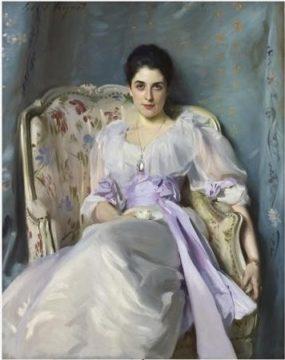 It was often the case in the late 19th century that if you wanted to add a little prestige to your life you had your portrait painted by a notable portrait painter. Or you had your family painted, or just your wife. This latter idea was the thought that occurred to Sir Andrew Agnew, the 9th Baronet of Lochnaw Castle in Wigtownshire, Scotland. He was proud of his wife, perhaps in the way one is proud of a horse, or an elegant piece of furniture. He wanted others to be proud too. There was a lot of pride going around.
So, Sir Andrew hired a fashionable portrait painter and, in 1892, a portrait was painted. The painting is known today by the name of its sitter, Lady Agnew of Lochnaw. The painter was a Mr. John Singer Sargent.
The portrait shows a person of great wealth and privilege engaged in the act of enjoying that wealth and privilege. To this, we might respond with complete indifference or even hostility. We’re also given, in the portrait, all the trappings of docile femininity. The soft gauzy fabrics of the chair, backdrop, and dress highlight the soft gauziness that adheres to Lady Agnew herself. The painting is staid in every possible meaning of the term.
And yet, I want to say that the painting is also exciting.
More here.
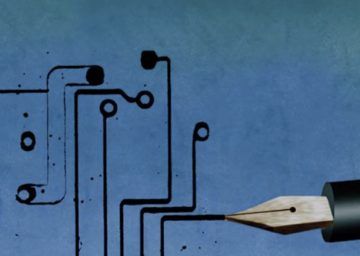 AI is a broad church, and like many churches, it has schisms.
 Fears about
 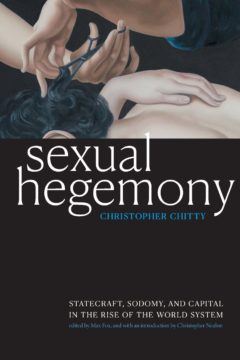 While some academics (like John Boswell and Terry Castle) spent years arguing, with ever-decreasing success, that something like the contemporary “gay” or “lesbian” had always existed in relatively similar ways, “constructionist” models like those offered by Foucault and D’Emilio have become dominant in today’s academic histories about gay, lesbian, and trans lives. In the mainstream, however, it’s almost the reverse. If in the 1970s and 1980s there was a vibrant public activist culture in which both Queer History One and Two were debated, today most gay and lesbian people firmly rely on the former. The wages of nationalism are generous, and Queer History One’s story—you have always existed, you have dignity because you are like Great Men/Women—has proven to be an easier position from which to argue for the dispensation of civil rights and protections from the state. It’s unsurprising that this has become the mass-market narrative about homosexuality in the contemporary West: we’re born this way, and we always have been. Recognize us, and we’ll marry, pay taxes, and serve in the military.
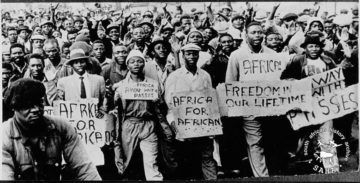 Like all children in our exile community whose parents were members of the African National Congress, I attended Young Pioneers meetings every weekend. The meetings were like Sunday school sessions. Politics was our religion, and we worshipped at the altar of
 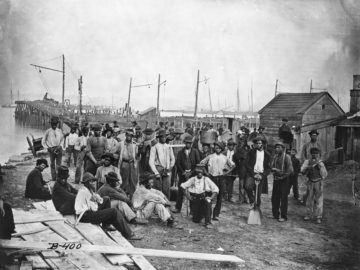 In August of 1619, the English warship White Lion sailed into Hampton Roads, Virginia, where the conjunction of the James, Elizabeth and York rivers meet the Atlantic Ocean. The White Lion’s captain and crew were privateers, and they had taken captives from a Dutch slave ship. They exchanged, for supplies, more than 20 African people with the leadership and settlers at the Jamestown colony. In 2019 this event, while not the first arrival of Africans or
 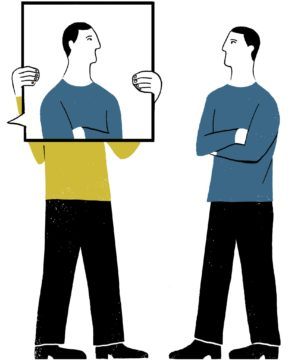 As an organizational psychologist, I’ve spent the past few years studying how to motivate people to think again. I’ve run experiments that led proponents of gun rights and gun safety to abandon some of their mutual animosity, and I even got Yankees fans to let go of their grudges against Red Sox supporters. But I don’t always practice what I teach.
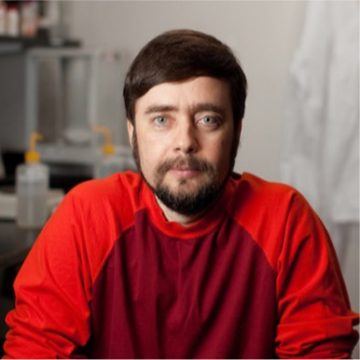 As a semi-outsider, it’s fun for me to watch as a new era dawns in biology: one that adds ideas from physics, big data, computer science, and information theory to the usual biological toolkit. One of the big areas of study in this burgeoning field is the relationship between the basic bioinformatic building blocks (genes and proteins) to the macroscopic organism that eventually results. That relationship is not a simple one, as we’re discovering. Standard metaphors notwithstanding, an organism is not a machine based on genetic blueprints. I talk with biologist and information scientist Michael Levin about how information and physical constraints come together to make organisms and selves.

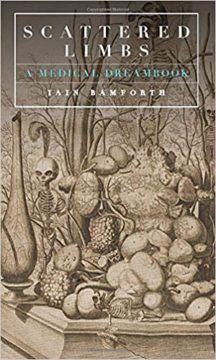 What is health anyway, when everyone dies in the end? The World Health Organization defines it as ‘a state of complete physical, mental and social well-being and not merely the absence of disease or infirmity’. This is a long way from the attitude of the ‘last of the great Bakhtishu family of physicians, around the year 1000 in Baghdad’, writes Bamforth: they found that the perfect state of health ‘does not exist’. What about Schopenhauer and his definition of humanity as a synthesis of the infinite and the finite?
 The pandemic, which has seemed
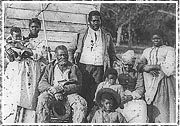 When Africans were taken from their homes and forced into slavery, they were separated from mothers, fathers, sisters and brothers and were torn from extensive kinship networks. Enslaved in the British colonies of North America or the free states of the American Union, the ability of Africans to reestablish nuclear families and familial support systems depended on many factors including the needs and desires of the slave owner. As the circumstances of slavery changed across time and place, the opportunities for slaves to marry, have children, and create stable family units fluctuated.
 Do bees have generals? Do they constitute a nation? A tribe? Perhaps a clan?