
Ross Simonini and Maggie Nelson at The Believer:
 BLVR: It’s interesting that you make the distinction between art and not-art, because your writing doesn’t seem to make that distinction.
MN: I do think it’s all part of one flow. And to me, how personal it is and what form it takes on the page are just a Bob Creeley, “form follows content” kind of a thing. But at the same time, I’m alert to what different genres can do. And I think if someone calls Bluets a novel, I’m like, OK, that’s fine. To me, it’s within the realm of experimental speculative nonfiction. Someone could say The Art of Cruelty is a series of essays, but it was not conceived as a series of essays. It was conceived as an ongoing thought that had episodic rings of action. On Freedom is weird because it’s four long chapters, which are each, like, seventy-five pages in manuscript. This was not a particularly elegant form to me. There was no real experimenting with the accretion of fragments, like I’ve done before. And then that became a kind of formal question to me, like: How can things this long hang together? I like to come up with subtitles, like “a reckoning” or “a murder” or things that kind of name something about the form. And I always thought of these sections of On Freedom as long songs. That was my idea about them. Songs can be quite long and still hang together, and they are less boring than chapters.
more here.
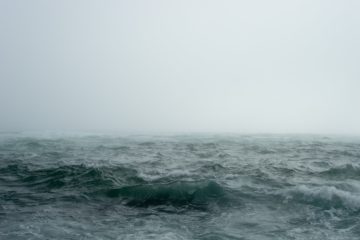 The fundamental struggle with water has never really abated since it first began on the shores of the Persian Gulf. The multiple transitions, from nomadism to sedentism, from hunting and foraging to domesticated agriculture, from small rural communities to a productive, specialized, urbanized society, were severe disruptions. But while individuals would have lived through them as gradual, incremental transformations, over the course of Homo sapiens’ existence, they amounted to shocking events. From the moment Homo sapiens, late in its history, decided to stay in one place, surrounded by a changing environment, it began to wrestle with water, an agent capable of destruction and life-giving gifts.
 T
T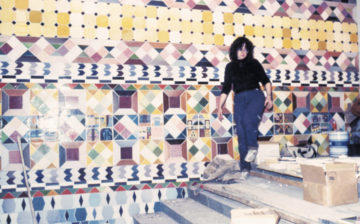 IN AN APPRECIATIVE 2016 REVIEW of new work by Valerie Jaudon, critic David Frankel noted that the Pattern and Decoration movement, of which Jaudon was a prominent member, had long been held in disrepute. “In the early ’80s,” Frankel wrote, “I remember a colleague at Artforum at the time saying it could never be taken seriously in the magazine.”1 In retrospect, what makes this dismissal so striking is that, in the mid-’70s, Artforum contributed significantly to P&D’s emergence into the spotlight, publishing key texts by its advocates along with numerous reviews of its shows. Amy Goldin’s “Patterns, Grids, and Painting” (1975) and Jeff Perrone’s “Approaching the Decorative” (1976) were among the early touchstones for P&D’s heterogeneous cohort, riled by the unmitigated critical support for diverse ascetic and masculinist tendencies pervasive in the painting of the moment. However, by the mid-’80s, eclipsed by newer developments—the Pictures generation, neo-geo, et al.—P&D was increasingly coming under fire for positions now considered controversial: for the purported essentialism of its versions of second-wave feminism, for a naive advocacy that masked acts of Orientalizing and primitivizing, for cultural imperialism. More fundamental “problems” largely went unnoted, including a lack of the kind of conceptual depth expected of cutting-edge practices: In their commitment to the decorative, P&D artists prioritized surface over subject matter, the former serving primarily as a vehicle for sensuous effects. Not least, the art world’s entrenched sexism fostered the occasion for its denizens to belittle and sideline a movement renowned for the dominant role played by women in its genesis and trajectory.
 Anil Seth
 The first time I learned I was Muslim was in preschool.
 COVID-19 deaths and cases are starting to decline and some
 I first became aware of the photographs of Deana Lawson because of a piece that Zadie Smith wrote about Lawson in The New Yorker a few years ago and I remember it being quite a good piece, which is not unusual for a piece by Zadie Smith and, to be completely truthful, I find that I am often much more moved and impressed when Zadie Smith writes about visual art than I am by the novels of Zadie Smith. But perhaps I am just being bitter in saying this because in fact I should also say that I once sort of thought that I was a little bit friends with Zadie Smith since she had liked an article I’d written about a collection of her essays and we engaged in something of an ongoing email exchange and then one day I noticed that we were both scheduled to do something at a literary event, to give a talk or give a reading or whatever people do at literary events and I thought I would drop by to say hi to her and maybe have a coffee and suddenly I was in a long line of people trying to get a moment with Zadie Smith as she was sitting at a table signing books. She was surrounded by different sorts of handlers and managers and, I guess, bodyguards and when I finally got up to Zadie Smith and when she realized that she sort of knew me through an email exchange there was an awkward chit chat between the two of us mixed with some overly long pauses and it felt, I must say, like I was standing there for several hours when in fact it must have only been a couple of minutes and the whole time she looked deeply pained and sorry for me and then her handlers sort of scooted me along down the hall and I finally realized that I am not friends with Zadie Smith at all, not even a little bit, and that she lives in a world that truly and completely has nothing to do with my own. She lives in a world of real and genuine fame and I do not. She ‘knows’ hundreds of people like me and mostly she just wants them to go away. And I don’t blame her at all for that. Not one bit. During that awkward couple of minutes standing in front of her book-signing table I wanted me to go away too.
 The Nobel Assembly at Karolinska Institutet has today decided to award the 2021 Nobel Prize in Physiology or Medicine jointly to David Julius and Ardem Patapoutian for their discoveries of receptors for temperature and touch.
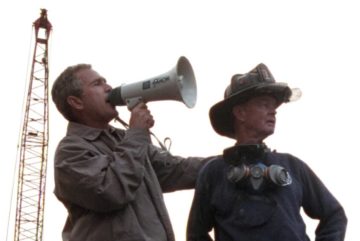 Postmortems on the war in Afghanistan stress errors of execution during the two decades of occupation. However, the greatest error may have been to invade at all.
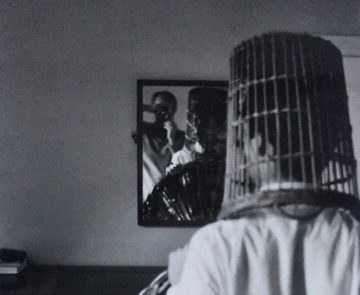 Readers of Sebald increasingly agree that it is wrong to see the Jewish and German tragedy of the Holocaust as the sole focus of his work: the darkness of his vision extends much further, to the whole of human history, to nature itself. That is true. But here is my limitation: I am the daughter of Jewish refugees from Nazism. It was the fact that Sebald was the German writer who most deeply took on the burden of German responsibility for the Holocaust that first drew me to him, and it is still one of the things that most amaze and move me about his work. He didn’t want to be labeled a “Holocaust writer” and I don’t call him one here. But though the Holocaust was far from the only tragedy he perceived, it was his tragedy, as a German, the son of a father who had fought in Hitler’s army without question. It was also my tragedy, as the daughter of Viennese Jews who had barely escaped with their lives. I think it is right to see the Holocaust as central to his work. But if I make it too central, that is why.
 ‘W
‘W E
E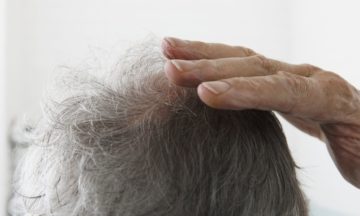 Every person, every mouse, every dog, has one unmistakable sign of aging: hair loss. But why does that happen? Rui Yi, a professor of pathology at Northwestern University, set out to answer the question.