https://www.youtube.com/watch?v=e6hB59zWm40

https://www.youtube.com/watch?v=e6hB59zWm40
Sophie Haigney at Art In America:
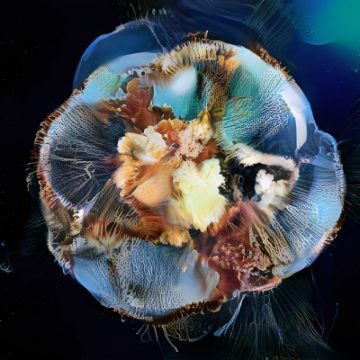 The creature appears to be, at first glance, a parrot, with bright feathers in yellow, red, green, and blue. But another look, and one sees that it’s shaped more like a duck, or perhaps two ducks melded into one. What looks like an eye might really be the wing of a butterfly. The more closely one looks at the image, the more the creature is unrecognizable; it dissolves into a strange jumble of component parts, which seem to add up to nothing, and then cohere once again into something both familiar and unknown.
This is one of the images from Sofia Crespo’s series “Neural Zoo” (2018–20). Crespo is an artist whose work combines neural network technologies and images of the natural world to generate what she calls “speculative nature.”
more here.
Negar Azimi at Bookforum:
 SHE CALLED HERSELF a minor writer. “I’m no Tolstoy,” said this woman whose parents named her after a character from War and Peace. One wishes Natalia Ginzburg hadn’t apologized for her gifts. Wishes that she had luxuriated in her standing as one of Italy’s finest postwar writers. The fact that her various novels, novellas, and essays are flying back into print—some freshly translated—thirty years after her passing is not unrelated to the extravagant success of the other Italian, the one whose books have become the stuff of prestige television. Ginzburg, alas, has no HBO series attached to her name, but surely her estate profits from the fumes of Ferrante fever. As publishers scramble to chart distinguished genealogies of Italian women writers, we are invited to “discover” Ginzburg’s work in essays like this one. As though it had not been hiding in plain sight for decades.
more here.
Dwight Garner in the New York Times:
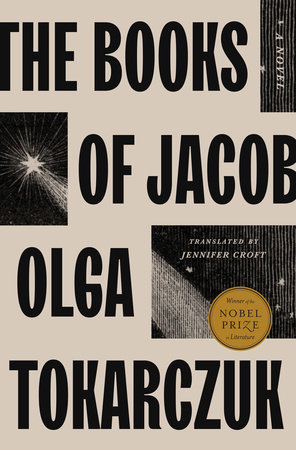 The Polish writer Olga Tokarczuk was, in 2019, a youthful winner of the Nobel Prize in Literature. She was 57, dreadlocked, mischievous of politics, a vegetarian.
Her novel “Drive Your Plow Over the Bones of the Dead” had recently been turned, by Agnieszka Holland, into the film “Spoor,” a slice of existential and ecology-minded dread.
Tokarczuk (pronounced To-KAR-chook) was not among those laureates the Swedish Academy sometimes seems to prop up in the crypt for a final viewing. Her career was, and is, in full gallop.
Her novels — they are often both pensive and mythic in tone — are slowly making their way into English. In addition to “Drive Your Plow,” these include the philosophical and often dazzling “Flights,” about travel and being between stations. It won the 2018 Man Booker International prize.
Tokarczuk’s most ambitious novel — the Swedish Academy called it her “magnum opus” — has long been said to be “The Books of Jacob,” first published in Poland in 2014. It’s here now. At nearly 1,000 pages, it is indeed magnum-size.
More here.
Sean Carroll in Preposterous Universe:
 Being a human is tricky. There are any number of unwritten rules and social cues that we have to learn as we go, but that we ultimately learn to take for granted. Camilla Pang, who was diagnosed with autism spectrum disorder at age eight, had a harder time than most, as she didn’t easily perceive the rules of etiquette and relationships that we need to deal with each other. But she ultimately figured them out, with the help of analogies and examples from different fields of science. We talk about these rules, and how science can help us think about them.
More here.
Musa al-Gharbi in The Guardian:
 According to a number of polls and surveys, significant majorities of Republican-aligned voters seem to believe the big lie that Trump was the rightful winner of the 2020 US presidential election and, consequently, the Biden administration is illegitimate.
Taking these data at face value, a growing chorus insists that we’re living in a “post-truth” era, where members of one political party, the Republican party, can no longer tell facts from falsehood. As a result of the Republican party becoming unmoored from reality, the narratives typically continue, America is drifting headlong into a fascist takeover or a civil war.
Fortunately for all of us, these dire predictions are almost certainly overblown. We are not living in a “post-truth” world. We are not on the brink of a civil war. The perception that we are is almost purely an artifact of people taking poll and survey data at face value despite overwhelming evidence that we probably shouldn’t.
More here.
To pray you open your whole self
To Sky, to earth, to sun, to moon
To one whole voice that is you.
And know there is more
that you can’t see, can’t hear;
Can’t know except in moments
Steadily growing, and in languages
That aren’t always sound but other
Circles of motion.
Like eagle that Sunday morning
Over Salt River, Circled in blue sky
In wind, swept our hearts clean
With sacred wings.
We see you, see ourselves and know
That we must take the utmost care
And kindness in all things.
Breath in, knowing we are made of
All this, and breathe, knowing
We are truly blessed because we
Were born, and die soon within a
True circle of motion,
Like eagle rounding out the morning
Inside us.
We pray that it will be done
In beauty.
In beauty.
by Joy Harjo
from Poetry Out Loud
The Poetry Foundation, 2005
Frank Rose in The New York Times:
 David Byrne is all about connectedness these days. “Everybody’s coming to my house/And I’m never gonna be alone,” he sings on Broadway in “American Utopia,” half joyful, half fretful, still open. His online magazine, “Reasons to Be Cheerful” — which bills itself as “a tonic for tumultuous times” — catalogs all the ways in which people are pulling together to make sure the world does not in fact go to hell in a handbasket. And on Feb. 2, he reprises this theme of connectedness at Pace Gallery in Chelsea with a show of 48 whimsical line drawings that span 20 years of art making, from his “tree” series of the early ’00s to the “dingbats” he made in lockdown in 2020-2021.
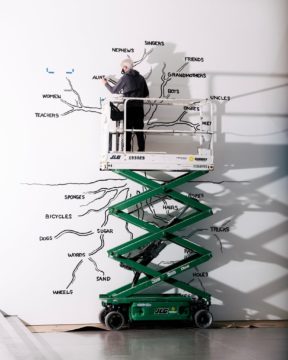
Byrne’s drawings are modest affairs, not much bigger than a standard sheet of paper. They compare perhaps with George Cruikshank’s illustrations for “Oliver Twist,” or John Tenniel’s for “Alice in Wonderland.” But when I dropped by the gallery two weeks ago to see them being hung, I found him some 15 feet up in the air, standing on a hydraulic lift as he labeled branches of an enormous tree he’d drawn on a wall that’s a good 20 feet high.
More here. (Note: Thanks to dear friend JP Le Calvezjean)
From Phys.Org:
 Researchers have explored the cellular changes that occur in human mammary tissue in lactating and non-lactating women, offering insight into the relationship between pregnancy, lactation, and breast cancer. The study was led by researchers from the Wellcome-MRC Cambridge Stem Cell Institute (CSCI) and the Department of Pharmacology at the University of Cambridge. Breast tissue is dynamic, changing over time during puberty, pregnancy, breastfeeding, and aging. The paper, published today in the journal Nature Communications, focuses on the changes that take place during lactation by investigating cells found in human milk.
This research, led by Dr. Alecia-Jane Twigger of CSCI, found that the cells in milk, once thought to be dead or dying, are in fact very much alive. These living cells provide researchers with the chance to study not only the changes that occur in mammary tissues during lactation, but also insight into a potential early indicator of future breast cancer development.
More here.
Rosalind E. Krauss at Artforum:
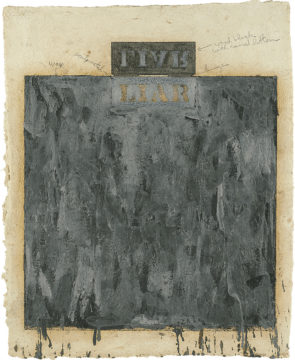 In contrast with this array of translucence, viscosity, gleam, Johns exploits the matte, the opaque, the alkaline. His wax encaustic, charcoal, grease, paint stick all militate—it would seem—against sheen.
But that is to overlook the glassy gleam of the mirror, which holds the represented object apart from its suspended reflection on the surface of representation. When Johns worked with Samuel Beckett on the 1976 book Foirades/Fizzles, Johns refused to illustrate a well-known work, such as the suggested Waiting for Godot, instead requesting a new text. (Beckett responded, “A new work? You mean you want me to write another book?”) Beckett ultimately sent Johns five unpublished fragments, for which the artist created etchings of crosshatchings that serve as reinforcements of the planar surface of the page. Beckett chose these for the endpapers of the book, and Johns responded with the (inevitable) painting End Paper, 1976.
more here.
Graham Majin in Quillette:
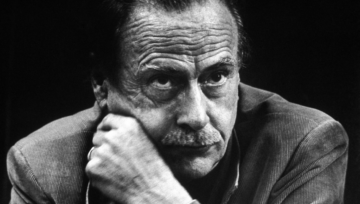 McLuhan’s impact on journalism was significant. His message was that all the techniques and values of Victorian liberal journalism should be discarded. The old-fashioned search for truth, using the tools of balance, objectivity, and impartiality, no longer applied. Although greeted with indifference or derision by older journalists, McLuhan’s insight was a Damascene moment for many young writers. As one underground journalist explained in 1966:
One year ago, in the first issue of The Paper, I discussed the loyalty I felt I had to the traditional ideals of journalism. … In the year since we began publishing, a very significant evolution has taken place in and around the American press.
The writer adds that he attributes “a great deal of importance to McLuhan” who had been his guide on a journey of transformation and enabled him to abandon the old journalism: “[W]e really didn’t have the slightest idea what we were getting into last year, when we thought we cared mainly about journalistic ideals.” Having abandoned impartiality, the writer describes how he embraced “the tendency to enlightened and interpretative subjectivity.”
More here.
Elizabeth Svoboda in Undark:
 In the fall of 1983, Soviet lieutenant colonel Stanislav Petrov was monitoring his country’s nuclear warning systems when alarm bells suddenly started ringing. The screen in front of him flashed the word “LAUNCH.” The alerts signaled what appeared to be a terrifying reality: The United States had lobbed five intercontinental missiles straight at the USSR.
Petrov knew what he was supposed to do next: pick up his phone and report the launch to the Soviet high command. Yet he hesitated as fear gripped him. He knew his report would mean the start of a nuclear World War III. Everything in him protested against such a possibility, and his fear mixed with an inchoate suspicion that the alerts might be wrong. So he waited, seconds ticking torturously away, until confirmation came that no missiles had been launched. Sunlight reflections, it turned out, had confused Soviet monitoring satellites and triggered the alert system. Petrov’s emotion-driven response had steered two world powers clear of mutually assured destruction.
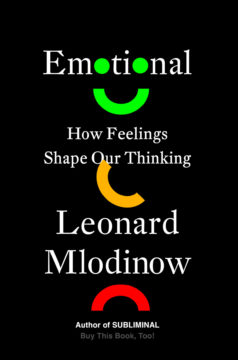
In “Emotional: How Feelings Shape Our Thinking,” physicist and science writer Leonard Mlodinow explores our feelings’ power to spur this kind of intelligent, nuanced action, even if the world’s fate doesn’t hang in the balance.
More here.
Daniel Cole in Current:
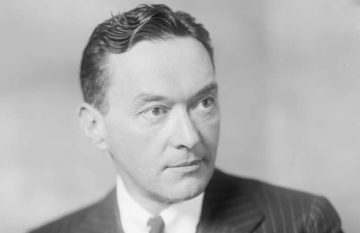 Mis- and disinformation, partisanship and polarization, crisis points and public trust—the big problems of 2022 were tackled by Walter Lippmann in his book Public Opinion, published one century ago. Certainly, the book’s central image of an average citizen spending thirty minutes a day with a print newspaper now seems quaint. Political media has exploded since 1922, and thirty minutes per day may sound healthier than the relentless torrent from multiple sources available now. Even so, Public Opinion holds up remarkably well. While Lippmann’s remedies were lacking, his diagnosis was dead-on.
A towering journalist and public intellectual through most of the twentieth century, Walter Lippmann (1889-1974) left a lexicon that is still with us. He coined the phrase “cold-war,” defining an era. In the pages of Public Opinion he repurposed the term “stereotype,” succinctly naming the simplistic preconceptions humans tend to rely on. The book’s similar notion of a “pseudo-environment” anticipates the concept of social constructionism. Although many associate the phrase “manufacture of consent” with Noam Chomsky, it first appeared in Public Opinion.
More here.
Alejandro Zamba at The Paris Review:
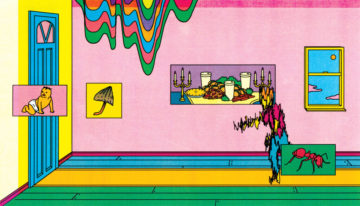 So without further ado, I decided to try to crawl. I managed to plant my elbows securely but not my knees, and then nailed my knees but not my elbows. This happened several times. I turned over repeatedly on the floor, remembering how I’d rolled down sand dunes at the beach as a child. I lay on my back and managed to drag myself over the floor with my heels, in a kind of inverse crawl. I lay on my belly again and tried using my toes and elbows, but I couldn’t move forward: a slug would have beat me in a hundred-centimeter sprint. Then I realized, or discovered, that I had never crawled as a baby. I’d asked my mother about this recently on the phone. “I’m sure you did. All children crawl,” she said. It bugged me that she didn’t remember. She remembered that I learned to talk very early (she said this as though referring to an incurable disease) and that I started walking before I turned one, but she didn’t have a memory of me crawling. “All children crawl,” she told me, but no, Mom: not all of them do.
more here.
The young poet Eumenes
complained one day to Theocritus:
“I have been writing for two years now
and have done only one idyll.
It is my only finished work.
Alas, it is steep, I see it,
the stairway of poetry is so steep;
and from the first step where I now stand,
poor me, I shall never ascend.”
“These words,” Theocritus said,
“are unbecoming and blasphemous.
And if you are on the first step,
you ought to be proud and pleased.
Coming as far as this is not little;
what you have achieved is great glory.
For even this first step
is far from the distant common herd.
To set your foot upon this step
you must rightfully be a citizen
of the cities of ideas.
And in that city it is hard
and rare to be naturalized.
In her marketplace you find Lawmakers
whom no adventurer can dupe.
Coming as far as this is not little;
what you have achieved is great glory.”
by C.P. Cavafy
from The Complete Poems of Cavafy
Harvest Books, 1961
translation: Rae Dalven
Emily Mayhew in The Guardian:
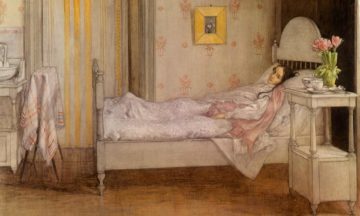 Getting better is rarely something that happens all the time. Whether we’ve been seriously ill or injured, everyone has to experience the complexities of recovery as the aftermath. Aftermath is an old agricultural term meaning “a second crop” growing unexpectedly in the space left by the main harvest and it can entail difficult decisions about what should be done with these remnants.
Recovery can feel like a second crop, something to be welcomed because we have survived, but an unpredictable and strange new phase in our healing. The medical professionals who have guided us through the harvest of treatment have usually moved on, replaced by different kinds of responders to the changes in our health. We find our questions about what is happening to us are answered more slowly, with what seems like a lower priority than before. More of the work that is needed, it turns out, is up to us and it is likely to be slow going. Often, the field in which we have been left alone is vast and the ground is churned and the few green shoots growing there stand far apart and hardly seem worth gathering.
More here.
Tyler Irving in Phys.Org:
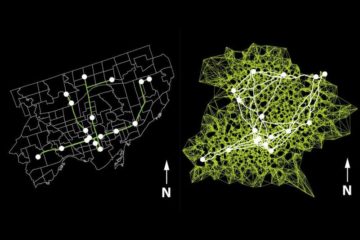 It doesn’t have a brain and survives on rotting vegetable matter—but it could offer valuable insights into city planning, according to a team of University of Toronto researchers. Physarum polycephalum is a slime mold, a single-celled amoeboid organism that grows as a greenish-yellow system of veins. These veins form a tubular network that is optimized to transfer nutrients efficiently throughout the entire organism.
Slime molds first “forage” broadly over an area, then refine their tubular network to optimize for transport of the nutrients. Now, researchers believe the slime mold’s efficient organic structure could provide a model for optimizing other networks—including those designed to move people and goods around a city.
More here.