
Category: Archives
The Crisis In Criticism
John Guillory and Jessica Swoboda at The Point:
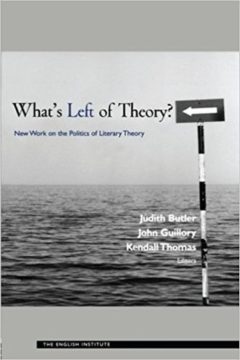 The only way to understand the “public sphere” today is by doing some historical reconstruction. Because what we’re really talking about with the history of literary criticism is an enormous shift between the nineteenth and twentieth centuries away from a media world at the center of which were the genres of periodical publication. The critics who wrote in that media sphere wrote about literature, but they were not professionalized in the way academics in the twentieth century became. This meant that they could write about pretty much anything, and they did. They won their audiences by the quality and force of their writing rather than by virtue of professional credentials. At the same time, these periodicals also published works of literature, serialized novels and other forms of literary writing, so people got a lot of exposure to literature through these periodicals, which had very large audiences. The connection between literature and public-sphere criticism was very close.
more here.
Thursday, June 9, 2022
RIP Thomas O’Dwyer
It is a sad day for 3QD as our longtime columnist and friend Thomas O’Dwyer has died. Over the last four years, Thomas wrote almost fifty essays for 3QD which you can see here. He will be much missed. Here is an obituary from today’s Jerusalem Post:
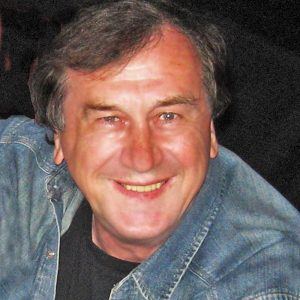 Thomas O’Dwyer, who was an accomplished journalist and writer and who served as a columnist and the foreign news editor of The Jerusalem Post between 1989-2000, died in Israel on Wednesday at age 69.
Ireland-born O’Dwyer became a journalist after 12 years as a Royal Air Force officer. He flew on the iconic Vulcans that were part of the British aerial nuclear deterrent force during the Cold War.
As a journalist, he was an analyst for the Beirut-based Arab Press Service and then chief editor of The Cyprus Mail in Nicosia. Reuters hired him as bureau chief for their first Cyprus office and he worked as a Reuters correspondent across the Middle East, in Bahrain and Dubai. He covered the Lebanese civil war, terrorism and hijackings, and the Iran-Iraq tanker war.
More here.
Ditching the “New Yorker” Voice
Kate Rossmanith in Public Books:
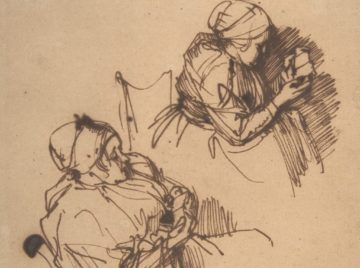 A few years ago, my book Small Wrongs was published. It has been labelled “essay-memoir” because it is a meditation on a concept: remorse in the criminal justice system and remorse in our everyday personal lives. In the criminal courts, a person’s apparent remorse can influence their sentence, including the granting of mercy in death penalty cases in the USA, and yet it is unclear how remorse is assessed. “Remorse is vague, ephemeral almost,” a lawyer told me. Remorse is a feeling, but it is also an exchange.
In developing Small Wrongs, I was confronted with the typical problems of writing from real life—negotiating all the ethical and technical obstacles—but the problem that seemed insurmountable concerned voice. I don’t mean, what is commonly referred to as, “the writer’s voice,” but to something else: the truth-speaking presence, the narrating “sound” of a piece of writing, the timbre of the consciousness on the page.
More here.
Using dendroclimatology to investigate megadroughts
Stephen E. Nash in Sapiens:
 Recently, with the increasing intensity of anthropogenic climate change, the topic garnering more of my attention is dendroclimatology. This fascinating science uses tree rings to reconstruct ancient precipitation, temperature, and other climatic variables. Unlike various instruments for tracking weather, tree rings provide researchers with a record going back hundreds or even thousands of years.
That is why tree rings make me nervous: The long-term picture these markers paint about megadroughts and climate change in the western U.S., where I live, is deeply troubling.
More here.
The Democracy of the Future
Tomas Pueyo in Uncharted Territories:
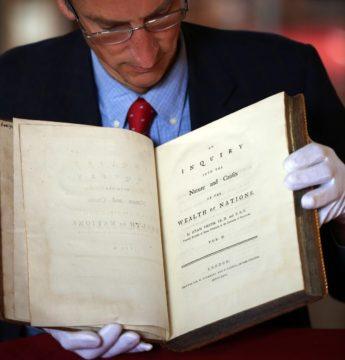 Fish don’t realize they’re swimming in water.
We don’t realize what alternatives to democracy will emerge because we’re submerged in the current system.
Democracy is the worst form of Government except for all those other forms that have been tried.—Winston Churchill
When you look at ideas to improve democracy, you find things like alternative ways to vote for your leaders or delegating your vote altogether. These are nice ideas, and can change the party in government like they recently did in Australia. But they’re superficial. The Internet is a bulldozer. It will uproot democracy and grow something new from scratch. To understand what will blossom in its place, we need to reprogram our brain first1. We’re too used to the current system to realize there are alternatives.
More here.
Stanislaw Ulam on John Von Neumann and the History of Computing (1976)
In the summer of 1976, the first generation of computer legends—top engineers, scientists, and software pioneers—got together to reflect on the first 25 years of their discipline at the Los Alamos National Laboratories. Here are more recently restored videos from the conference.
What Are Scientists Learning About the Deepest Diving Creatures in the Ocean?
Stephanie Pain in Smithsonian:
 There’s only one word for it: indescribable. “It’s one of those awesome experiences you can’t put into words,” says fish ecologist Simon Thorrold. Thorrold is trying to explain how it feels to dive into the ocean and attach a tag to a whale shark — the most stupendous fish in the sea. “Every single time I do it, I get this huge adrenaline rush,” he says. “That’s partly about the science and the mad race to get the tags fixed. But part of it is just being human and amazed by nature and huge animals.”
Whale sharks are one of a select group of large marine animals that scientists like Thorrold, of the Woods Hole Oceanographic Institution in Massachusetts, have signed up as ocean-going research assistants. Fitted with electronic tags incorporating a suite of sensors, tracking devices and occasionally tiny cameras, they gather information where human researchers can’t. They have revealed remarkable journeys across entire oceans, and they have shown that diving deep is pretty much ubiquitous among large marine predators of all kinds.
Many regularly plunge hundreds and sometimes thousands of meters — to depths where the water can be dangerously cold and short of oxygen, there’s little or no light except for the flickers and flashes of bioluminescent organisms, and the pressure is immense, putting some animals at risk of fatal decompression sickness.
More here.
Thursday Poem
Song of the Fox
Dear man with the accurate mafia
eyes and dog sidekicks, I’m tired of you,
the chase is no longer fun,
the dispute for this territory
of fences and hidden caverns
will never be won, let’s
leave each other alone.
I saw you as another god
I could play with in this
maze of leaves and lovely blood,
performing hieroglyphs for you
with my teeth and agile feet
and dead hens harmless and jolly
as corpses in a detective story
but you were serious,
you wore gloves and plodded,
you saw me as vermin,
a crook in a fur visor;
the fate you aim at me
is not light literature.
O, you misunderstand,
a game is not a law,
this dance is not a whim,
this kill is not a rival.
I crackle through your pastures,
I make no profit / like the sun
I burn and burn, this tongue
licks through your body also
by Margaret Atwood
from Margaret Atwood Selected Poems
Oxford University Press, 1976
To Have Or To Be: Erich Fromm
Patrick Leigh Fermor in the Caribbean
Bina Gogineni at Salmagundi:
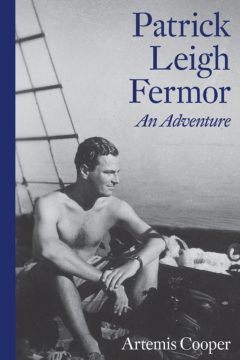 Rather than repel or frighten him as it might a conventional English gentleman travel-writer, this “atmosphere of entire strangeness” calls to Fermor, pulling him into the fray. Not only does he foray into the local market before even reaching his hotel, but soon afterward he investigates all things Créole—the language, the population, and the dress. Within a mere two days—and despite the fact that Guadeloupe ends up his least inspiring destination—he has so thoroughly immersed himself in the very things whose strangeness had captured his attention that he can bandy Créole patois terms with ease and has decoded the amorous messages indicated by the number of spikes into which the older women tie their silk Madras turbans. What is striking is the thoroughness of his inquiry and his capacity to explain the exotic without eviscerating its alluring quality of otherness.
more here.
Why is Dad so mad?
Daniel Engber in The Atlantic:
 In the spring, just before the launch of Fatherly, a Clemson University student’s viral essay introduced the world to the phrase and image of the dad bod: “a nice balance between a beer gut and working out,” as she put it. Soon dad bod was the subject of hundreds of newspaper stories, including five in The Washington Post alone. But as the phrase’s popularity increased, so did debates about its meaning. Was the dad bod hard or soft? Was it imposing or forgiving? Was it just a state of mind, or was it—as Men’s Health suggested—a dangerous reality? (“Face it: The dad bod is just a precursor to dead bod,” the magazine’s editor proclaimed.)
Everybody knew that dads used to earn a living; that they used to love their children from afar; and that when the need arose, they used to be the ones who doled out punishment. But what were dads supposed to do today? “In former times, the definition of a man was you went to work every day, you worked with your muscles, you brought home a paycheck, and that was about it,” the clinical psychologist Thomas J. Harbin would explain to Fatherly a few years later. “What it is to be a man now is in flux, and I think that’s unsettling to a lot of men.” Indeed, modern dads were left to flounder in a half-developed masculinity: Their roles were changing, but their roles hadn’t fully changed.
More here.
Goya’s Horrific Black Paintings Brought To Life
Adrian Searle at The Guardian:
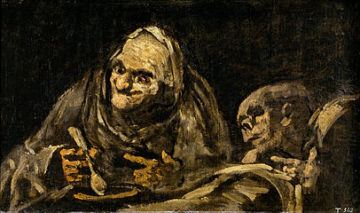 Among the most enigmatic works of his turbulent life, they now occupy a single room at Madrid’s Prado museum, whose collection they entered in 1881. Why Goya painted them, and even if they were all originally painted by the artist himself; how much he revised and changed them, and how much they were further altered by early restorers – all that remains a matter of debate. There is also conjecture about his house (which got its name not from Goya, but from the previous occupant), which was demolished in 1909.
A few steps away from the Black Paintings takes us 200 years into the future, to a room of similar proportions, temporarily converted into a small cinema by the French artist Philippe Parreno, where he is showing La Quinto del Sordo, a film first seen at a Goya exhibition in Switzerland last year. Now it is paired with the paintings that provide its subject. Typically of this complex artist, there is more to it. Several times a day, the lights go down and a cellist takes a seat beside the screen, reading a statement by Spanish composer Juan Manuel Artero before beginning to play.
more here (thanks Brooks).
Wednesday, June 8, 2022
Cornel West’s pragmatic America
Sean Illing in Vox:
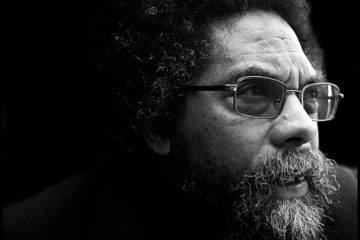 Cornel West is one of the most unique philosophical voices in America. He has written a ton of books and taught for over 40 years at schools like Princeton, Harvard, and now at the Union Theological Seminary.
West is what I’d call a public-facing philosopher, which is to say he’s not a cloistered academic. He’s constantly engaging the public and his thought is always in dialogue with poetry and music and literature. (If you’ve ever seen one of his lectures, you know what I mean.)
That civic-mindedness is a product of his roots in a school of thought called pragmatism. America doesn’t have an especially deep tradition of philosophy, but if we’re known for any one tradition, it’s pragmatism.
More here.
How life could have arisen on an ‘RNA world’
Robert F. Service in Science:

It’s the ultimate chicken-and-egg conundrum. Life doesn’t work without tiny molecular machines called ribosomes, whose job is to translate genes into proteins. But ribosomes themselves are made of proteins. So how did the first life arise?
Researchers may have taken the first step toward solving this mystery. They’ve shown that RNA molecules can grow short proteins called peptides all by themselves—no ribosome required. What’s more, this chemistry works under conditions likely present on early Earth.
“It’s an important advance,” says Claudia Bonfio, an origin of life chemist at the University of Strasbourg who was not involved in the work. The study, she says, provides scientists a new way of thinking about how peptides were built.
More here.
‘Napalm Girl’ at 50: The story of the Vietnam War’s defining photo
Oscar Holland at CNN:
 The horrifying photograph of children fleeing a deadly napalm attack has become a defining image not only of the Vietnam War but the 20th century. Dark smoke billowing behind them, the young subjects’ faces are painted with a mixture of terror, pain and confusion. Soldiers from the South Vietnamese army’s 25th Division follow helplessly behind.
Taken outside the village of Trang Bang on June 8, 1972, the picture captured the trauma and indiscriminate violence of a conflict that claimed, by some estimates, a million or more civilian lives. Though officially titled “The Terror of War,” the photo is better known by the nickname given to the badly burned, naked 9-year-old at its center: “Napalm Girl”.
The girl, since identified as Phan Thi Kim Phuc, ultimately survived her injuries. This was thanks, in part, to Associated Press photographer Nick Ut, who assisted the children after taking his now-iconic image. Fifty years on from that fateful day, the pair are still in regular contact — and using their story to spread a message of peace.
More here.
Bill Gates: 5 great books for the summer
[More details here.]
A CRISPR view of gene function
From Nature:
Benjamin Izar is trying to work out what happens when immune cells encounter cancer cells. He starts with large molecular profiling studies, such as whole-exome sequencing and RNA-seq. “They give dozens of putative targets or mechanisms that may play a role in disease or drug response, but it is impossible to functionally validate each of them individually,” he laments.
To help, Izar, a physician-scientist at Columbia University’s Herbert Irving Comprehensive Cancer Center in New York, turned to CRISPR screens. CRISPR allows researchers to precisely alter cells’ DNA sequences, and modify gene function. With high-throughput screens, the effects of thousands of perturbations can be assessed in a single experiment. These tools aid research and drug discovery efforts by helping scientists identify the genetic variations, in both coding and non-coding regions, that contribute to disease.
However, until now, typical read-outs of CRISPR screens under different conditions, such as drug treatment or viral infection, have been quite simple cell growth and survival assays. These read-outs reveal genes that, when disturbed, either sensitize or confer a selective advantage to the challenged cells — but with no indication of how they do so. Newly developed techniques provide single-cell, multi-omic readouts of CRISPR-modified cells. “Any large-scale profiling or screening effort may benefit from such methods as they help drill down to what might be functionally relevant,” says Izar. With these ‘high-content’ CRISPR screens, researchers can start to evaluate the myriad nominated mechanisms and targets.
More here.
Rectal Cancer Disappears After Experimental Use of Immunotherapy
From MSKCC:
 Sascha Roth remembers the phone call came on a hectic Friday evening. She was racing around her home in Washington, D.C., to pack for New York, where she was scheduled to undergo weeks of radiation therapy for rectal cancer. But the phone call from Memorial Sloan Kettering Cancer Center (MSK) medical oncologist Andrea Cercek changed everything, leaving Sascha “stunned and ecstatic — I was so happy.” Dr. Cercek told Sascha, then 38, that her latest tests showed no evidence of cancer, after Sascha had undergone six months of treatment as the first patient in a clinical trial involving immunotherapy at MSK.
Immunotherapy harnesses the body’s own immune system as an ally against cancer. The MSK clinical trial was investigating — for the first time ever — if immunotherapy alone could beat rectal cancer that had not spread to other tissues, in a subset of patients whose tumor contain a specific genetic mutation. “Dr. Cercek told me a team of doctors examined my tests,” recalls Sascha. “And since they couldn’t find any signs of cancer, Dr. Cercek said there was no reason to make me endure radiation therapy.”
These same remarkable results would be repeated for all 14 people — and counting — in the MSK clinical trial for rectal cancer with a particular mutation. While it’s a small trial so far, the results are so impressive they were published in The New England Journal of Medicine and featured at the nation’s largest gathering of clinical oncologists in June 2022. In every case, the rectal cancer disappeared after immunotherapy — without the need for the standard treatments of radiation, surgery, or chemotherapy — and the cancer has not returned in any of the patients, who have been cancer-free for up to two years. “It’s incredibly rewarding,” says Dr. Cercek, “to get these happy tears and happy emails from the patients in this study who finish treatment and realize, ‘Oh my God, I get to keep all my normal body functions that I feared I might lose to radiation or surgery.’ ”
More here.
IDLES Full Set | From The Basement