
Category: Archives
Good Grief
Joseph Epstein in Commentary:
 Fortunate is the person who has reached the age of 50 without having had to grieve. To be among the grieving, the bereaved, is an experience most of us go through, excepting only those who die preternaturally young and are themselves the cause of bereavement. The death of a parent, a husband or wife, a brother or sister, a dear friend, in some ways saddest of all, a child, is among the major causes of grief. May grief be avoided? Ought it to be? Is there any sense in which, as Charlie Brown’s favorite phrase had it, there is good grief?
Socrates held that one of the key missions of philosophy was to ward off our fear of death. Upon his own death, by self-imposed hemlock, he claimed to be looking forward at long last to discovering whether there was an afterlife. Montaigne wrote an essay called “To Philosophize Is to Learn How to Die,” in which, as elsewhere in his essays, he argues that, far from putting death out of mind, we should keep it foremost in our minds, the knowledge of our inevitably forthcoming death goading us on the better to live our lives.
More here.
Stunning new Webb images: baby stars, colliding galaxies and hot exoplanets
Alexandra Witz in Nature:
 The views of the Universe just keep getting better. NASA’s US$10-billion James Webb Space Telescope released four new scientific images on 12 July, including newborn stars sparkling through dramatic ‘cliffs’ of gas, and galaxies interacting in an intricate cosmic dance. A day earlier, astronomers had marveled at its very first image, a mind-boggling deep dive into the distant Universe.
Webb observes the cosmos in infrared wavelengths, which gives it a different view than many other observatories, such as the Hubble Space Telescope. Webb’s 6.5-metre-wide mirror is the largest ever launched into space, and the combination of the large mirror and its infrared detection capabilities allow Webb an unprecedented view of many astronomical phenomena. That includes stars and shock waves generated as galaxies collide in the group of five known as Stephan’s Quintet, 90 million parsecs away in the constellation Pegasus. The images that Webb collected of the galaxy grouping reveal millions of young stars forming as gas and dust collide, as well as sweeping tails left by one of the galaxies, NGC 7318B, as it storms its way through the cluster. “It really shows the type of interaction that drives the evolution of galaxies,” says Giovanna Giardino, an astronomer with the European Space Agency.
More here.
Wednesday Poem
I Was Reading a Scientific Article
They have photographed the brain
and here is the picture, it is full of
branches as I always expected,
each time you arrive the electricity
of seeing you is a huge
tree lumbering through my skull, the roots waving.
It is an earth, its fibers wrap
things buried, your forgotten words
are graved in my head, an intricate
red blue and pink prehensile chemistry
veined like a leaf
network, or is it a seascape
with corals and shining tentacles.
I touch you, I am created in you
somewhere as a complex
filament of light
by Margaret Atwood
from Margaret Atwood Selected Poems
Oxford University Press, 1976
Tuesday, July 12, 2022
The World as a Game
Justin E. H. Smith in Liberties:
 What is a game? Ludwig Wittgenstein famously chose this nebulous concept to illustrate what he meant by “family resemblance,” where the individual members of a class can be determined to fulfill no necessary and sufficient conditions for admission, and instead only share some traits with some others in the class, others with others. Yet we can at least identify two types of game, which seem not just distinct from one another but very nearly opposite. One class of games, which includes peek-a-boo, charades, and musical improvisation as representative instances, is characterized by free expressivity. It is the manifestation of what Friedrich Schiller called the Spieltrieb, the “play-drive,” which is innate in all human beings insofar as they are free. The other class includes chess, fencing, and wargames as its representative instances. If there is still some dose of freedom operating in this sort of game, it is freedom under severe constraints. The purpose here is to win, and one does so by means of strategy aforethought. In such games, serendipity and spontaneity are disadvantages. While some such games may, like Schillerian free play, be “fun” (especially when you win and the other guy loses), at their outer edge they shade over into a domain of human endeavor that has little to do with leisure at all. At their most serious they can determine the fate of the world.
It is this latter sort of game alone that machines are capable of “understanding.”
More here.
Sean Carroll’s Mindscape Podcast: N.J. Enfield on Why Language is Good for Lawyers and Not Scientists
Sean Carroll in Preposterous Universe:
 We describe the world using language — we can’t help it. And we all know that ordinary language is an imperfect way of communicating rigorous scientific statements, but sometimes it’s the best we can do. Linguist N.J. Enfield argues that the difficulties run more deeply than we might ordinarily suppose. We use language as a descriptive tool, but its origins are found in more social practices — communicating with others to express our feelings and persuade them to agree with us. As such, the very structure of language itself reflects these social purposes, and we have to be careful not to think it provides an unfiltered picture of reality.
More here.
Wide-ranging interview with writer Mohammed Hanif
David Wengrow and the trouble with rewriting human history
Andrew Anthony in The Guardian:
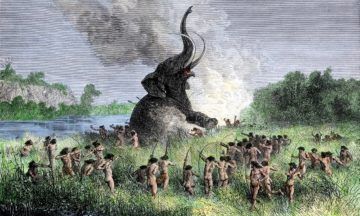 Last year a book called The Dawn of Everything announced that most of what we think we know about human history is wrong. Its co-authors, David Graeber and David Wengrow, took aim at the established story that has been repeated by brand writers such as Jared Diamond, Yuval Noah Harari and Steven Pinker – the one that says that for most of prehistory, we lived in small egalitarian bands of hunter-gatherers, and it was only with the agricultural revolution about 12,000 years ago that we adopted larger forms of social organisation leading to complex, hierarchical communities. All of that, they argue, is based on outdated information.
In their bestselling books Collapse, Sapiens and The Better Angels of Our Nature, those authors drew heavily on archaeological and anthropological findings, although none of them are archaeologists or anthropologists. By contrast Graeber, who died two years ago, was thought by many to be one of the leading anthropologists of his generation. And co-author Wengrow is a well-respected archaeologist.
More here.
Miles Davis with John Coltrane- March 21, 1960
On Gone with the Wind
Alex Von Tunzelmann at Literary Review:
 The screen version of Gone with the Wind could not entirely ignore the existence of black people, so it toned down the book’s racist language as well as some of its racial violence. There is a degree of irony in Scarlett, whose ‘magnolia skin’ is heavily fetishised, being played by Vivien Leigh, who probably had Indian ancestry. The producer, David Selznick, and Leslie Howard, who played Scarlett’s first love, Ashley Wilkes, were both of Jewish origin. Howard, says Churchwell, ‘categorically refused to read Gone with the Wind’. Most notably, though, the film’s black cast had to be persuaded to work on a white supremacist project. Hattie McDaniel, who won an Oscar for her performance as Scarlett’s maid, Mammy, was born to parents who had both once been enslaved. Her father was a veteran of the Union Army who had fought in the Civil War. McDaniel insisted she had taken the role for the money: ‘she had chosen between $700 a week to play a maid, or $7 a week to be a maid.’ Yet she and Butterfly McQueen, who played Prissy, must have cared a bit about what they were doing. Both lobbied to have one of the novel’s most-used words – rendered by Churchwell as ‘nxxxxr’ – excised completely from the screenplay. Eventually it was, though only after Selznick struck a deal with the censors to eliminate it in return for being allowed to keep Rhett Butler’s final ‘damn’.
more here.
Why Write?
Elisa Gabbert at The Paris Review:
 Nabokov spoke of shimmers too. “Literature was born on the day when a boy came crying wolf, wolf and there was no wolf behind him,” he said in a lecture in 1948. “Between the wolf in the tall grass and the wolf in the tall story, there is a shimmering go-between.” In this view, it seems to me, the writer’s not the wraith who can pass between realms of reality and fantasy. The art itself is the wraith, which the artist only grasps at. Elsewhere, Nabokov writes that inspiration comes in the form of “a prefatory glow, not unlike some benign variety of the aura before an epileptic attack.” In his Paris Review interview, Martin Amis describes the urge to write this way: “What happens is what Nabokov described as a throb. A throb or a glimmer, an act of recognition on the writer’s part. At this stage the writer thinks, Here is something I can write a novel about.” Amis also saw images, a sudden person in a setting, as if a pawn had popped into existence on a board: “With Money, for example, I had an idea of a big fat guy in New York, trying to make a film. That was all.” Likewise for Don DeLillo: “The scene comes first, an idea of a character in a place. It’s visual, it’s Technicolor—something I see in a vague way. Then sentence by sentence into the breach.” For these writers that begin from something like hallucination, the novel is a universe that justifies the image, a replica of Vegas to be built out of words.
more here.
How to Read English in India
Akshya Saxena in LA Review of Books:
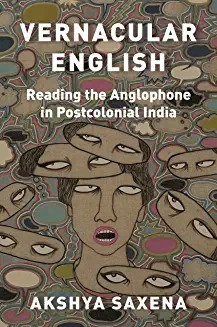 AS SOMEONE WHO grew up in India in the early 2000s, after the once-colonized country had opened itself to the global economy, one thing was clear to me. Aspiration and English were synonymous. Both were essential. This lesson was drilled into me at my missionary-run English-medium high school in New Delhi. Whether we dreamed of becoming doctors or engineers or corporate hotshots, we were repeatedly told that we needed to have English. Students were penalized for speaking in any language other than English, and our pronunciations were disciplined in preparation for roles no one doubted we would take on. Away from the institutional ear, my peers and I still cherished our other languages, to varying degrees. But, for the most part, we learned to joke, dream, rebel, and obey in English.
Everyone agreed that English was A Good Thing to Have. I heard similar ideas about the importance of English at home as well. My father, raising daughters in a country that did not value women, encouraged my sister and me to speak in English, and beamed with pride when we did. This expectation felt awkward — absurd, even — because English was not a language the other women in our family shared.
More here.
First Webb Space Telescope Image
From The New York Times:
 In a brief event at the White House on Monday evening, President Biden unveiled an image that NASA and astronomers hailed as the deepest view yet into our universe’s past. The image, taken by the James Webb Space Telescope — the largest space telescope ever built — showed a distant patch of sky in which fledgling galaxies were burning their way into visibility just 600 million years after the Big Bang. “This is the oldest documented light in the history of the universe from 13 billion — let me say that again, 13 billion — years ago,” Mr. Biden said. The president, who apologized for beginning the event tardily, praised NASA for its work that enabled the telescope and the imagery it will produce. “We can see possibilities no one has ever seen before,” Mr. Biden said. “We can go places no one has ever gone before.”
…One of the most ambitious of the Webb telescope’s missions is to study some of the first stars and galaxies that lit up the universe soon after the Big Bang 14 billion years ago. Although Monday’s snapshot might not have reached that far, it proved the principle of the technique and hinted at what more is to come from the telescope’s scientific instruments, which astronomers have waited decades to bring online. As the telescope “gathers more data in the coming years, we will see out to the edge of the Universe like never before,” said Priyamvada Natarajan, of Yale University, an expert on black holes and primeval galaxies, in an email from India. She added, “It is beyond my wildest imagination to be alive when we get to see out to the edge of black holes, and the edge of the universe.”
More here.
Tuesday Poem
Under den Linden No More
Two basswood trees
Two basswood trees of four original
stood for many years in front of my house
their summer blossoms perfuming the avenue
these American Linden trees
in their Old World varietals
these American Linden trees sacred to so many
their summer blossoms perfuming the avenue
my earliest memories
could not withstand the assault of PSE&G
could not withstand the assault of PSE&G
their branches chopped brutally
over the years
Chateaubriand would have noted their size
and now
cut down
these two basswood trees
are completely cut down
cut down
their stumps
their stumps ground down
splinters
now
by John J. Trause
from The Rutherford Red Wheelbarrow, #3, 2010
Sunday, July 10, 2022
Neoliberal Economic Thinking and the Quest for Rational Socialism in China
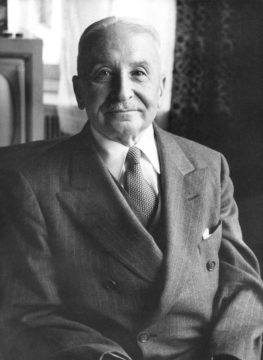 Isabella M. Weber in the Journal of the History of Ideas (photo by Ludwig von Mises Institute):
Ludwig von Mises’s theoretical claim that economically rational socialism was impossible sparked the “socialist calculation debate” of the interwar period and established the Austrian economist as a founding father of neoliberal economic thinking. In his article “Economic Calculation in the Socialist Commonwealth” (1935 [1920]), Mises argued that while the world was “approaching nearer and nearer to socialism,” economics figured “all too sparsely in the glamorous pictures painted by the Utopians.” They promised that “in the cloud-cuckoo lands of their fancy, roast pigeons will in some way fly into the mouths of the comrades,” but, according to Mises, “omit[ted] to show how this miracle is to take place.” And in Mises’s eyes, this “miracle” was in fact logically impossible.
Mises saw socialism as a system based on public ownership that excluded the means of production from exchange and relied on planning instead. Under socialism money played only a limited role as the medium of exchange for consumer goods and could not serve as a meaningful standard for economic calculation. Without universal market exchange based on private property and a universally employed medium of exchange (genuine money), Mises argued, a socialist economy lacked any yardstick for values or prices and thus did not have a rational criterion for allocation and production decisions. To Mises, socialism could never be organized in an economically rational way and would always rely on arbitrary decisions by planners and production managers; the envisioned socialist economic miracle would never occur. Mises went as far as to claim that “Without economic calculation there can be no economy. Hence, in a socialist state wherein the pursuit of economic calculation is impossible, there can be … no economy whatsoever.” Mises added that this impossibility of economic rationality under socialism might even result in a general disappearance of “rationality and logic in thought itself.”
More here.
How insect ‘civilisations’ recast our place in the Universe
Thomas Moynihan in Science:
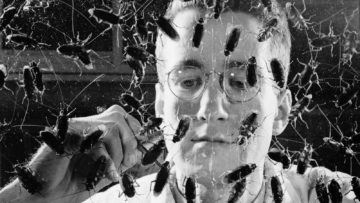 It is 1919, and a young astronomer turns a street corner in Pasadena, California. Something seemingly humdrum on the ground distracts him. It’s an ant heap. Dropping to his knees, peering closer, he has an epiphany – about deep time, our place within it, and humanity’s uncertain fate. The astronomer was Harlow Shapley. He worked nearby at Mount Wilson Observatory: peering into space. With help from colleagues like Henrietta Leavitt, Annie Jump Cannon, and Cecilia Payne-Gaposchkin, Shapley went on to “measure” the Milky Way. Their work revealed that we don’t live at our galaxy’s centre, and that there are many other galaxies besides.
A lifelong advocate of progressive causes, Shapley also reflected regularly upon humanity’s long-term future, alongside the risks jeopardising it. He was among the first to suggest, during a lecture given while World War Two raged, that humanity should learn the lesson from 1918’s pandemic and prepare properly for the next one. Instead of battling each other, he prescribed a “design for fighting” the risks facing all of humanity: declaring war on the gamut of evils, from pandemics to poverty, endangering the whole globe. (Only two audience members applauded; it appears we didn’t take heed.)
More here.
How TS Eliot found happiness
Erica Wagner in The New Statesman:
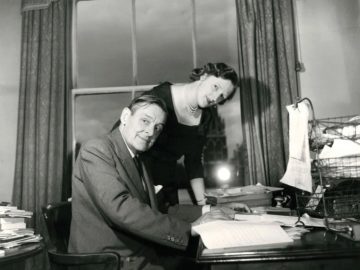 It is impossible not to be moved by the final pages of Robert Crawford’s Eliot: After The Waste Land, in which the 20th century’s greatest poet at last finds contentment with his young wife Valerie. Much more than contentment: “I am madly happy in being her husband,” Eliot wrote to his friend Violet Schiff upon the couple’s return from honeymoon in 1957. The wedding – and indeed, the whole courtship and relationship – between the 68-year-old Nobel Laureate and his 30-year-old Yorkshire-born secretary had been a secret from nearly everyone who knew them until the very last moment. The ceremony had been conducted at 6.15 in the morning, by special licence from the Archbishop of Canterbury, so as to evade the attentions of the press.
The bride’s parents were in attendance, and Eliot’s lawyer: no one else. Eliot’s devoted colleague Geoffrey Faber had been informed but, as he told the Daily Mail, “I am not in the habit of getting up at five in the morning to attend wedding ceremonies.” Eliot’s friend of nearly 20 years’ standing, Mary Trevelyan, learned of his actions after she returned from her holiday to find a postcard dated 9 January: “On Thursday the 10th January I am being married to Valerie Fletcher,” Eliot had written. “Naturally I thought Tom had gone out of his mind,” Mary would write of this moment: she had known nothing of any personal relationship between Eliot and “Miss Fletcher”, as he had always referred to her in Mary’s presence. In the years prior to his marriage, Eliot had shared a flat with the critic John Hayward; Hayward felt abandoned by the poet, and as Crawford writes, took to describing himself as “the Widow”.
More here.
Reformation in the Church of Science
Andrea Saltelli and Daniel Sarewitz in The New Atlantis:
Fake news is not a perversion of the information society but a logical outgrowth of it, a symptom of the decades-long devolution of the traditional authority for governing knowledge and communicating information. That authority has long been held by a small number of institutions. When that kind of monopoly is no longer possible, truth itself must become contested.
This is treacherous terrain. The urge to insist on the integrity of the old order is widespread: Truth is truth, lies are lies, and established authorities must see to it that nobody blurs the two. But we also know from history that what seemed to be stable regimes of truth may collapse, and be replaced. If that is what is happening now, then the challenge is to manage the transition, not to cling to the old order as it dissolves around us.
More here.
The systems that harm animals go hand in hand with systems that harm humans
Alice Crary and Lori Gruen in the Boston Review:
 One strand of animal ethics is preoccupied with suffering—suffering that occurs in slaughterhouses, laboratories, and other sites of animal confinement. Another strand counters this focus on the elimination of suffering by urging that we instead emphasize respect for the rights and dignity of animals. While contributions to these strands of animal ethics have contributed to increased recognition of animals’ plights, they mostly presuppose frameworks that obscure the nature of the problem. Many practices that harm animals are embedded in institutions that also systematically harm socially vulnerable human beings. Analyzing these mutually supporting systems of harms to humans and other animals is imperative so that we are equipped to meaningfully intervene in the injustices animals and human outgroups are facing.
More here.
Governance in an Increasingly Virtual and Massively Distributed World
Eric B. Schnurer in The Hedgehog Review:
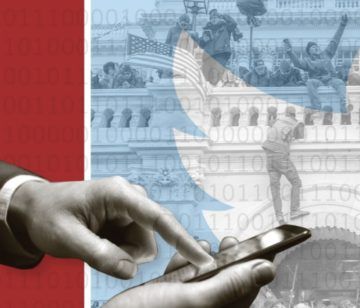 While thirty years ago, scholars, pundits, and political leaders were confidently proclaiming the end of history, few now deny that it has returned—if it ever ended. And it has done so at a time of not just geopolitical and economic dislocations but also historic technological dislocations. To say that this poses a challenge to liberal democratic governance is an understatement. As history shows, the threat of chaos, uncertainty, weakness, and indeed ungovernability always favors the authoritarian, the man on horseback who promises stability, order, clarity—and through them, strength and greatness.
How, then, did we come to this disruptive return?
More here.