
Category: Archives
Claes Oldenburg’s Soft Machines
Barbara Rose at Artforum:
 CLAES OLDENBURG IS THE SINGLE Pop artist to have added significantly to the history of form. In order to perceive this, however, one must look beyond the Rabelaisian absurdity of his grotesque imagery to the inventiveness of his shapes, techniques, and materials. These are sufficiently original to identify Oldenburg, not, as he has erroneously been seen, as a chef d’ecole of Pop art, but as one of the most vital innovators in the field of contemporary sculpture, whose vision has affected the work of many other young artists of his generation.
Every major artist dreams of reconstructing the world in his own image, but Oldenburg has actually succeeded in translating the external environment into a series of shapes and images that physically resemble the large, mesomorphic frame of Claes Oldenburg. To accomplish this solipsistic goal, he had to invent a vocabulary of forms that would be as vulnerable, as irregular, as eccentric, unique and expressive as the human body itself.
more here.
‘Precious Blood’ Relic: Lost And Found
 After 20 years spent recovering long-lost artifacts and priceless art from across the globe, Dutch art detective Arthur Brand thought his career had peaked. He wondered how any case could top those that turned up a stolen Picasso or the pair of bronze horses made for Adolf Hitler once believed to have been destroyed by the Soviet army.
But then the doorbell rang.
When he answered the door on the night of June 21, the street was dark and utterly empty — except for a cardboard box holding an artifact that had inspired legends, pilgrimages and prayers for over a millennium. Carefully, Brand carried inside the stolen reliquary of the “Précieux Sang,” or “Precious Blood” in French — an ornate, jewel-encrusted container that protects two lead vials with pieces of linen believed to be doused with the blood of Jesus.
more here.
Friday Poem
Butterfly Man Tells a Story
… near butterfly mountain
lived a medicine person
… from the mountain
… i come to know myself
he told me
… from the mountain
… my name was given to me
… butterfly man
… is how i am known
… some men
… laugh at my name
… but that doesn’t bother me
… … my grandmother told me
… … never laugh at others
… … because the future is unknown
… … queer people are sacred
… … we must always remember
by Manny Loley
from The Poetry Foundation
Translated by the author from the Navajo
How cartoonists are chronicling the ‘wild’ Jan. 6 hearings
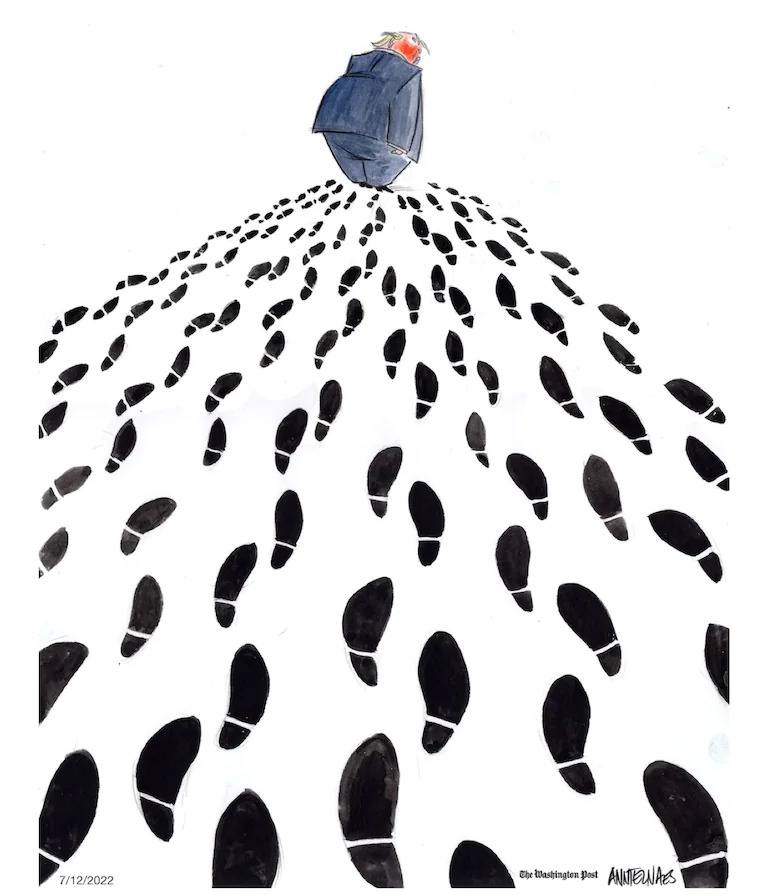
Jan. 6 hearings

Thursday, July 21, 2022
Misinformation Is Here To Stay (And That’s OK)
Isaac Saul in Persuasion:
 Many of the things that you believe right now—in this very moment—are utterly wrong.
I can’t tell you precisely what those things are, of course, but I can say with near certainty that this statement is true. To understand this uncomfortable reality, all you need is some basic knowledge of history.
At various times throughout the history of humankind, our most brilliant scientists and philosophers believed many things most eight-year-olds now know to be false: the earth was flat, the sun revolved around the earth, smoking cigarettes was good for digestion, humans were not related to apes, the planet was 75,000 years old, or left-handed people were unclean.
Around 100 years ago, doctors still thought bloodletting (that is, using leeches or a lancet to address infections) was useful in curing a patient. Women were still fighting for the right to vote, deemed too emotional and uneducated to participate in democracy, while people with darker skin were widely considered subhuman. The idea that the universe was bigger than the Milky Way was unfathomable, and the fact the earth had tectonic plates that moved beneath our feet was yet to be discovered.
More here.
The $10 Billion Webb Telescope Has Been Permanently Damaged, Say Scientists
Jamie Carter in Forbes:
 Scientists are reporting that damage sustained to the James Webb Space Telescope (JWST) during a micrometeoroid strike in late May 2022 may be worse than first thought.
In a new paper published in the wake of Webb’s incredible first images last week a group of scientists outlined the performance of the space telescope during its commissioning phase.
They reported problems that “cannot be corrected” as well as a “small effect on the telescope throughput, which is not yet measurable.”
More here.
A new study suggests that people who become affluent have less sympathy for the poor than the born rich do
Susan Pinker in the Wall Street Journal:
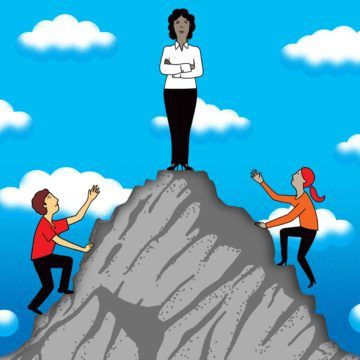 Ms. Koo wondered whether people who started out at the bottom and achieved high status would support public policies to assist other strivers like themselves. Or, having successfully climbed the socioeconomic ladder, would they perceive upward social mobility as less difficult? “If I did it, why can’t they do it?” Ms. Koo asked rhetorically.
The research team, which included psychology professors Paul Piff at U.C. Irvine and Azim Shariff at the University of British Columbia, began with two studies designed to assess Americans’ attitudes to the rich. Six hundred randomly selected adults were asked to rate two groups: the “born rich,” who had inherited their wealth, and the “became rich,” who had earned it. Which group would be more likely to attribute poverty to external circumstances, for example, or feel empathy toward the poor?
More here.
Factchecking Jordan Peterson’s Conversation with Richard Dawkins
Diane Arbus and Sylvia Plath: “The Horror! The Horror!”
Jeffrey Meyers at Salmagundi:
 Sylvia Plath is the Diane Arbus of poetry, the verbal equivalent of her visual art. Since Arbus and Plath had strikingly similar lives, it’s surprising that they never mentioned each other and that their biographers have not compared them. They were self-destructive sexual adventurers, angry and rebellious, driven and ambitious. Both suffered extreme depression, had nervous breakdowns and committed suicide. But they used their mania to deepen their awareness and inspire their art, and created photographs and poetry to impose order on their chaotic lives. They shared an ability to combine the ordinary with the grotesque and monstrous, and expressed anguished feelings with macabre humor. Arbus was consciously and deliberately bohemian, Plath outwardly conventional yet inwardly raging. Both explored the dark side of human existence and revealed their own torments.
more here.
The Joy Of Volcano-Chasing
Mary Wakefield at The Spectator:
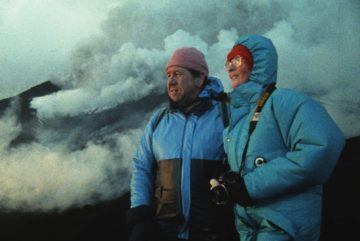 Katia and Maurice Krafft were both born in the 1940s in the Rhine valley, close to the Miocene Kaiser volcano, though they didn’t know each other as children. They met on a park bench when they were students at the University of Strasbourg, and from that moment on, according to their joint obituary in the Bulletin of Volcanology, ‘volcanic eruptions became the common passion to which everything else in their life seemed subordinate’. They married in 1970, formed a crack team of volcano-chasers, équipe volcanique, and set off to get as close as they possibly could to the very edge of every fiery crater, to collect samples and data and just to be there, ecstatic with the enormity of it all, like a pair of mad moths drawn into a candle flame.
‘Maurice and Katia were always the first ones there when a volcano erupted,’ says Sara Dosa, the writer and director of Fire of Love, when we meet in Trafalgar Square.
more here.
Russia’s Finest Metaphysician: On Vladimir Sorokin
Ben Hooyman at the LARB:
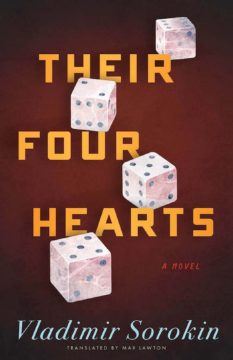 ALTHOUGH VLADIMIR SOROKIN has earned his reputation as Russia’s premier satirist, he deserves more credit for being among its finest metaphysicians. In Russia, as the saying goes, fiction is philosophy. Though very few Russian philosophers have established a position for themselves in the Western canon, the particularities of Russian thought still find their way into the global imagination through the work of literary greats like Tolstoy and Dostoyevsky. Sorokin, known as much for his stylistic range as for his prescient depictions of Russia’s shifting sociopolitical tides, is a standard-bearer in this venerable tradition.
Born in a small village outside of Moscow in 1955, Sorokin’s life spans the end of the Soviet period and the rise of Putin’s Russia. And just as the author’s life is defined by these two eras, so too is his literary work.
more here.
These evidence-based strategies can help you achieve healthy work-life balance
Chris Woolston in Smithsonian:
 It was the first in a series of “Rosie” posters of women first responders, an ongoing project that has helped Bergen calm her mind during her downtime. Ultimately, she says, the Rosies helped her withstand the stress of her job and allowed her to show up to work each day with new energy and focus. “They made it possible for me to keep going.” While workers like Bergen are responding to emergency calls and saving lives, many of us are doing things like responding to emails and saving receipts from business trips. But even for people with jobs in offices, restaurants and factories, there’s an art and a science to making the most of downtime, says Sabine Sonnentag, a psychologist at the University of Mannheim in Germany. The right approach to non-work time can help prevent burnout, improve health and generally make life more livable. “When a job is stressful, recovery is needed,” says Sonnentag, who cowrote an article exploring the psychology of downtime in the 2021 issue of the Annual Review of Organizational Psychology and Organizational Behavior.
Workers everywhere are feeling frazzled, overwhelmed and ready for the weekend. With that backdrop, researchers are doing work of their own to better understand the potential benefits of recovery and the best ways to unwind.
More here.
How to fall back in love with reading
Alisson Wilkinson in Vox:
 Even if you do manage to pick up a book, you might feel lingering guilt if it isn’t an important book, or at least an improving one. “There is no such thing as the correct book to read,” Allison Escoto reminded me over Zoom, a bookcase looming behind her. Escoto is the head librarian and education director at the Center for Fiction in Brooklyn. The canon of “important books” — what they are, and who gets to choose them — has been in a vibrant state of reexamination and expansion in recent years, she reminded me, and that means the “notion of the correct book, or the right book, or the acceptable book is itself under scrutiny.”
In fact, numerous studies seem to suggest that when it comes to the psychological benefits of reading, just doing it might matter as much or more than the content. Researchers have found that people who spend a few hours per week reading books live longer than those who don’t read, or who read only articles in periodicals; the sustained act of cognition that books demand seems to be the deciding factor. Other research finds a vast array of social-cognitive benefits that come with reading, particularly reading fiction, aiding the brain’s development in understanding others and imagining the world.
Some studies have suggested that reading fiction can increase empathy. But a perhaps even more surprising finding comes from researchers who discovered a short-term decrease in the need for “cognitive closure” in the minds of readers of fiction. In brief, the researchers write, those with a high need for cognitive closure “need to reach a quick conclusion in decision-making and an aversion to ambiguity and confusion,” and thus, when confronted with confusing circumstances, tend to seize on fast explanations and hang on to them. That generally means they’re more susceptible to things like conspiracy theories and poor information, and they become less rational in their thinking. Reading fiction, though, studies have found, tends to retrain the brain to stay open, comfortable with ambiguity, and able to sort through information more carefully.
More here.
Thursday Poem
Three Cold Mountain Poems
VI
Thirty years in this world
I wandered ten thousand miles,
By rivers, buried deep in grass,
In borderlands, where red dust flies.
Tasted drugs, still not Immortal,
Read books, wrote histories.
Now I’m back at Cold Mountain,
Head in the stream, cleanse my ears.
VIII
I travelled to Cold Mountain:
Stayed here for thirty years.
Yesterday looked for family and friends.
More than half had gone to Yellow Springs.
Slow-burning, life dies like a flame,
Never resting, passes like a river.
Today I face my lone shadow.
Suddenly, the tears flow down.
XIII
Han-shan has his critics too:
‘Your poems, there’s nothing in them!’
I think of men of ancient times,
Poor, humble, but not ashamed.
Let him laugh at me and say:
‘It’s all foolishness, your work!’
Let him go on as he is,
All his life lost making money.
Wednesday, July 20, 2022
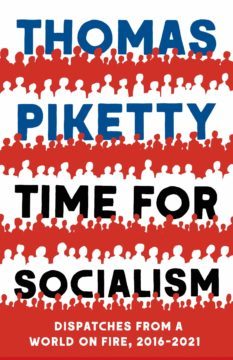
Time? For? Socialism?
Noam Maggor in the European Review of Books:
 Saint Domingue was the crown jewel of the French empire in the Caribbean when its slaves rebelled in 1791. They formed the independent republic of Haiti in 1804, but the terms of the island’s separation from France was contested long thereafter, and French reconquest loomed. In 1825, in order to secure their sovereignty, the Haitians were forced (in the words of Charles X’s decree) « to compensate the former colonists who may claim an indemnity » for the human property that had been lost. The total sum of these reparations was 150 million golden francs, which the new Caribbean nation funded through a massive loan, paid back slowly over decades. Generations of Haitians – deep into the twentieth century – contributed a significant portion of their livelihood to support the descendants of those who had kidnapped their ancestors from Africa in the hundreds of thousands and forced them to labor under genocidal conditions.
The French aristocrat and intellectual Alexis De Tocqueville is best remembered for his prophetic insights into American democracy, but in 1843 he turned his attention to Haiti. When the indemnity arrangement was again debated in France, Tocqueville declared his unqualified support for the deal, calling it « fair to all participating parties. » Not only would it compensate slaveholders for their lost property, he argued, and restore the social order that had been badly undermined by the rebellion.
More here.
A Decisive Blow to the Serotonin Hypothesis of Depression
Christopher Lane in Psychology Today:
 Almost as soon as it was floated in 1965 by Harvard psychiatrist Joseph Schildkraut, the serotonin hypothesis of depression—reduced and simplified by pharma marketing to the “chemical imbalance” theory of depression and anxiety—has been subject to critical research and found wanting.
The poor standing of the hypothesis in the scientific literature, however, barely dented its afterlife in textbooks, across clinical and treatment settings, and on mental health apps and websites. Nor has it dispelled the continued use of the phrase as “shorthand” between doctors and patients and in everyday settings, including for quite different mental states and conditions.
More here.
A Way To Return The Constitution To The People
Robert Lempert in Noema Magazine:
 Term limits or other reforms to the composition of the court seem worthy but would be slow-acting at best and do not solve the fundamental problem: that, on occasion, constitutional interpretation necessarily requires value-laden and not purely legal judgments.
Citizens’ assemblies, a new innovation in governance, may provide an answer. Similar in some ways to a jury, a citizens’ assembly is a body formed from randomly selected citizens who engage in structured deliberations that recognize multiple viewpoints, then move to consensus on important issues. Such assemblies differ from juries in having more participants, more structured deliberative processes and an ability to summon experts to inform them.
More here.