
Lauren Beard on NPR:
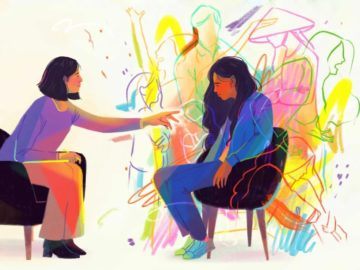 Cambodian American Eden Teng was was born in a refugee camp on the border of Thailand and Cambodia just a few years after the Cambodian genocide. She moved to the U.S. with her mom and aunt when she was 6. Teng attributes much of her own resilience in transitioning to the U.S. to her exuberant mom, who wore whatever she wanted and wasn’t afraid to defy social norms — even when it was embarrassing for a teenage Teng.
But when she was growing up, Teng also witnessed the negative impacts of historical, racial and intergenerational trauma on her mom’s wellbeing. Teng often felt confused by the way her mom’s emotions could spiral out of control for seemingly no reason, or why why she had so many health problems. When Teng first encountered psychology in college, she realized that her mother’s past was directly connected to her emotional and physical health. (Scientists are learning that stress and trauma are sometimes linked to chronic illnesses, like hypertension, diabetes and kidney disease.) It was this realization that compelled Teng to become a therapist; in 2018 she began her graduate studies in Seattle.
More here.
 Political strategists on winning campaigns are visited like gurus after an election, with reporters looking to discern secrets of success that might be replicated at scale. In this spirit, in the days after the midterms, the
  IF ’80S CINEMA experienced a “
 The digital era has two basic axioms. The first is that information has no form; information technology is a means of disseminating and aggregating data, but data itself belongs to no place or context. Data cannot tell the story; information is uninforming and uninformative. The digital age can therefore have no real culture of its own, no culture in the etymological sense of cultivation and accumulated growth. Things trend or happen online, but nothing settles into lasting place or takes its time to show itself significant. Each day’s frenzy and distraction are as overwhelming unto the day as they are forgettable.
 The second axiom is that the Internet is for cat pictures; everyone knows that transmitting images of cute animals is the whole point of it. It remains astounding that pet videos run into the tens of millions of views. That they have their own film festival. That they are used as bait to pull people into political misinformation campaigns. That there are bona fide pet celebrities and pet influencers. That some of them are raking it in, with spin-off merch and copyrighted brand clout all their own.
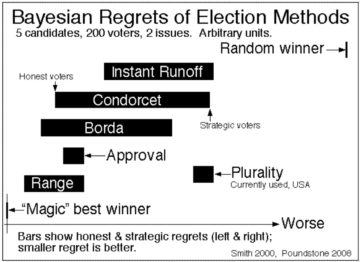 Here is the setup. You have a set of voters {1, 2, 3, …} and a set of choices {A, B, C, …}. The choices may be candidates for office, but they may equally well be where a group of friends is going to meet for dinner; it doesn’t matter. Each voter has a ranking of the choices, from most favorite to least, so that for example voter 1 might rank D first, A second, C third, and so on. We will ignore the possibility of ties or indifference concerning certain choices, but they’re not hard to include. What we don’t include is any measure of intensity of feeling: we know that a certain voter prefers A to B and B to C, but we don’t know whether (for example) they could live with B but hate C with a burning passion. As
  Now that the American electorate appears to have rejected Republican extremism, some will argue that Biden should tack right to capture the political center. But that is the wrong way to read the 2022 midterm result, because the electorate is not seeking some kind of Solomonic splitting of the baby.
 The Liz Truss
  Bacterial infections are the second leading cause of death worldwide, accounting for one in eight of all deaths in 2019, the first global estimate of their lethality revealed on Tuesday.
 Your classiest friend invites you to dinner. They take out a bottle of Chardonnay that costs more than your last vacation and pour each of you a drink. They sip from their glass. “Ah,” they say. “1973. An excellent vintage. Notes of avocado, gingko and strontium.” You’re not sure what to do. You mumble something about how you can really taste the strontium. But internally, you wonder: Is wine fake?
 For most of my adult life, I believed in the implications of the phrase “non-stick pans”: other pans must be unmanageably sticky. During the pandemic, as I began to want my own listening room and wrote every day across from a stove, I started to cook. I bought a Lodge cast-iron skillet that cost about forty dollars. It heats up quickly and evenly and can be easily cleaned. Our non-stick pan, by comparison, sheds its coating, and the handle keeps coming unscrewed. This is like the history of audio gear. The cast iron was sufficient, but an imaginary quality—stickiness—was being “solved” by new technology like Teflon. The new gear is fine, and works well in a couple of settings, but seems largely like an unnecessary innovation.
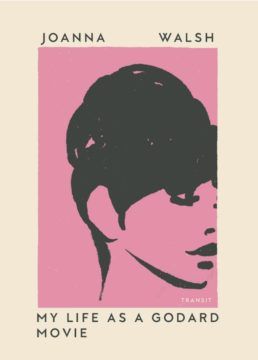 In My Life, Walsh remembers a time when “instead of dying I went to Paris,” a providentially budgeted eleventh-hour day trip consisting of “ten hours’ travel and eight hours’ walking: eighteen hours: a day, a day that saved my life.” The transformation by the pandemic of Paris — of crowds, of urban bustle, of the tactile delectations of flânerie — from a font of salvation into a space of mortal dangers and morbid anxieties appears as a kind of violent inversion. But this alienated affect sits comfortably in Walsh’s oeuvre: the founding condition of her writings is a consciousness and interrogation of feelings of geographic, interpersonal, and emotional displacement. Her women navigate their worlds in the exilic mode. Walsh’s settings are intermediary or quite literally transit/ory: hers is a literature of the cafe, the train, the bus, the hotel. That the principal concerns of Godard’s early period were the ennui and political uncertainties of an interstitial generation (“the children of Marx and Coca-Cola,” as Godard notoriously identifies them in 1966’s Masculin Féminin), the defamiliarization of romance, and a kind of uncanny French apocalyptica (think, for example, of the remarkable, and remarkably long, single-take traffic scene in Week-end) establishes an especially fructuous ground for Walsh’s philosophies of the uprooted.
 Anyone
  Malta is not so much an island as it is the top of a mountain. Some 14,000 years ago the glacier that covered Europe began to recede. As it did, the water level of the Mediterranean rose, some 120 meters to be exact, enough, anyway, to separate Malta from its mainland. Just 80 kilometers separates the island from Sicily’s Cape Passero. On a clear day you can see Mt. Etna.