
Category: Archives
Remembering The Poets Of Attica Correctional Facility
Lizzy Lerud at Poetry Magazine:
 On a May evening in 1972—eight months after the uprising—Tisdale passed through Attica’s security gates and held his first workshop. He began by asking his students, “What is poetry?” He recorded their answers in his journal: “Personal, deals with emotions, historical, compact (concise), eternal, revolutionary, beauty, rhyme, rhythm, a verbal X-ray of the soul.” Knowing he was under nearly as much scrutiny as the imprisoned men, Tisdale approached the “revolutionary” aspects of poetry with caution. Attica’s administrators feared another revolt. Officers were always present for the workshops; Tisdale’s journal makes special note of the occasions when a Black officer, recruited after the uprising, attended. Regardless of the surveillance, the workshop began to gel after the first few weeks as participants became more comfortable with Tisdale. He noticed quickly that many contributors possessed great skill as poets. They told him that nothing had changed at Attica since the revolt; prison conditions remained abhorrent. They shared an urgency to write about the violence they had witnessed and America’s carceral system in general, and they did not hold back.
more here.
Sam Lipsyte Reinvents The Detective Novel
Lisa Borst at Bookforum:
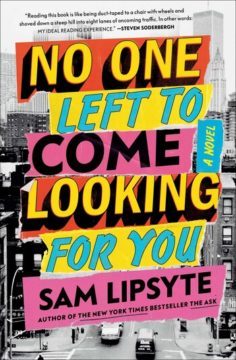 ONE OF SAM LIPSYTE’S SIGNATURE ACCOMPLISHMENTS has been to find the baroque musicality in the emergent vocabularies—commercial, bureaucratic, wellness-industrial, pornographic—opened up by twenty-first-century English. “Hark would shepherd the sermon weirdward,” he writes in his 2019 novel about an entrepreneurial inspirational speaker, “the measured language fracturing, his docile flock of reasonable tips for better corporate living driven off the best practices cliff, the crowd in horrified witness.” Across his first six books, Lipsyte’s sentences have been excessive, pun-laden, and lyrically raunchy. When language threatens to sound measured, a character with a zany name can be counted on to fracture it.
Lipsyte’s latest novel, the East Village–set No One Left to Come Looking for You, is by contrast remarkably stripped down. Its moments of linguistic flamboyance are outnumbered by an almost screenwriterly tendency toward dialogue, and its characters talk in a clipped, plainspoken style that verges on hard-boiled. An exchange on page 1: “He left with it?” “Yeah.” “Fuck.”
more here.
Thursday Poem
A Blessing
Just off the highway to Rochester, Minnesota,
Twilight bounds softly forth on the grass.
And the eyes of those two Indian ponies
Darken with kindness.
They have come gladly out of the willows
To welcome my friend and me.
We step over the barbed wire into the pasture
Where they have been grazing all day, alone.
They ripple tensely, they can hardly contain their happiness
That we have come.
They bow shyly as wet swans. They love each other.
There is no loneliness like theirs.
At home once more,
They begin munching the young tufts of spring in the darkness.
I would like to hold the slenderer one in my arms,
For she has walked over to me
And muzzled my left hand.
She is black and white,
Her mane falls wild on her forehead,
And the light breeze moves me to caress her long ear
That is delicate as the skin over a girl’s wrist.
Suddenly I realize
That if I stepped out of my body I would break
Into blossom.
by James Wright
from Above the River: The Complete Poems and Selected Prose
Wesleyan University Press, 1990
Wednesday, November 30, 2022
Is AI Our New God?
Meghan O’Gieblyn at The Believer:
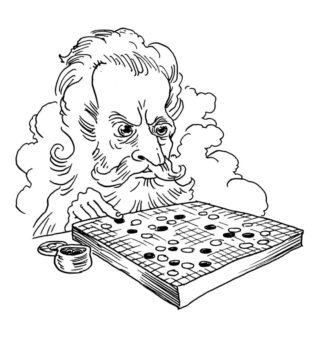 Science was supposed to have banished God, but he keeps turning up in our latest technologies. He is the ghost lurking in our data sets, the cockroach hiding beneath the particle accelerator. He briefly appeared three years ago in Seoul, on the sixth floor of the Four Seasons Hotel, where hundreds of people had gathered to watch Lee Sedol, one of the world’s leading go champions, play against AlphaGo, an algorithm created by Google’s DeepMind. Go is an ancient Chinese board game that is exponentially more complex than chess; the number of possible moves exceeds the number of atoms in the universe. Midway through the match, AlphaGo made a move so bizarre that everyone in the room concluded it was a mistake. “It’s not a human move,” said one former champion. “I’ve never seen a human play this move.” Even AlphaGo’s creator could not explain the algorithm’s choice. But it proved decisive. The computer won that game, then the next, claiming victory over Sedol in the best-of-five match.
more here.
Saudi Arabia Breaks Ground on Massive Sci-Fi Megacity
Kevin Hurler at Gizmodo:
 The future starts now? Drone footage shows construction beginning on Saudi Arabia’s sci-fi megacity called The Line—a city planned to be 105 miles (170 kilometers) long that people can live and work in without ever leaving.
As another day of failed cryptocurrency companies and Big Brother watching us passes, it truly feels like we are inching ever-closer to a bleak future from a sci-fi novel—the only thing we’ve really been missing is a futuristic megalopolis. Saudi Arabia’s The Line caught headlines this past summer for its sleek and arguably unnecessary approach to a city—featuring a mirrored exterior that contains a completely self-contained city that is 546 yards (500 meters) tall, 218 yards (200 meters) wide, and a whopping 105 miles (170 kilometers) long. While the knee-jerk reaction was rampant skepticism over when and how this monstrosity would ever get off the ground, new footage from Saudi Arabia confirms that The Line is officially a work in progress.
more here.
The Line
The Evolution of Childhood Is Very Strange
Brenna Hassett in Sapiens:
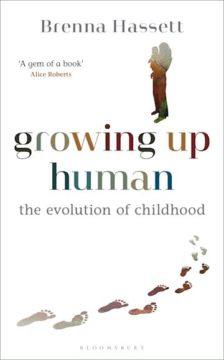 Humans are weird. We’re weird for many reasons, including planetary domination, plus a long tale of lost penis spikes, viral body parts, unripe yet overly large babies, shapeshifting milk, and that radical force of evolution: grandmothers.
One of the most startling adaptations our species has made is the long, long journey we make to grow up human. We take nearly the same time to grow up as a 100-ton bowhead whale, who is going to live at least a century longer than us. The path to making such an incredible investment in our forever-children has made surprising turns throughout our history. Many of these twists are only now coming to light as new generations of researchers ask new questions.
More here.
Sean Carroll’s Mindscape Podcast: Dani Bassett and Perry Zurn on the Neuroscience and Philosophy of Curiosity
Sean Carroll in Preposterous Universe:
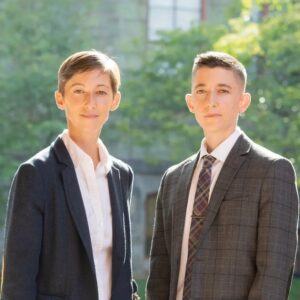 It’s easy enough to proclaim that we are curious creatures, but what does that really mean? What kinds of curiosity are there? And how does curiosity arise in our brains? Perry Zurn and Dani Bassett are a philosopher and neuroscientist, respectively (as well as twins), whose new book Curious Minds: The Power of Connection explores these questions through an interdisciplinary lens. We break down the different ways that curiosity can manifest — collecting and creating loose knowledge networks, digging deeply to create a tight knowledge network, and creatively leaping to make unexpected connections.
More here.
Ken Kesey and the Rush to Deinstitutionalization
Stephen Eide in Quillette:
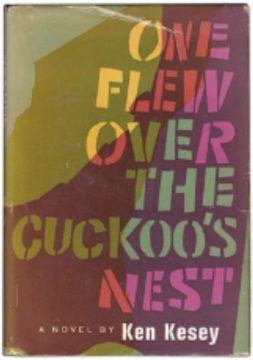 Ken Kesey (1935–2001) was a great admirer of manliness, a quality that would inform his countercultural indictment of America’s attitude toward mental illness, and of postwar America more generally. The darkly comic 1962 novel for which he is known, One Flew Over the Cuckoo’s Nest, likened US society to an asylum in which men (in particular) are stripped of freedom and psychologically castrated. Inspired by interactions with patients at a San Francisco-area Veterans’ Hospital—which sometimes coincided with his own participation in clinical studies on the use of mescaline, LSD, and other hallucinogenic drugs—Kesey came to believe that these institutions only made people sicker, notwithstanding the grand scientific pretensions under which they operated.
Cuckoo’s political message was aimed at both emptying America’s asylums and extinguishing the climate of social oppression that, as the author saw it, lay behind them. On both fronts, Kesey’s programmatic recommendation was to provide everyone, including those who seem troubled or dysfunctional, with more autonomy. It’s a viewpoint that’s gained enormous influence in the 60 years since One Flew Over the Cuckoo’s Nest was published. Unfortunately, whatever the literary strengths of Kesey’s signature novel, the movement it helped inspire has done much to harm both the mentally ill and the communities in which they live.
More here.
The Chris Hedges Report: Marcel Proust’s In Search of Lost Time with Justin E.H. Smith
Wednesday Poem
“There are 47 percent who are with [the president], who are
dependent upon government, who believe that they are victims,
who believe that government has a responsibility to care for them,
who believe that they are entitled to health care, to food, to housing,
to you name it . . . That’s entitlement.” —Mitt Romney to the
roomful of people at the private fundraiser for Mitt Romney, May 2012
“All things therefore whatsoever ye would that men should
do unto you, even so do ye also unto them.” — Matthew 7:12
“Who is here so vile that will not love his country? If any,
speak: for him I have offended.” —Julius Caesar, act 3, scene 2
Unto Others
Who there knows how good it is to know
a warm bed and a roof? If any, speak.
Who there knows how good it is to know
a schoolroom? If any, speak.
Who there knows how good it is to know
the stiffness of new shoes? If any, speak.
Who there knows how good it is to know
the steam of a meal on your cheeks? If any, speak.
Who there knows how good it is to know
some God hears you weep? If any, speak.
Who there knows how good it is to know?
All of you know, so speak.
So you know how good it is to know.
All of you know, so speak. Say it’s OK
for others to know how good it is to know.
Say it. Speak. You lose nothing
if others know how good it is to know.
Go ahead. Speak.
If you know how good it is to know,
why then don’t you speak?
Why then don’t you speak?
Say something. Speak. Speak. Speak.
by Lauren Marie Schmidt
from Filthy Labors
Curbstone Books, 2017
The Look of a Loser: What roughed-up beast slouches in Mar-a-Lago?
Rafia Zakaria in The Baffler:
 A FEW WEEKS AGO, I could not have thought of any scenario where I would watch former president Donald Trump announce his presidential bid and feel smug about it. Yet, as the midterm vote counts from the near and far reaches of the United States continued to trickle in and a strangely subdued Donald Trump took the stage on Tuesday, I was watching. And it felt like we were looking at a loser.
Not only had the Red Wave of a triumphant Republican comeback failed to materialize, Trump’s cherry-picked MAGA candidates had underperformed other Republicans by about five percentage points, according to a New York Times report. One of the first to fall was Mehmet Oz, his choice for the U.S. Senate in Pennsylvania, who lost to John Fetterman, who had suffered a stroke during the campaign. And in Arizona, Kari Lake, a former anchorwoman who had managed to charm Trump and his legion of MAGA voters, lost to Katie Hobbs, a woman who had stood up to the MAGA machine during the extended vote count in 2020—though in true Trumpian style, Lake refused to concede and announced she was assembling a legal team to investigate the breakdown of voting machines.
More here.
The Next 500 Years: Engineering Life to Reach New Worlds
Christopher Mason in Delancey Place:
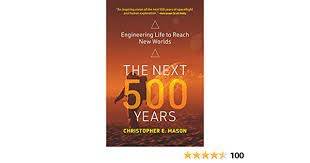 Every multicellular organism begins as one cell, which contains all of the intricate instructions to synthesize, organize, and regulate not only this cell but the development and maintenance of all cells that will inevitably comprise the organism. All of these instructions are encoded in the first cell’s DNA. This underscores the complexity of the genome and how each cell’s expression must be controlled in specific ways depending on its function. The cells hailing from each tissue in the human body (e.g., muscle, lung, heart, liver) harbor a unique epigenetic signature, which enables the maintenance of tissue-specific functions through the control of gene regulation, as just discussed.
Our knowledge of the total number of unique cells, or cell types, is still growing. Previous estimates put the number of unique cell types in the human body at ~300, but new estimates from the Human Cell Atlas have shown that we may have thousands of cell types and subtypes, each harboring a unique function for a specific physiological state or response to stimuli. But even cells of the same cell type will not be identical.
More here.
Tuesday, November 29, 2022
How To Keep The Thrill Of Space Travel Alive
Charles T. Rubin at The New Atlantis:
 As the story is often told, even before the era of manned lunar exploration ended, policymakers and the public were losing interest. It was enough to have fulfilled the promise of President John F. Kennedy, and to have “beat the Russians.” President Richard Nixon may have paid lip service to bigger and bolder goals when he announced the space shuttle program, but he was also clear about the shuttle’s less-than-inspiring purpose — to “revolutionize transportation into near space, by routinizing it.” Perhaps we should better appreciate the wonders of the commercial world, but to make something routine is precisely to suck the wonder out of it, to make it uninteresting. And indeed, that is pretty much what happened.
It may seem odd that things should have turned out this way. For while many are the wonders of our technological powers, surely few are more wonderful than our ability to reach outer space, and to survive there for extended periods. And getting into space is just the beginning of the wonders.
more here.
Lost In The City With The Feelies
Vikram Murthi at The Current:
 The Feelies never quite belonged to the “blank generation,” a term coined by punk rocker Richard Hell that describes the midseventies New York punk scene. They certainly played alongside the likes of Television, the Patti Smith Group, the Shirts, and other CBGB and Max’s Kansas City mainstays, but they never quite gelled with that crowd. Their sound was more angular and percussive than the shambolic style of their peers. They were the jangly alternative to the alternative culture, exemplifying a vibrant sonic quality that strongly influenced early R.E.M. and almost every other band that critics would eventually label “college rock.” Perhaps the twin rhythm guitar and percussion sections contributed to their outsider status. Or maybe they never quite belonged because Glenn Mercer and Bill Million, the founding members, hail from suburban New Jersey.
more here.
The Feelies – Sooner or Later
Coming to terms with our new textual culture
Richard Hughes Gibson in The Hedgehog Review:
 In his 1987 book Die Schrift, the Czech-born Brazilian philosopher Vilém Flusser posed the question of whether writing had a future (Hat Schreiben Zukunft? reads Flusser’s subtitle). As he surveyed the media landscape of the late twentieth century, Flusser observed that some aspects of writing (“this ordering of written signs into rows”) could already be “mechanized and automated” thanks to word processing, and he foresaw that artificial intelligence would “surely become more intelligent in the future” allowing the mechanization of writing to proceed further.
In fact, Flusser anticipated that AI would soon exhibit the hallmark cognitive traits of the mental world inaugurated by writing. Of that mental world, Flusser writes, “Only one who writes lines can think logically, calculate, criticize, pursue knowledge, philosophize.” Above all, Flusser credits writing with giving humans “historical consciousness,” which he defines as the ability to see and describe the world in terms of goal-oriented processes—as opposed to the unchanging cycles that marked prehistorical societies. AIs, in Flusser’s view, will soon “possess a historical consciousness far superior to ours,” allowing them to “make better, faster, and more varied history than we ever did,” with the result that we’ll leave the business of history-writing to them. Writing may indeed have a future, Flusser believed, but that future won’t be an entirely, or even primarily, human one.
More here.
How the game theory of John von Neumann transformed the 20th century
David Nirenberg in The Nation:
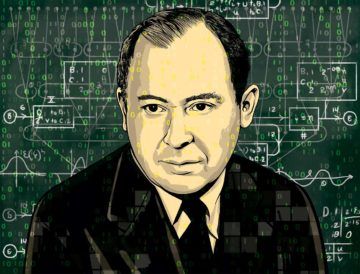 Unlike his much more famous colleague Albert Einstein, John von Neumann is not a household name these days, but his discoveries shape the possibilities of life for every creature on this planet. As a teenager, von Neumann provided mathematics with new foundations. He later helped teach the world how to build and detonate nuclear bombs. His invention of game theory furnished the conceptual tools with which superpowers today decide whether to wage war, economists model the behavior of markets, and biologists predict the evolution of viruses. The pioneering programmable computer that von Neumann and his employer, the Institute for Advanced Study in Princeton, N.J., completed in 1951 established “von Neumann architecture” as the standard for computer design well into the 21st century, making first IBM and then many other corporations fabulously wealthy.
More here.
Why climate finance is a political hot potato — and what to do about it
Editorial in Nature:
 For warming to be limited to 1.5 °C, emissions need to fall by 45% from 2010 levels by 2030. According to the latest UNFCCC report, published in October, they are set to increase by more than 10%. There is still no coordinated plan to turn these figures around. With some 45,000 people registered to attend COP27 — a record — many are questioning whether a planetary emergency can be tackled in this way.
One undoubted step forwards, however, came with the historic agreement to create a ‘loss and damage’ fund. For the first time, countries that have suffered devastation as a result of climate change will be helped with the associated costs, such as those of rebuilding homes and businesses destroyed by floods. This represents a totally new kind of fund, going beyond existing (if imperfectly implemented) mechanisms for funding the costs of mitigating and adapting to the effects of climate change.
More here.