Salman Rushdie on the enduring beauty of the Taj Mahal

Salman Rushdie in National Geographic:
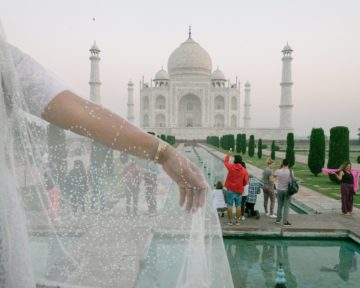
The trouble with India’s Taj Mahal is that it has become so overlaid with accumulated meanings as to be almost impossible to see. A billion chocolate-box images and tourist guidebooks order us to “read” the Mughal emperor Shah Jahan’s marble mausoleum for his wife Mumtaz Mahal, known as “Taj Bibi,” as the World’s Greatest Monument to Love. It sits at the top of the West’s short list of images of the Exotic (and also Timeless) Orient. Like the Mona Lisa, like Andy Warhol’s silk-screened Elvis, Marilyn, and Mao, mass reproduction has all but sterilized the Taj Mahal.

Nor is this by any means a simple case of the West’s appropriation or “colonization” of an Indian masterwork. In the first place, the Taj, which in the mid-19th century had been all but abandoned and had fallen into a severe state of disrepair, would probably not be standing today were it not for the diligent conservationist efforts of the colonial British. In the second place, India is perfectly capable of over merchandising itself.

More here.
Sunday, February 5, 2023

The Philosophy of Mourning

Paul J. Griffiths in Commonweal:

But what, exactly, is mourning, and how does doing it well contribute to a fully human life? These are good questions, addressed too rarely. In Imagining the End, Jonathan Lear takes them on with his usual learning, verve, and lucidity. Lear, who has taught at the University of Chicago since the 1990s, has written prolifically on various fundamental aspects of human life—including hope, love, illness, and irony, with Aristotle, Socrates, Plato, Freud, Kierkegaard, and Wittgenstein among his most frequent interlocutors. He is always concerned with the texture of human life: how it is woven, how it can become unwoven, what its principal virtues are. He wants to know how we should live, and on that question he is among our most intelligent guides.

More here.

A ‘De-extinction’ Company Wants to Bring Back the Dodo

Christine Kenneally in Scientific American:

Colossal Biosciences, the headline-grabbing, venture-capital-funded juggernaut of de-extinction science, announced plans on January 31 to bring back the dodo. Whether “bringing back” a semblance of the extinct flightless bird is feasible is a matter of debate.

Founded in 2021 by tech entrepreneur Ben Lamm and Harvard University geneticist George Church, the company first said it would re-create the mammoth. And a year later it announced such an effort for the thylacine, aka the Tasmanian tiger. Now, with the launch of a new Avian Genomics Group and a reported $150 million of additional investment, the long-gone dodo joins the lineup.

More here.

What international law says about Israel’s planned destruction of Palestinian assailants’ homes

Robert Goldman in The Conversation:

Israel has demolished the homes of thousands of Palestinians in recent years. Bulldozing properties of those deemed responsible for violent acts against Israeli citizens or to deter such acts has long been government policy.

But it is also illegal under international law. As an expert on international humanitarian law, I know that holding the family of assailants responsible for their acts – no matter how heinous the crime – falls under what is know as collective punishment. And for the past 70-plus years, international law has been unequivocal: Collective punishment is strictly prohibited in nearly all circumstances. Yet, when it comes to the demolition of Palestinian homes, international bodies have been unable to enforce the ban.

More here.

Kafka’s Remarkable Letter to His Abusive Father

From The Marginalian:

Prompted in large part by the dissolution of his engagement to Felice Bauer, in which Hermann’s active disapproval of the relationship was a toxic force and which resulted in the estrangement of father and son, 36-year-old Kafka set out to hold his father accountable for the emotional abuse, disorienting double standards, and constant disapprobation that branded his childhood — a measured yet fierce outburst of anguish and disappointment thirty years in the buildup.

His litany of indictments is doubly harrowing in light of what psychologists have found in the decades since — that our early limbic contact with our parents profoundly shapes our character, laying down the wiring for emotional habits and patterns of connecting that greatly influence what we bring to all subsequent relationships in life, either expanding or contracting our capacity for “positivity resonance” depending on how nurturing or toxic those formative relationships were.

More here.

Education has become an investment. But what are its returns?

Eleni Schirmer in Lapham’s Quarterly:

Higher education in the United States is a speculative endeavor. It offers a means of inching toward something that does not quite exist but that we very badly want to realize—enlightenment, higher wages, national security. For individuals, it provides the lure of upward mobility, an illusion of escape from the lowest rungs of the labor market. For the federal government, it has charted a kind of statecraft, outlining its core commitments to military strength and economic growth, all the while absolving the state of the responsibility for ensuring that all its subjects have dignified means to live. We are told the path to decent wages and social respect must route through college.
The metric of higher education is credit; it runs on the belief of future value amid present uncertainty. This has readily lent to the industry’s financialization, the elaborate ways of using money to make more money rather than to produce goods and services. Today financialized systems of higher education mean that colleges and universities operate as investors or borrowers or both.

More here.

Unequal Opportunity: Race and Equity in Higher Education

Bahar Imboden in Inversant:

In her poignant essay “What is Owed,” Nikole Hannah Jones paints a compelling picture of the inequity and inequality faced by black Americans. In it, Jones shares the disparity between class, income, and wealth. 

“So much of what makes black lives hard, what takes black lives earlier, what causes black Americans to be vulnerable to the type of surveillance and policing that killed Breonna Taylor and George Floyd, what steals opportunities, is the lack of wealth that has been a defining feature of black life since the end of slavery.”

Wealth is power, security, and peace of mind. Our higher education system, like our entire system, has failed at providing black Americans a path to building wealth and financial stability. Black and African American communities have long dealt with a targeted message: The belief that a college degree is the key to upward economic mobility. There’s the promise of higher wage premiums – the difference in wage between college and non-college graduates. The result is higher wealth formation, which is central to the great American Dream.

But for black communities, it’s remained an unattainable dream.

While a  college degree might bring higher wages to black people, it still falls behind their white peers. This explains the stubborn and growing wage gap between white and white communities. However, when it comes to forming wealth, college does nothing for black Americans. Economists at the Federal Reserve Bank of St. Louis show that on average, black families headed by college graduates born in the 1960s, 1970s, and 1980s haven’t accumulated more wealth than households headed by black, non-college graduates born in the same decades. In fact, the authors of the study conclude that whites are the only racial or ethnic group for whom college provides a reliable wealth advantage over non-college graduate families.

More here. (Note: Throughout February, at least one post will be dedicated to Black History Month. The theme for 2023 is Black Resistance. Please send us anything you think is relevant for inclusion)

Sunday Poem

Ode to H2O

three atoms, covalently bonded
a simple elixir to keep bodies
nourished; one which allows
cells, tissues, organs to regulate
body temperature as well as cook
pasta, boil meat, or even bubble
a human in the form of a bath or
jacuzzi; and sure, in frozen form
a cube to plop into a strawberry
soda or add to a cocktail

a liquid that can be swum in for
exercise, added to a sponge to
clean a mess, or even used to dip
an infant
to absolve original sin

a fluid that one can use to refresh
first thing in the morning
a cold slap against epidermis
or watch
leak from the sky, or pelt tired
rooves, and smear against windshields

this planet—mostly water
our bodies—too

the system is a closed one:
the amount of water on earth
never changes
the same drops we use
hydrated Shakespeare,
scrubbed Cleopatra, diluted
the blood that oozed from
Christ’s crown of thorns

evaporation, condensation,
precipitation—a holy trinity

the water molecule—a god
living around us, within us

by Mathieu Cailler
from
the Ecotheo Review

Saturday, February 4, 2023

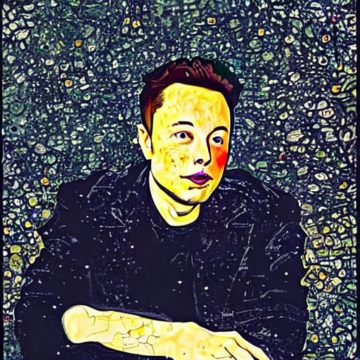
The Elon Musk experience: celebrity management in financialised capitalism

Agustin Ferrari Braun in Celebrity Studies (via Syllabus):
In November 2021, financial journalist Matt Levine asked an interesting question:

Is it consistent with [Elon] Musk’s fiduciary duties as chief executive officer and controlling shareholder of Tesla Inc. to sell or not sell $20.8 billion worth of stock […] based on the results of a Twitter poll? In answering this question, keep in mind that Tesla has a $1.2 trillion market capitalization and essentially free access to limitless capital, in part because Musk does so much entertaining reckless nonsense on Twitter.

This quote encapsulates Musk’s unique capacity to turn the movement of large sums of money into mass entertainment, benefitting from his position as ringmaster of the show. The South African entrepreneur has developed a special relationship with the markets, tying his public persona to the financial performance of his many ventures. Musk’s companies (including car manufacturer Tesla, aerospatial enterprise SpaceX, construction service The Boring Company, and neurotechnological developer Neuralink) cannot be separated from his celebrity image (Gamson 1994) of visionary genius. An image that has been carefully cultivated through his Twitter presence (Kosoff 2018, Levin 2018), media appearances (Duboff 2018, Grady 2018), and regular cameos in popular movies and shows like Machete Kills (2013), The Big Bang Theory (2015), or Rick and Morty (2019).

Celebrity businessmen are not a new thing: the robber-barons’ PR campaigns in the early 20th c. (Guthey et al2009), Gianni Agnelli’s personification of the triumphant Post-War Italian bourgeoisie (Nevola 2004), or Richard Branson’s early embrace of environmentalism (Prudham 2009) come to mind. However, Musk’s capacity to blend celebrity and corporate finances is characteristic of financialised capitalism, as a mode of capital accumulation that privileges control of flows of money and information over the production of commodities (Mader et al2020). While his approach is not unique, his commercial success and position in popular culture single him out as a particularly well-suited case study for this contingent form of business celebrity.

More here.

Microfinance’s Imagined Utopia

Kevin P. Donovan in Boston Review:

When the Grameen Bank and the Bangladeshi academic who helped start it, Muhammad Yunus, won the 2006 Nobel Peace Prize, the event marked the rise of microfinance—the style of global development they pioneered. The prize committee joined supporters such as the U.S. Agency for International Development (USAID) and governments across the Global South in valorizing the idea that making small loans to those typically considered unworthy of credit could “empower” them and “alleviate” poverty.

After experimenting for a number of years, Yunus launched the Grameen Bank in 1983, lending working capital (often as little as a few dollars) to rural women making handicrafts or running shops. Grameen’s appeal was captured in the idea of “social business” that Yunus extolled. While he readily critiqued exclusionary banks and predatory moneylenders, microcredit was hardly opposed to commerce. Instead, it made markets the key domain for fighting global poverty. After all, these were loans not handouts. Lenders expected women to use the money profitably, often grouping Grameen borrowers together so they were jointly liable for individual debts. They believed that social pressure and mutual support would significantly diminish the rate of default—and it did.

More here.

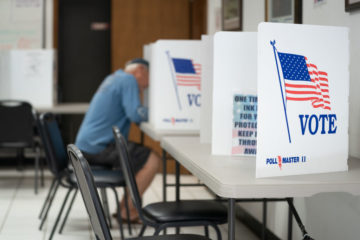
US Voting Patterns Are Shifting. But It’s Not Simply “Class Dealignment.”

 (Photo by Sean Rayford/Getty Images)

Chris Maisano in Jacobin:

Donald Trump’s shocking 2016 victory inaugurated a cottage industry of commentary on the political behavior of the “white working class,” much of it useless. Fortunately, Kitschelt and Rehm applied the insights of their 2014 work to the question of changing patterns of partisanship among white voters in the United States, and illuminated the ways income and education interact in the process of political realignment.

In a key 2019 study on realignments in white partisan support, Kitschelt and Rehm describe the US electorate in terms of income (low vs. high) and education (low vs. high) and model their interaction. The dramatic expansion of higher education, they contend, has disrupted the traditional New Deal alignment and shaped the political demands of four main groups: low-education/low-income, low-education/high-income, high-education/low-income, and high-education/high-income.

The main conclusion of the article is that the two parties’ core constituencies during the New Deal order (low-education/low-income voters for the Democrats, high-education/high-income voters for the GOP) have become swing groups, while the former swing groups (high-education/low-income for the Democrats, low-education/high-income for the GOP) have become the core.

Lower-education voters of all income levels are shifting toward the Republicans at different speeds, while lower-income voters are split. Lower-income voters with higher levels of educational attainment are strengthening their identification with the Democrats, while those with both lower income and fewer credentials — particularly but not exclusively among white voters — can be swayed to vote for the Right depending on a candidate’s electoral appeal. Trump won a significant amount of support from low-education, low-income white voters in 2016, they contend, not just because of his reactionary views on governance and citizenship, but because he was widely perceived as not a typical Republican on economic policy issues.

More here.

Green Empire?

Ed McNally in Sidecar:

In its conviction that the climate crisis ‘changes everything’, and in its search for a historical agent capable of coupling deliverance from catastrophe with radical social transformation, left climate politics is often sustained by a residual optimism. Yet this mood is far from universal. Some commentators have suggested that, given the shortage of time and the dim prospects for seizing state power, climate saviours will have to be drawn from enemy ranks. Take Michael Klare. A longtime peace studies scholar and defence correspondent for The Nation, he is now a cheerleader for the eco-conscious vanguard forming within the United States Department of Defense (DoD). ‘As global temperatures soar and vital resources dwindle’, Klare writes, the climate-mitigation efforts of the DoD have become ‘a model for the rest of society to emulate’. Not only that; the Pentagon’s outlook on global climate politics should be seen as ‘the starting point for America’s future foreign relations’. Has it really come to this? It may be true that, in the absence of a powerful socialist-environmentalist movement, the best hope for humanity is decarbonization from above. But what role is the American imperial apparatus likely to play in this process? Can it plausibly claim to be a ‘climate leader’?

More here.

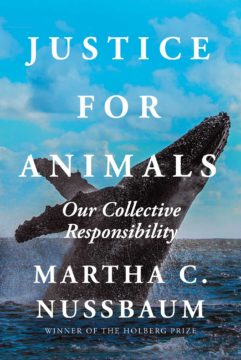
‘Justice for Animals’ by Martha C Nussbaum

Rohan Silva at The Guardian:

As Justice for Animals rigorously argues, the latest scientific research reveals that the opposite is true: “all vertebrates feel pain subjectively”, many animals “experience emotions like compassion and grief” and display “complicated social learning”. For Nussbaum, the implications are “huge, clearly”. Once we recognise there’s no easy demarcation between human sentience and that of animals, “we can hardly be unchanged in our ethical thinking”.
Make no mistake, this is a serious work of philosophy – and probably not most people’s idea of an ideal beach read, with its earnest interrogation of Kantian ethics and utilitarianism. That being said, the book does tell the sad stories of specific animals, such as Hal the humpback whale whose complex song constantly changed “apparently out of sheer fashion and interest in novelty”, but who starved to death with 88lbs of plastic trash in his guts.

more here.

A New ‘Galaxy Brain’ Novel

Mark Athitakis at the LA Times:

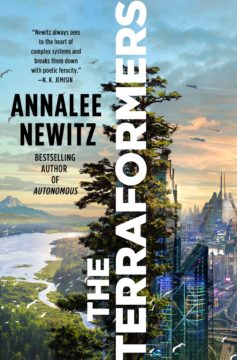
The Terraformers,” Newitz’s new novel, is an ingenious, galaxy-brain book. Set in the very distant future — circa AD 59,000 — it imagines human civilization evolving to the point where we can build new worlds and effectively process new types of creatures to steward them. Destry, a ranger monitoring a planet in progress in the novel’s early going, is a “hominin,” a human-like being who can live hundreds of years, and her fellow hominins peacefully cohabitate with different species. (Her steed is a flying, talking moose-like creature; naked mole rats abound.)

But the management of Destry’s planet, Sask-E, is handled by a distant corporation, Verdance, and corporations haven’t evolved much at all. “The Terraformers” is thick with space travel, whiz-bang technology and radical re-envisioning of intra-species relationships, but Newitz’s concerns are earth-bound.

more here.

The Black Women Who Paved the Way for This Moment

Keisha Blain in The Atlantic:

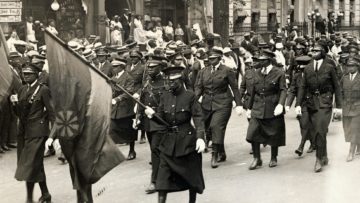
In the 20th-century U.S., black-nationalist women—individuals who advocated for black liberation, economic self-sufficiency, racial pride, unity, and political self-determination—emerged as key political leaders on the local, national, and even international levels. When most black women in the U.S. did not have access to the vote, these women boldly confronted the hypocrisy of white America, often drawing upon their knowledge of history. And they did so in public spaces—in mass community meetings, at local parks, and on sidewalks. These women harnessed the power of their voices, passion, and the raw authenticity of their political message to rally black people across the nation and the globe.
In the early 1920s, Amy Ashwood Garvey, a co-founder of the Universal Negro Improvement Association, advocated for the rights and freedom of black people while standing on crowded street corners in Harlem. Using these public spaces as platforms to advance her political agenda, Ashwood held nothing back, imploring black people to resist white supremacy in all of its forms. On several occasions, the activist publicly recited poetry, including Paul Laurence Dunbar’s famous work “We Wear the Mask,” which emphasized the strategies black people employed to survive segregation, oppression, and daily degradation.

More here. (Note: Throughout February, at least one post will be dedicated to Black History Month. The theme for 2023 is Black Resistance. Please send us anything you think is relevant for inclusion)

As Wallace Stevens Once Put It: Hi!

Elisa Gabbert in The New York Times:

Poker players have an expression for that moment when you look at your cards and discover you’ve been dealt the luckiest possible hand. It’s called “waking up with aces.” This reminds me of the way that the first lines of poems seem to come out of nowhere. It’s true for the poet, the lines just arriving, as if by dictation or angelic message — as Eliot writes in his essay on Blake, “The idea, of course, simply comes.” And it’s true for the reader, who can only have the same in medias res experience, encountering a line at the top of a page. There’s a shock to this unveiling. All the emails I get begin with some variation on “I hope this finds you well,” but a poem can begin in any kind of way. “I felt a Funeral, in my Brain.” “Thou still unravish’d bride of quietness.” There’s a Wallace Stevens poem that starts “Hi!”

“In the middle of our life’s journey,/I found myself in a dark wood.” That’s the most literal translation of the first two lines of Dante’s “Inferno.”

More here.