
Ode to Herb Kent
Your voice crawls across the dashboard of Grandma’s Dodge Dynasty on the way home from Lilydale First Baptist. You sing a cocktail of static and bass. Sound like you dressed to the nines: cowboy hat, fur coat & alligator boots. Sound like you lotion every tooth. You a walking discography, South Side griot, keeper of crackle & dust in the grooves. You fell in love with a handmade box of wires at 16 and been behind the booth ever since. From wbez to V103, you be the Coolest Gent, King of the Dusties. Your voice wafts down from the ceiling at the Hair Lab. You supply the beat for Kym to tap her comb to. Her brown fingers paint my scalp with white grease to the tunes of Al & Barry & Luther. Your voice: an inside-out yawn, the sizzle of hot iron on fresh perm, the song inside the blackest seashell washed up on a sidewalk in Bronzeville. You soundtrack the church picnic, trunk party, Cynthia’s 50th birthday bash, the car ride to school, choir, Checkers. Your voice stretch across our eardrums like Daddy asleep on the couch. Sound like Grandma’s sweet potato pie, sound like the cigarettes she hide in her purse for rough days. You showed us what our mommas’ mommas must’ve moved to. When the West Side rioted the day MLK died, you were audio salve to the burning city, people. Your voice a soft sermon soothing the masses, speaking coolly to flames, spinning black records across the airwaves, spreading the gospel of soul in a time of fire. Joycetta says she bruised her thumbs snappin’ to Marvin’s “Got to Give It Up” and I believe her.
by Jamila Woods
from:Poetry, December
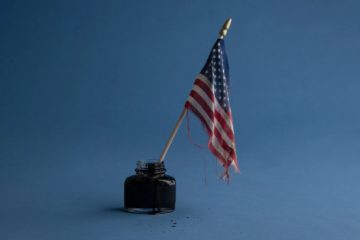
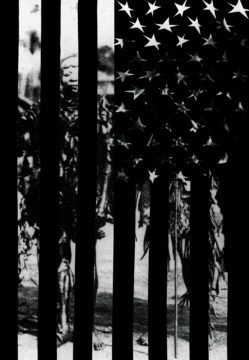 My dad always flew an American flag in our front yard. The blue paint on our two-story house was perennially chipping; the fence, or the rail by the stairs, or the front door, existed in a perpetual state of disrepair, but that flag always flew pristine. Our corner lot, which had been redlined by the federal government, was along the river that divided the black side from the white side of our Iowa town. At the edge of our lawn, high on an aluminum pole, soared the flag, which my dad would replace as soon as it showed the slightest tatter.
 The problem with trees is that they are too slow.
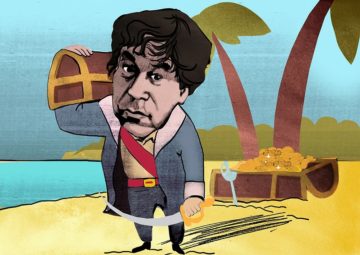 Was there really a colony known as “Libertalia”, founded by Enlightened pirates on the north-east coast of Madagascar in the early 18th century?
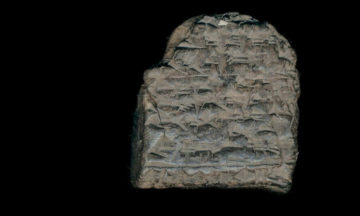 I was sitting in a quiet office in the Louvre Museum in Paris, a clay tablet in my hand, using a magnifying glass to make out words that had been inscribed on it in small, careful, wedge-shaped signs known as cuneiform. It looked diminutive in my palm, just
  Cities are incredibly important to modern life, and their importance is only growing. As
 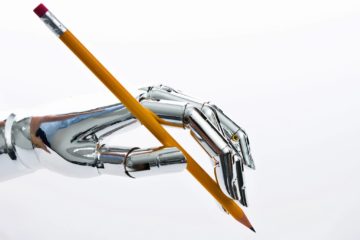 Steven Pinker thinks ChatGPT is truly impressive — and will be even more so once it “stops making stuff up” and becomes less error-prone. Higher education, indeed, much of the world, was set abuzz in November when OpenAI unveiled its ChatGPT chatbot capable of instantly answering questions (in fact, composing writing in various genres) across a range of fields in a conversational and ostensibly authoritative fashion. Utilizing a type of AI called a large language model (LLM), ChatGPT is able to continuously learn and improve its responses. But just how good can it get?
  The way Dominion’s attorneys tell the story, the problem really started when, late on election night, Fox News’s decision desk called the state of Arizona for Joe Biden — and no other networks joined them. The Fox call was consequential, seriously undercutting Trump’s hope of portraying the election outcome as genuinely in question. It also was, probably, premature. The consensus among other decision desks and election wonks was that Fox called the state too quickly, considering how much of the vote remained uncounted and where and whom those uncounted votes were coming from. Other outlets left Arizona uncalled
  On Jan. 28, 2019, Nikole Hannah-Jones, who has been a staff writer at The New York Times Magazine since 2015, came to one of our weekly ideas meetings with a very big idea. My notes from the meeting simply say, “NIKOLE: special issue on the 400th anniversary of African slaves coming to U.S.,” a milestone that was approaching that August. This wasn’t the first time Nikole had brought up 1619. As an investigative journalist who often focuses on racial inequalities in education, Nikole has frequently turned to history to explain the present. Sometimes, reading a draft of one of her articles, I’d ask if she might include even more history, to which she would remark that if I gave her more space, she would be happy to take it all the way back to 1619. This was a running joke, but it was also a reflection of how Nikole had been cultivating the idea for what became
  Advait Arun in Phenomenal World’s The Polycrisis:
 Ira Katznelson in Boston Review:
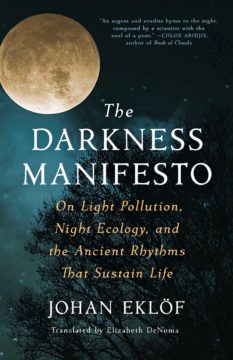 The zoologist Johan Eklöf began to consider the disappearance of darkness in our brightly lit world in 2015, when he was out counting bats in southern Sweden. The surrounding grounds were dark, as they had been decades earlier when his academic adviser had tallied the bat populations in the region’s churches. In the intervening years, however, those churches — whose belfries are famously appreciated by the winged mammals — had been illuminated with floodlights. “I started to think, how do the bats actually react to this?” Eklöf says.
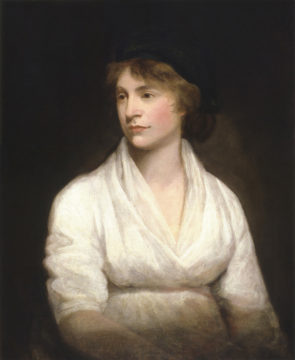 To vindicate indicates one of two aims: to make a defense or to stake a claim. With the Vindication of the Rights of Men, published in 1790, Wollstonecraft upheld the natural rights of man, a notion enthroned by the revolutionaries in their “Declaration of the Rights of Man,” embraced by Thomas Paine in his fiery pamphlet Rights of Man, and excoriated by Burke in his Reflections. Two years later, though, and to the shock of her critics, Wollstonecraft pivoted from defense to offense—in both senses of the word—by making a jaw-dropping claim. Natural rights, she declared, also belong to the other half of humankind: women. “I love man as my fellow,” she proclaimed in the Vindication of the Rights of Woman, “but his sceptre, real or usurped, extends not to me, unless the reason of an individual demands my homage.” Wollstonecraft was not alone in making so extraordinary a claim. The following year in France, the playwright Olympe de Gouges published her Declaration of the Rights of Woman. Demanding full civil and political rights for both sexes, de Gouges insisted that a woman’s place in the public square was side by side, as a full equal, to man.
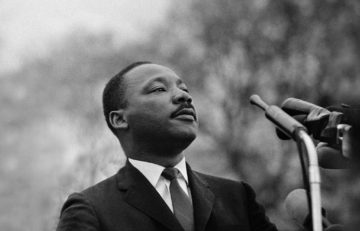 Martin Luther King Jr.