
by Scott Samuelson
During our disturbingly subdued celebration of the Declaration of Independence’s two-hundred-and-fiftieth anniversary, one of the many things I’ve been thinking about is our natural right to “the pursuit of happiness.” As I’ve reconsidered the philosophical tradition that the Committee of Five was drawing on when they lit on that memorable phrase, seven great puzzles of happiness have stood out to me, which also emerge time and again in any halfway-thoughtful person’s life.
PUZZLE #1: WHAT’S IN OUR CONTROL?
In many languages, the word for happiness can also mean luck. Even in English, “happiness” derives from “hap,” which gives us words like “happenstance.” So, maybe happiness isn’t in our control at all. That’s one answer to the puzzle. Happiness is happenstance, sheer luck. Let’s just hope and pray for the best.
In many ways, the tradition of ancient Greek philosophy emerged to give an alternative answer. We can make an art of being human. We can shape our lives to be open to happiness. Fundamentally, the good life isn’t a matter of luck. It involves habits and virtues that we cultivate in ourselves. It’s more about what we do than what’s done to us.
Some philosophers—arguably Socrates himself, but certainly the Stoic philosophers he influenced—went so far as to say that happiness is totally in our control. If we cultivate the right mindset and practice the right virtues, we can be happy under all circumstances. Even when we’re wrongly imprisoned and face an unjust execution (to take the tragic example of Socrates—excuse me, I should say comic example, since all endings are happy endings for a virtuous person), we can be completely happy if we’re just at peace with our conscience. So, there’s another answer to our first puzzle. With the right moral character, we can be happy no matter what our fate holds.
Yet other philosophers, most famously Aristotle, argued that while our choices and virtues are the lion’s share of happiness, there’s still a little luck that we need. At minimum, a happy life involves dodging the worst of fates, a fate like that of Priam, who had to endure the rape and murder of his family, the destruction of his homeland, and the genocide of his people—a fate still being suffered in our current world. So, there’s another answer. Happiness is mostly in our control, but we need a little luck—or at least we need to be spared horrible luck.
Maybe we also need the basic equipment for being happy—for instance, a home and food. If so, that raises interesting political questions for anybody committed to a natural right to the pursuit of happiness.
PUZZLE #2: SHOULD WE WANT WHAT WE WANT?
A straightforward approach to happiness says that getting what we want will make us happy. We’ve always dreamt of paradises where all our wishes are granted—ripe fruit falls off the trees, rivers flow with milk and honey, nobody suffers or dies, and little streams of alcohol come trickling down the rocks.
Isn’t our consumer economy the attempt to make personal paradises readily available? Its advertisements promise us that buying what we want (or increasingly renting services that dole out what we want) will make us happy.
You may find yourself skeptical of this consumerist vision if you’ve ever been with children on a day when they’re showered with presents and get overstimulated, grumpy, bored, or counterproductively selfish.
Some philosophies—Buddhism and Stoicism come to mind—go so far as to take the opposite position: desire (or at least a certain species of desire) is the cause of suffering. On this view, we’re better off when we disentangle our happiness from our desires and focus on ego-reducing things like acceptance, compassion, or generosity.
Yet other philosophies—I’m thinking of Epicureanism—take a more moderate approach and hold that desire is a crucial clue to our happiness even though it can easily get out of hand. On this view, we should scale back our yearnings to the simple desires for healthy food, a cozy home, good work, good play, and good companionship—and weed out all our desires for more, more, more.
PUZZLE #3: IS MONEY EVER ENOUGH?
When I was a kid, my pals and I would sometimes quiz each other, “If you could have three wishes, what would you wish for?” You know the first answer: a thousand more wishes!
I think that’s basically what the desire for money is: a wish for more wishes. If our consumer economy promises us that buying things will enhance our happiness, the natural thing for us to think is that true success is being rich and being able to buy whatever we want, whenever we want.
It’s worth noting that every single tradition of religion and philosophy is adamantly opposed to this view. When we align ourselves with these traditions, our overwhelming emotion for Elon Musk should be pity.
The extremists of these traditions hold that money is the root of all evil and commit themselves to poverty to escape its clutches. Religious ascetics take vows of poverty, and most ancient philosophers (we sometimes forget) were scruffy, wild-haired, grubby bums—like Diogenes, who was once caught begging money from a statue. When someone asked him why, he replied, “To get used to being refused.”
Even thinkers who don’t completely oppose money think that it’s a category mistake to believe that money equals happiness. Though money can help us acquire the equipment of a happy life, wanting money itself, like my wishing for a thousand wishes, is simply to want more, more, more—and thus never to be happy with what you have or even could have. They treat money like most of us treat toothpaste. It’s good to have a tube of it, maybe even a spare tube in the closet, but it would be absurd and a wicked nuisance to desire or to possess a million, a billion, or a trillion tubes of toothpaste.
When I taught a course called Working in America, one of the questions I’d ask my students is how much annual income they would need to have a great life. After initial dreams of millions or billions, most of them concluded that a great life did need some money but could be fully accomplished without a whole lot. Even things like life-changing travel can be done on a shoestring—in fact, some argued that it’s better accomplished on a shoestring. It brought them up short to realize that their default was to want far more money than they needed to have a great life. Some of them began to wonder if the pursuit of extra money was worth it.
PUZZLE #4: ARE IDLE HANDS THE WORK OF THE DEVIL OR THE ANGELS?
Since the invention of the philosophy major, philosophy majors have been asked, “What are you going to do with that?” The assumption, which has now become the explicit motto of the university, is that higher education is workforce training. Since there aren’t any philosophy factories with “help wanted” signs on the door, isn’t studying Plato a waste of time and money?
Interestingly, philosophy majors discover that the ancient Greeks had the exact opposite view: to be trained in something useful is to make yourself fit for slavery. The point of realizing our humanity, on this view, is to rise above the merely useful. The great good is not labor or work but leisure. True happiness involves sculpting our ability to use free time well, to discipline our attention and then direct it at higher goods like truth and beauty—that is, to be more than just people who do their job and then offload their brains onto the entertainment industry.
As it turns out, the only thing that these leisure-loving ancient Greeks managed to accomplish was the invention of geometry, astronomy, the theater, history, logic, physics, philosophy, athletics, academia, and democracy.
But maybe these Greek philosophers are missing out on what’s good about labor and work. Can’t chores teach us humility? Doesn’t work bring out the best in us? Don’t we long to make tangible contributions to our community? And don’t we need a job to keep us occupied and provide us with the money we need to have a good life?
What’s the blend of chores, work, and leisure that makes us happy? I like to point out that our country was founded by farmers who studied philosophy. So, another way of putting it is: what’s the right mix of farming and philosophy in a good life?
PUZZLE #5: HOW EQUAL SHOULD WE BE?
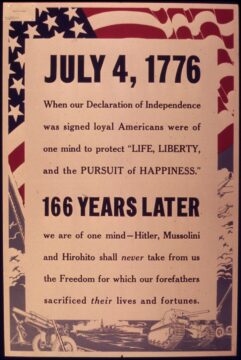
What exactly is the equality that Declaration of Independence declares is the birthright of all people? It means not being under the thumb of any person or group. It means being able to look others in the eye, even your boss or your president. It means wielding a meaningful voice in the shaping of your political community: having a vote, being able to speak your mind, maybe running for office—the central goods of a liberal democracy. In a word, it means liberty rather than slavery, freedom rather than serfdom.
If we go back to those ancient Greeks, we find Aristotle arguing that not all people are created equal, that some people are (in his words) “natural slaves,” people who are happiest not to make decisions for themselves but rather to be told what to do. Such natural slaves are perfect for doing the jobs necessary for the economy so that others can enjoy their leisure and run the show. If my history is correct, I believe that some of the Founders entertained a similar view.
It’s easy—and important—to condemn such vile elitism, but I think that we continually need to confront the challenge of Aristotle’s concept of natural slavery, especially in a time of algorithmic manipulation and political disenfranchisement. Are we still committed to citizenship as a crucial part of our flourishing, or are we okay with offloading liberty onto technological or political overlords? Is it still a self-evident truth that we’re all equal?
PUZZLE #6: IS OUR TRUE LONGING FOR GOD?
For the sake of argument, let’s say that we manage to live out good answers to all our previous puzzles. We cultivate and exercise our virtues, manage our desires, have enough but not too much money, strike the right balance of good work and meaningful leisure, and practice a generous form of citizenship—or at least something in that ballpark. Is all that enough to be happy? Or will we still long for something bigger than our fully realized human life?
In the Confessions, Augustine narrates his own search for happiness and finds that pleasure, entertainment, friendship, sex, virtue, and philosophy all fail to deliver. After a breakdown and a mystical vision, he turns himself over to God. As he famously puts it, “You have made us for yourself, O Lord, and our heart is restless until it rests in you.”
Even if we aren’t as extreme as Augustine, we still might think that some amount of transcendence is necessary for a happy life. People often find peace and happiness in being united with something bigger than them, something that takes them out of themselves and puts them in touch with the timeless: festivals, dancing, meditation, prayer, art, nature, psychedelics. Such experiences have the potential to humble us in the face of being and to fill us with a more-than-human joy.
PUZZLE #7: WHAT’S LOVE GOT TO DO WITH IT?
In my book, the biggest puzzle of all is love. Just think of the central role that love plays in Plato’s dialogues, or Augustine’s distillation of ethics as “love and do what you will,” or Dante’s vision of “the love that moves the sun and the other stars.”
I love what the poet Randall Jarrell says about love:
Love removes none of the contradictions of our lives but, by adding one more, induces us to accept them all; transfigured by it, we had rather be loved than right—are willing, even to be happy. Whether it moves the sun and the other stars we cannot tell, but that it moves the men and women and children and cats and dogs among whom we live we can hardly doubt. The house not built upon it, blessed by it, is founded upon the sand.
It’s certainly not so simple as that love is the key to happiness, for it’s also responsible for most of our misery, grief, and violence. But here’s my suspicion: a life without loving and being loved, even an otherwise happy life, is missing the key ingredient.
The mysteries of love are wild and vast—and permeate almost every one of our other puzzles. How much of love is luck? Can we somehow open ourselves to it? What are the virtues of loving and being loved? How helpful are our strong attractions? Should love inform our work, our leisure—both? How do we weave love into everyday life? What do we do with a broken heart?
I’m not claiming these are the only puzzles of happiness, just that these seven big puzzles confront each and every one of us. Though I’ve got my own hunches about all of them, it’s probably healthy to recognize what a gargantuan mystery the pursuit of happiness is, because living with mysteries, even when we’re utterly baffled by them, is better than buying into stupid answers and moving on.
*
Scott Samuelson is the author of several books, most recently To Taste: On Cooking and the Good Life. A version of these remarks was given at the Lyceum Movement’s Tallgrass Festival of Ideas in Des Moines, Iowa on August 8th, 2026.
Enjoying the content on 3QD? Help keep us going by donating now.