
by Richard Farr
To say that bureaucracies perpetuate and expand their power without limit is not to criticise them; it is only to state an indelible fact about human institutions, and explain why vigilance about anything calling itself “official” is the price of liberty. People at all points on the political spectrum can agree, using different examples no doubt, that the state itself is the ultimate example of the problem, and that a further problem is the state’s inclination to treat our vigilance not as a virtue but as a threat to be controlled. But the UK’s new Hillsborough Law is a reason for all of us to celebrate — a case study in how determined citizens, horribly wronged by deceitful officials, can fight back. Or to put it a better way: how they can come to the state’s aid by helping it recover from its own corruption.
But let’s talk about treason for a moment. The idea of treason — that it’s an especially heinous crime for those under the state’s command to undermine the state itself — reaches back to antiquity. For most of our history it existed in the context of Divine Right, a brilliant piece of propaganda that dominated our thinking about power from its origin in the Sumerian King List (2000 BCE) to James I’s The True Law of Free Monarchies (1598). According to Divine Right, an attack on the crown is nothing less than a proxy attack on God, because the crown is God’s legitimate representative. Once you accept that, it seems feeble at best if not treasonous in itself to express qualms about a little disemboweling.
After the French Revolution and American Revolution, and perhaps especially after Locke’s Second Treatise on Government, it was easy to see this for the eons-long scam that it was (and in too many places still is). We are beneficiaries of a better idea: “consent of the governed” means the state can demand only our allegiance to the sovereign that is law. We accept that some forms of government are better than no government, and that government without law is impossible; this is why, for us, the special crime of treason is less interesting than a broader category that encompasses it: undermining the rule of law.
In the realm of melodrama, this could be a secret cabal trying to install a ‘Manchurian Candidate.’ Much more commonly, it’s rich private citizens trying to buy our elected representatives, or poor private citizens trying to intimidate or kill them. But what happens when elements of the government itself are the underminers? At some point inevitably they will be, or will be motivated to be — which is why some aspects of the state in particular (policing, security, espionage, all forms of government data collection and surveillance, laws targeting protest and dissent of any kind) should be treated as a two-edged razor, subject to permanent, robust, genuinely independent oversight.
The gateway drug for official corruption is often self-protection through dishonesty. But now in the U.K. decades of injustice and pain have led to a new place, where at least some kinds of official dishonesty have at last been recognized not as an exasperating fact of life but as crimes.
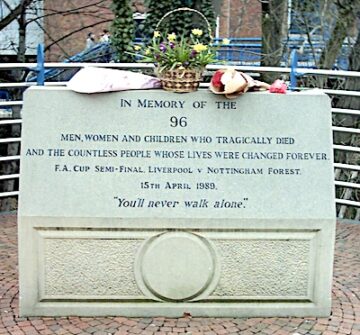
To put a very long, marvellously ugly story into a small nutshell: in 1989, at Hillsborough Stadium in England, nearly 100 football (soccer) fans were crushed to death, and hundreds more severely injured, in an incident of crowd control gone wrong. The South Yorkshire Police, who were responsible for public order at the game, immediately put about the story that a major factor was fan drunkenness. They also claimed that a gate they had decided to open, in order to get more fans onto the terraces (a key cause of the disaster), had been forced open by the uncontrollable fans themselves.
Bereaved families protested that the police were involved in a self-protective cover-up. and that higher officials had done little to bring them to account. Over subsequent decades the families pushed (and pushed, and pushed) to have the names of their loved ones cleared and the real causes of the disaster made plain. A fistful of unsatisfactory inquiries left a trail of literally hundreds of thousands of pages of evidence. Eventually it became clear that senior SYP officers had lied endlessly, to everyone, and had further subverted official inquiries by for example altering witness statements in an attempt to shore up their version of events and absolve themselves of responsibility.
Finally — or almost — in 2017 a report by James Jones, the retired Bishop of Liverpool, got to the nub of the matter in a well-chosen title: The patronising disposition of unaccountable power. (The subtitle was A report to ensure the pain and suffering of the Hillsborough families is not repeated.) Jones wasn’t finishing things off but rather getting them rolling: among several other recommendations, he said that the law should reflect a “duty of candour” — a legal requirement, potentially with criminal penalties attached, that officials such as police officers, involved in any public inquiry, be both honest and actively helpful.
Six years later, while bloviating about its staunch commitment to transparency, the government rejected all of Jones’s detailed recommendations for legal change. And yet finally, finally, in 2026, the “Hillsborough Law,” officially the Public Office (Accountability) Bill, has passed the House of Commons. (Passage through the House of Lords and royal assent are expected by autumn.) The law is based directly on Jones’s report, and it creates a legal sea-change worthy of putting on the shelf next to Magna Carta — for it makes the type of dishonesty employed by the SYP in stonewalling or corrupting a public investigation a criminal offense for any public official.
I recently finished on a novel in which a fictional state that might be mistaken for Elizabethan England shifts from the routine, enthusiastic execution of “traitors” — anyone the crown finds troublesome — to a revolutionary new dispensation in which, while treason and execution are still on the books, this most extreme crime and its punishment are reserved exclusively for “politicians who lie to their constituents.” Okay, so it’s just a novel. But here in the real world the Hillsborough saga is a reminder of how hard it is to overcome officialdom’s instinct to corrupt itself by protecting itself. And the Hillsborough Law is, like the rejection of Divine Right theory, a giant stride away from unaccountable power in the direction of genuine democracy.
Plenty of caveats remain. Does the new law do enough for whistleblowers? Does it really only protects us from dishonesty and obstruction in low places? And to what extent can some of our public servants still wave the evergreen free pass of National Security?
Still, a remarkable moment. Our new PM, Andy Burnham, was involved in the Hillsborough campaign for years, and he described passage of the Bill as ‘a rewiring of the state.’ Possibly; only time and further vigilance will tell. But some other democracies I could name might like to take a look.
***
Enjoying the content on 3QD? Help keep us going by donating now.