
by Gary Borjesson
It is the first week of the new year, a time traditionally given to reflecting on the year past and the year to come. Reviewing, summing things up—all those top 10 lists—and making resolutions. Having slowly gained more knowledge of what is stable in my disposition (for better and worse), I’m less tempted to dream of radical reinvention or even self-improvement. Depending on my mood, this can feel like self-acceptance or defeat.
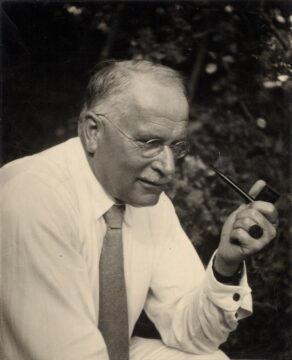
One way of describing the situation is to say that I’m getting to know what Carl Jung described as the archetypal aspects of my psyche. Jung acknowledged that his account is a paraphrase of Plato’s description of the psychic patterns that structure our experience. For Jung these emerge from the collective unconscious, a realm beyond immediate conscious awareness. Plato’s Socrates locates them in an analogous place, the Underworld. These archetypes guide our lives in some respects, but they’re not the only forces at work. For Socrates and Jung, we exercise our power to be truly self-determining through getting to know the patterns that guide our lives, but do not determine our fates.
In honor of the birth of a new year, I want to share the story Socrates tells at the end of the Republic, about how souls come to choose the lives into which they’ll be reborn. For those familiar with depth psychology, this myth of Er (as the story is called) will be strikingly resonant.
A friend once told me he’d spent years trying to make himself into a scholar, and by the world’s eyes he had succeeded. But it never felt like a fit to him. Eventually he realized that, whatever his conscious intentions, he had the instincts and desires of an artist. (His academic articles kept wanting to become stories!) Denying this part of himself had generated internal conflict. So, rather than work against his natural wiring, he started finding ways to be an artist in his work and life.
Platonic and Jungian psychology start here, with what experience teaches, that we’re not born as blank slates. By the time we have a modicum of self-awareness, patterns have already been inscribed on our slate, by factors such as genetics, epigenetics, and early experience—all outside our control. But again, while these contribute to our development, we still have a say in who we become. Thus my friend was more free once he saw his artistic type clearly and owned it, rather than leaving it in those Jungian shadows to work on him unawares.
Now to the story of Er that Socrates tells his young companions. Er lived long ago. Upon his death in battle, he was allowed to tour the Underworld and see how souls choose their next lives. Er was then brought back to life, and just in time, for he was about to be burned on the funeral pyre. He was allowed to live in order to tell humanity what he learned.
First, Er learns that the soul is immortal. He watches the transmigration of souls from one life to the next—a complex journey in its own right. The part we’re interested in is how souls come to choose the pattern or archetype of their next life. Imagine souls milling about on a large plain in the Underworld. Lots are cast out into the crowd, one landing beside each soul. These determine the order in which souls choose from among the available life-patterns. The lots acknowledge the role of randomness and fortune in determining the shape of a human life. We acknowledge the same when we say things like someone “won the genetic lottery.”
Next, souls choose from a variety of psychodynamic patterns scattered over the ground. Er saw the person with the first pick reach ‘heedlessly’ for the life of a glutton and tyrant. Others chose being a warrior or politician, or they chose the life of an animal such as an eagle. (Some archetypes Jung identified include caregiver, rebel, mother, lover, and creator.)
The lottery does limit a soul’s choice. Nevertheless, Er is reassured by an authority that even the unlucky person who chooses last can still find a good life from among the remaining patterns. Indeed, Er is present when none other than the soul of Odysseus who “had drawn the last lot of all and…from memory of its former labors had recovered from love of honor, and went around looking for the life of a private man who minds his business; and with effort found one lying somewhere, neglected by the others.” Socrates is here making a shameless plug for the philosophical life to his young friends! As usual, Odysseus is an outlier, for, like the philosopher, he has learned from his experience and thus is in a position to choose a better life for his next time around. For most souls, however, Socrates reports that the choice was not so free, but “made according to the habituation of their former life.”
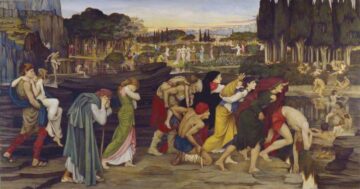
Having made their choice, the souls cross the river Lethe, which causes them to forget their past life and any specific memory of having chosen their next life. So, how does the archetypal pattern shape their life? Er is told that in making their choice, the soul also chooses their daimon, a guardian spirit that remembers their choice and guides their life accordingly.
There’s a fascinating parallel here with Buddhism’s notion of karma (which means action in Sanskrit). Both karma and daimon imbue the pattern with momentum. Karma represents the continuity of consciousness from lifetime to lifetime: experiences embed themselves as memories that result in emotional and behavioral tendencies that in turn give the soul momentum, meaning that, like the daimon, the soul moves in a specific direction.
In Er’s vision, as well as in Buddhism and modern depth psychology, there’s a common acknowledgement that, by default, much of our thought and behavior is directed by forces outside our awareness. Some of those forces lie outside our control. Part of the Socratic and therapeutic challenge is to get to know these durable patterns so that, like my friend, we can accept them and work with the momentum of our nature rather than against it.
Yet there is freedom, if we can do as Plato does, as Socratic midwifery does, as myth does, and as psychodynamic therapy does: make the ordinarily invisible (Underworld-Unconscious) transmission visible. The measure of freedom gained through education and self-exploration can reveal that as attractive as the tyrant’s life looks at first, upon closer inspection it proves to be one of the worst. Thus Socrates suggests to his friends this moral for Er’s story: having a good life depends on “being a seeker and student of that study by which one might have the capacity and the knowledge to distinguish the good and the bad life, and so everywhere and always to choose the better from among those lives that are possible.”
In the Platonic and Jungian view, becoming aware of our archetypal situation makes it more workable. We’re not the slave of our inheritance or victims of chance; but we’re also not free in the cartoon version of existentialism to choose our essence and destiny, as we would a suit of clothes off the shelf. Instead, we can put ourselves in the position of the artist. They too are constrained by their medium—academic articles aren’t the place for spinning myths! Whatever they make must be their expression of what’s possible with this lump of clay or marble, this canvas and these paints, this instrument, this body doing this dance.
So, this new year I’m telling myself it’s not about changing direction or lighting out for the territories. I’ve abandoned the fantasy that I can radically change the momentum of my life. It’s more about staying the course, and making course corrections. It’s about continuing to work the edges of what I can shape up in myself, even as I accept (sometimes grudgingly) where my daimon seems determined to lead me. Working with what’s given, but not fated to it.
Enjoying the content on 3QD? Help keep us going by donating now.