
by Andrea Scrima (excerpt from a work-in-progress)
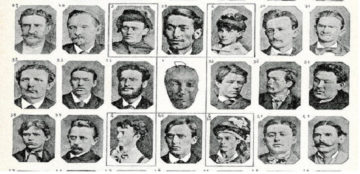 When they arrived in the U.S., Southern Italians brought with them the sense that they’d been branded as underdogs, that they belonged and would forever belong to a lower class, but the birth of the Italian-American gangster was rooted in attitudes toward the Mezzogiorno that dated back far earlier. After Italy was unified under Vittorio Emanuele II in 1861, a new national government imposed Piedmont’s centralized administrative system on the South, which led to violent rebellion against State authority. Politicians and intellectuals took pains to deflect responsibility for what they saw as the “barbarism” of the Mezzogiorno, and were particularly receptive to theories that placed the blame for the South’s many problems on Southern Italians’ own inborn brutishness. The decades following Unification saw the nascent fields of criminal anthropology and psychiatry establish themselves in the universities of Northern Italy; implementing the pseudosciences of phrenology and anthropometry in their search for evolutionary remnants of an arrested stage of human development manifested in the people of the Mezzogiorno, they used various instruments to measure human skulls, ears, foreheads, jaws, arms, and other body parts, catalogued these, and correlated them with undesirable behavioral characteristics, inventing in the process a Southern Italian race entirely separate from and unrelated to a superior Northern race and officially confirming the biological origins of Southern “savagery.” Read more »




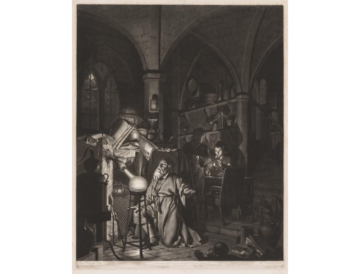

 Moeen Faruqi. Chamber Dialogue, 2016.
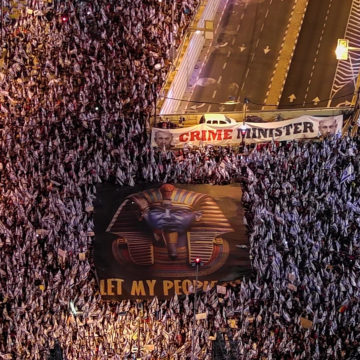 The state of Israel is on the brink of deliquescence. A corrupt multi-indicted prime minister has handed the reins of government to extremist (read: blood-thirsty) right-wing (read: populist imperialist) religious (read: obscurantist) coalition parties whose alliance is based on a net refusal to heed the Israeli Supreme Court and a pact to instil a theocratic regime where there has been, since the state’s creation in 1948, a democracy. Both these goals are to be achieved by changing the law, giving parliament (the Israeli knesset) the right to dictate the terms of justice to the courts of justice. It is a situation the philosopher Plato had staged at the start of his Republic, back in the 4th century BC.
 School Boards across the country have become radicalized, energized, weaponized. They have become the new political battleground where extremist right-wing ideologues test the political waters. The plan is to infiltrate the schools, use them as the megaphone to broadcast the GOP’s agenda, with lots of soapboxing and grandstanding thrown in.
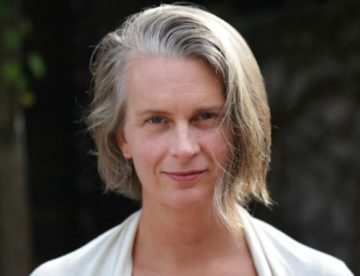
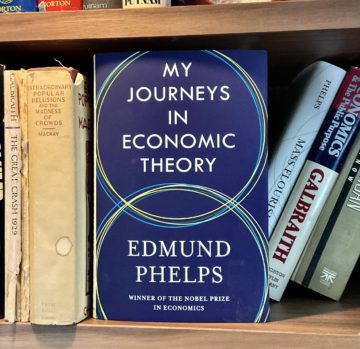 On page 184 of Edmund Phelps’ new book, My Journeys In Economic Theory, he tells the story of a lunch party with friends, at which, presumably after the plates were cleared (but not the glasses), the then 80-something-year-old 2006 Nobel Prize winner in Economics belted out “Garden Grow.”
 Last month I saw the Whitney exhibit “no existe un mundo poshuracán: Puerto Rican Art in the Wake of Hurricane Maria.” As you might remember, Maria was a Category 4 storm that hit Puerto Rico September 20, 2017. According to Harvard University’s T.H. Chan School of Public Health, 4,645 Puerto Ricans died as a result of the storm, but according to the Puerto Rican government, only 64 died. The Whitney’s museum label stated that the smaller number “not only insulted the populace with its miscalculation but also undercounted at-risk sectors that experienced increased deaths from accidents, cardiac conditions, diabetes, suicide, and even leptospirosis—a usually rare, potentially deadly, yet preventable bacterial infection spread by rats that grew prevalent in the months following the storm due to contaminated water.” A year after the hurricane, an impromptu installation of over 3,000 pairs of shoes was placed in front of Puerto Rican government buildings to memorialize the actual number of dead..