by Nate Sheff

(Lots of spoilers for Barbie.)
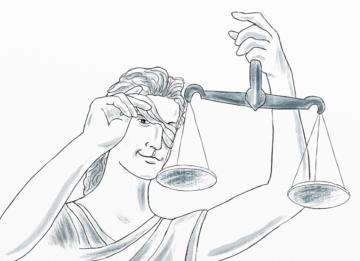
Plato’s cave allegory depicts the philosopher’s journey out of the world of appearances and into the real light of day. After a long climb out from the pits and puppet shows, our protagonist emerges into the world under the sun, whose light makes everything else visible. Having learned from this journey, the philosopher turns back into the cave to spread the good news. The shadows on the wall pale in comparison to the real. True goodness can only be sought elsewhere, up above, after a journey towards the light.
Let’s picture a different one.
Our version starts in the sky. The sun shines, and the world below brightens and basks in its glow, the sun somehow becoming stronger and even more real. But something else comes into being: sighs and grumbling half-heard from a crack in the rocks. The sun’s light dims. Maybe it’s time to see how things are going down there. So the sun steps down from the heavens, taking the form of just another human, and peeks its head down into the cave. After a climb down – not easy, given this is the first time the sun has felt gravity – the sun finally meets the humans and tells them about the boundless sky and the light of day.
But humans know all about that, and they’ve decided that light is light, even from a measly fire. The sun’s “good news” is empty hype, mere marketing.
The sun considers this and feels its confidence waning. These people are denying the intrinsic goodness of its light. How can that be? How can these humans embrace a messy, complex, blurry world over simple brilliance? Maybe it’s the sun that has some learning to do.
Plato tells a story about the Idea of the Good, a source of goodness that is so independent as to be impossibly remote yet infinitely powerful. We need it to understand ourselves and our place in the world. The funhouse mirror version has that Idea shedding the trappings of the ideal for the sake of understanding the non-ideal, but complicated and interesting real world. I like this version. It might not have Plato’s insight or artistry, but it has a scrappy charm that allows me to think about Plato’s original in a new way.
Barbie, Greta Gerwig’s film (co-written with Noah Baumbach), plays a trick like this. Read more »
 The other day, one of my grandsons asked me if I’d like to play Mario Kart with him. It goes against my grain to turn down invitations from my grandsons. However, when we’d played Mario Kart a few weeks earlier, I’d been terrible at it. His younger brother, watching from the sidelines, wanted to know why I played so badly. I said it was because the game was new to me, but in fact I’ve always been slow and clumsy at games that require quick reactions and hand-eye coordination, back to Pac-Man and even earlier. As an undergrad I was good at an arcade version of Trivial Pursuit, but that cuts no ice with anyone these days.
 In geometry, a line goes on and on: it goes on and on and never stops. In poetry, a line goes on as long as the poet lets it….though in practice this rarely means more than six or seven words at a stretch.


 There has been talk in recent years of what is termed “the internet novel.” The internet, or more precisely, the smartphone, poses a problem for novels. If a contemporary novel wants to seem realistic, or true to life, it must incorporate the internet in some way, because most people spend their days immersed in it. Characters, for example, must check their phones frequently. For example: