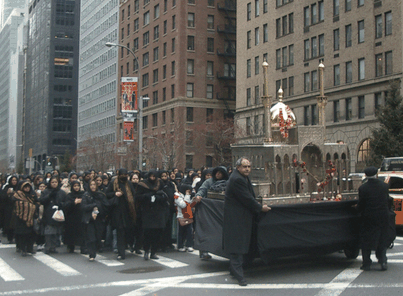
Which of the following would best be described as an hiatus?
Which of the following would most likely be considered a furlough?
For extra money, an hour or two most days, I pose variations of these questions over and over. Each of them, along with its set of possible answers, goes into the database of an on-line vocabulary-building tool. It's a pretty straightforward formula, the interrogative of multiple choice. However, what strikes me with each variation is the tense in which it must be formed: would be most likely to, would best be described as, would most likely. Always the conditional – to signal, I suppose, that these are all hypothetical instances – and thus the words here deployed are equivalent to blanks in a loaded gun: they make the same sound but do not pierce us in any way.
And so I compose these questions, one after another, ten to fifteen an hour, careful to insert the conditional, as if I were setting up a practice shooting range, a multiple choice of clay pigeons and cardboard targets. I do wonder, though, how effective this sort of vocabulary building will be for its subscribers. (I have no concrete research before me, but I suspect that learning vocabulary outside of its natural habitat1 is somewhat analogous to swallowing vitamin pills instead of eating actual vegetables: less is absorbed.) But to be perfectly candid, I'm not so much concerned about the improved verbal scores of these potential subscribers as I am just a bit saddened each time I confine another word to a purely hypothetical existence.
“Philosophical problems arise when language goes on holiday,” Wittgenstein so quaintly tells us in his Philosophical Investigations. He was getting at how difficult it is to actually learn much at all about words and their attendant conventions once you've removed them from the everday speech and printed page that is their office – once you're fanning an isolated word with the palm front of philosophical analysis.2 And certainly the practice shooting range of this vocabulary-building tool is just such a holiday setting. Being presented with a cursory definition of a word, its part of speech, and then asked to identify the most plausible instantiation of it in a lineup of four, is hardly akin to encountering it under workaday circumstances. But this, of course, is true of any number of tools and programs aimed at improving one's vocabulary. What really underscores the disparity between holiday and workaday, it seems, is the use here of the conditional tense – that single block of would – that confines each word to something like a cryogenic chamber of unreality.3
Which of the following would most likely be considered a sabbatical?
Because, you see, what is never explicitly stated in these questions, but what's undeniably understood, is the condition for using the vocabulary word in question – the condition, of course, being actuality. If this weren't a practice shooting range; if you were ever to encounter these words in their natural habitat – each question implicitly (hauntingly) begins. The would that always follows, in the explicitly stated clause of the question, is that ghostly class of the conditional called the speculative, or counter-factual, conditional The Bedford Handbook's4 description of it gives me chills: speculative conditional sentences express unlikely, contrary-to-fact, or impossible conditions in the present or future. I.e., it is unlikely, contrary-to-fact, or even impossible that you, the type who subscribes to this kind of vocabulary-building tutelage, will ever, ever encounter these words in their natural habitat.5