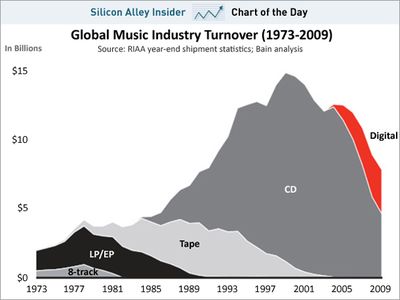
This chart's got a 'hook' – in this case, a simple and clean presentation that illustrates the rise and fall of the music business. And it has so many overtones: economic, musical, personal …
The story's simple: Vinyl got replaced by tape, then tape started falling off just as revenues from CDs picked up the slack and started skyrocketing. The business kept falling upward, making more and more money as it went. Until it didn't.
When Things Go Wrong … It Hurts Me Too
I had it … I had a deal lined up. I was going to make it.
In the late seventies rock and roll seemed to be booming. I had some songs and a five-piece band, and two managers were fighting over me. One was still struggling, on the way up. He'd take me out to breakfast once in a while according to then-standard manager/artist protocol: rented limo, Eggs Benedict and champagne, an offer of coke in the back seat on the way back. He'd managed to scrape up an offer from a second-rate record company that had a lot of hits once, but was struggling to be relevant again. The other manager couldn't care less about impressing me. But he had a superstar New Wave client and got me into a couple of major labels, both of which booked studio time for demos.
The first manager was a nice guy – not always a plus in a manager – and he had the hustle it might've taken to break an unknown act. But I dropped him and went with the guy who had the superstar in his stable. Everything was going great until I met the superstar at a party and mentioned his name. “I'm sorry I have to walk the same planet as that asshole,” she said. Uh-oh.


 The late economist Hyman Minsky wrote that after fortunes inflate on the back of a speculative bubble, and after investors’ irrational optimism and overvalued assets inevitably collapse, an economy enters a “period of revulsion,” when people remember that it’s risky to bet big on an uncertain future. Likewise, it’s always during the depths of a hangover that a drinker remembers how whiskey invites its own overconsumption and swears that the only way to avoid another descent into this purgatory is to never touch the stuff again. But after the fog leaves and with a clear head regained, he forgets the pain after the party and declares another Manhattan to be an eminently reasonable investment. Of course, the trick is to recall at just that moment how miserable you’ll be after another three. A pessimistic economist faces the same cyclical popularity as a tee-totaling friend; a consoling voice the morning after becomes a buzz killer as soon as night falls again.