By Tolu Ogunlesi
Nigeria's ongoing general elections have placed it in the news in recent weeks – a blend of hopeful and depressing news. Politics is a 'grand' theme, and generally partial to generalisations. Broad strokes are inevitable – Nigeria as a country divided into a “largely Muslim North and a largely Christian South”; Nigeria as a “rich country of poor people” and land ripped apart by “post-election violence.”
It occured to me to present a portrait of an ordinary Nigerian, one of the multitudes of people who have, in an unprecedented demonstration of optimism, been trooping out since the beginning of April to cast their votes in the hope that they will have a say in the shaping of their future.
This woman you're about to meet is not rich. She's a 'struggling' Nigerian (one of tens of millions), and a hardworking one. Most importantly, she is not a “victim” — i.e she will not inspire your pity — despite the seeming toughness of the kind of life she has to live. I met and interviewed her three years ago (April 2008). I have no idea what she's up to today, or if she still sells food at that spot. The only thing I can say for sure is that not much has changed in Nigeria's economic circumstances, between then and now.
The hope is that the politicians being elected at this time will seek to bring genuine transformation to the lives of people like Iya Seun, and make it easier for them to live comfortable lives in the country they call home.
***
Lagos is the Land where the Sun Never Sets on the Hungry Human Stomach. Every vacant spot in every business district cries out (successfully) for occupation by a woman – or band of women – armed with firewood, giant steel pots, and a talent for kidnapping the affections of human stomachs.
Iya Seun (“Seun's mother”) is one of them. She makes a living selling fried yam, fish and bean-cakes (akara) next to a wall at one end of Olosa Street, Victoria Island, Lagos. I imagine that the smoke from her “kitchen” mingles happily with that emerging from the luxurious kitchens of the nearby 5-star Eko Hotels – evidence perhaps of the classlessness that distinguishes smoke from the human existence.
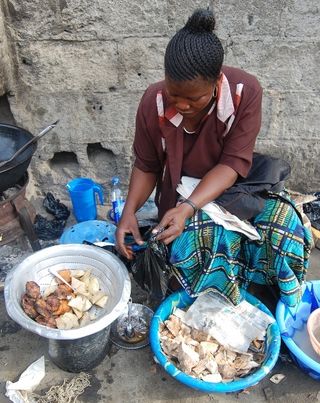
There are two questions on my mind as I speak with Iya Seun. I want to know why she doesn’t have a constructed stall (the standard makeshift affairs that dot the streets of Lagos, most commonly made from corrugated iron sheets, or wooden planks). And then I want to know why she operates a minimalist kitchen, offering “fast-food” instead of the more formidable local staples – Amala, Eba, Fufu – and even rice.
I soon discover that both questions have the same answer.
KAI.
“Kai!” is the Yoruba equivalent of “Don’t!” or “Stop it!” But in this instance it has far more forbidding implications. “KAI” is the abbreviation for the “Kick Against Indiscipline” Squad, the dreaded Lagos anti-vice squad known for harassing street traders and carting off their wares on a journey of no return.
Read more »