by Justin E. H. Smith
 I get some of my best writing done at Charles de Gaulle International Airport, where I now sit.
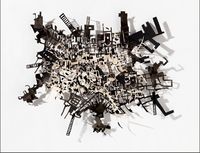
I could use my time here otherwise; I could learn the layout of the place, something that after countless visits remains entirely mysterious to me. I've made out at least a vague resemblance to some coiled viper that has, at intervals, swallowed several large rodents, causing it to bulge in spots and to narrow in others. The whole snake surrounds a mass of concrete curly-queues, traffic roundabouts at various elevations, each serving its own class of vehicle. Everything is concrete: concrete slabs of ceiling supported on concrete pillars, concrete ramps blocked off by concrete barriers. The ghost of General de Gaulle himself haunts this grey mess. It sings of French third-way-ism, flimsy viennoiseries at certain narrowings along the viper's vertebrae, sad succursales of the Hippopotamus chain at others; the shells of abandoned Minitel cabins: all the sagging, unsustainable sadness of a half-Soviet hybrid. It looks to be on the verge of collapse, and indeed great chunks of it have collapsed. Scrap metal litters the runways and has been known to trip up Concordes. The arrivals screens have been seen to report as retardé what they might more accurately have described as disparu.
I sit and stare at my computer screen and write because, in truth, this place terrifies me.
But I'm sitting here, obviously, because I've been going around France again, which means also going around exchanging bisous. This is problematic for me, as I am an American, and even among Americans am exceptionally awkward when it comes to physical contact. But over the years I've practiced, and have now reached the point where I am able to kiss strange cheeks with passable elegance.
But why all this kissing, anyway?
Something needs to be done to inaugurate social interaction. There must be some signalling of a transition from each doing his or her own thing, to each participating in a shared moment. The Japanese mark this transition by a subtle bow, Americans by a handshake (or sometimes a half-assed 'hug', a concept to which I'll return shortly); bonobos mark it by genital displays. But the merely visual presentation of the Japanese does not seem transformative enough, and in the bonobos' case it seems to misread the character of the impending interaction (or at least to read it in a way that human beings would rather not acknowledge too soon). The American handshake is indissociably linked to commercial interests, to deal-making and to vulgar Mammonism. One needs, as the Europeans have understood, to get the lips involved, to make a little suction noise that announces that two human bodies are in the same place doing the same thing, in order to set a properly human encounter in motion.
Some etymological considerations. The verb 'to kiss' in many languages is formed by onomatopoeia. In Sanskrit the verbal root is chumb– (giving us the lovely syllabic redoubling of the third-person singular perfect form: chuchumba, 'she kissed'). 'Kiss' and 'küssen' hear the sound differently than their Indo-European ancestor, but somehow no less accurately. When the verb is not onomatopoeic, it often emerges from a semantic cluster that is even more revealing than the natural sound of a kiss. Thus the Russian tselovat' is connected to tsel', which is to say 'target'. And isn't that what kiss-compressed lips in fact are? Isn't that what bodily orifices are?
Read more »








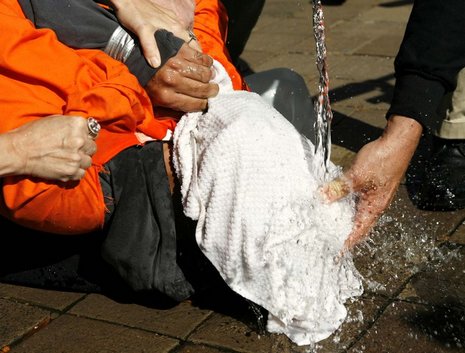 In the wake of Osama bin Laden’s killing on May 2, veterans of the Bush Administration have hit the airwaves in an effort to reserve for their policies a portion of the credit for the success of SEAL Team Six’s covert lethal mission in Abbottabad. Chief among the many Bush policies they credit with enabling President Obama’s team to kill bin Laden are those permitting the torture and “rendition” of foreign combatants. According to