by Michael Blim
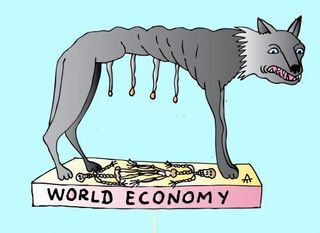
Different sets of players do their bits. Economists and the world financial elite keep trying to treat each crisis discreetly, finding a cause here, a remedy there, and hoping that the rest of the world economy will keep vamping as they fix each one. Financial market traders, selling on good news, and buying on bad, or the other way around if it suits them, put words to the numbers. “The markets are worried about Libya,” ‘the market is pricing in the impact of unemployment rates on overall demand,” and so on. The “market” in this turn of phrase is like an open-source mind transforming words into numbers, which of course makes one wonder how those chatty traders have mind enough to change the numbers back into words again. Finally, nightly news reports put the two tracks, words and numbers, back together, and each of us tries to understand what just happened, and with more preoccupation what might happen tomorrow.
Each of the estates in their way is trying to handle the aftershocks of the crisis that began in the fall of 2008. The economists and financial elite are trying to end them, or contain their damage. The market players are betting on scenarios that will make them money. And the news media are trying to write the story as others tell it to them.
Yet the estates have neither fixed “the problem,” nor assuaged the fear that the 2008 economic earthquake was the global North’s “big one,” and that the world as we know it has undergone a profound and fundamental change. The great tectonic plates upon which the world economy stands have shifted its center south and east to the “emerging economies.” And the collision between the emerging and developed economies, the cause of the quake, has left the latter so deeply damaged that the failure of successive rescue efforts threatens the short-term viability of the world economy itself.

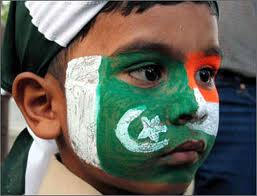
 I am going to make twin arguments: that the difference in everyday life, everyday oppressions and everyday successes is LESS than commonly stated (though a gap may finally be opening up), but at the same time, the asymmetry in their ideals and foundational myths is much greater than outsiders tend to see. Outsiders in general tend to see other nations as generic “nations”; they assume (usually unconsciously) that the default “national interests” are likely to be reflections of the same set of assumptions everywhere. My argument here is that this is frequently true and is true enough of India and Pakistan in many cases (e.g. in negotiations over river waters), but there are some unique elements in the Pakistan story that slowly but steadily push in a less desirable direction