by Misha Lepetic
“This is what a million people looks like”
~Blood Diamond
 The visual and journalistic rhetoric of refugee camps, as produced and consumed by the West, follows a well-known script. Following some armed conflict and/or natural catastrophe, tens of thousands star-crossed innocents cross into a foreign land with whatever they can carry, and into the waiting arms of whatever the (generally reluctant) host country has managed to jury-rig, along with the help of IRC or UNHCR or any of the other major players in the global humanitarian complex. Once the camps are established, they are quickly brought to capacity and then some, at which moment the journalists descend, documenting the misery, the helplessness and the usual hand-wringing on the part of all involved. We see how initial, optimistic talk of rapid repatriation by various officials eventually gives way to finger-pointing and panicky fund-raising as the temporary situation assumes increasingly permanent characteristics. Finally, unless or until famine or disease reinvigorate coverage of these sites, our awareness of these unhappy situations slips unnoticed into the collective memory hole.
However, there is another, far more compelling and humane way to view these camps, and that is as prototypical urban types. The various ways in which we define the urban, such as population density, non-agricultural economic activity, and reasonably well-defined boundaries, are conditions that are here amply met. And when one considers the ways in which people artificially conjure cities (consider a company town, built for the sole purpose of extracting a natural resource), then why shouldn’t we consider refugee camps to be cities? More importantly, if we do consent to think of them as cities, what is it that we can learn from them?
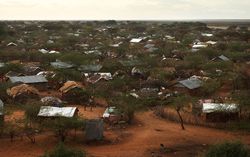
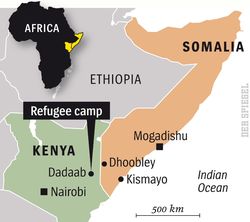
Consider, for example, the three refugee camps collectively known as Daadab, in northeastern Kenya. Founded in 1991 to take in Somali refugees from the then-new civil war, the camp is now the world’s largest, and is still growing after 22 years; the influx of new arrivals has been guaranteed not only by the still-unresolved civil war, but also by the added stress of two failed monsoons in the Horn of Africa. As a result,
Dadaab is now the third-largest city in Kenya, but there are no Kenyans living there. Instead, it is home to 450,000 Somalis in a camp that was built for 90,000 people. Refugees…are not permitted to leave the camp, because the Kenyan government wants them to remain refugees and not become illegal immigrants. The government also prohibits them from working.
 This illustrates the paradox of the refugee camp and why, at first blush, it may seem counterintuitive to think of this form as a fundamentally, if prototypically, urban one. For one, the restrictions on the freedom of mobility violates our contemporary conception of the city: as a place to which people migrate in order to seek economic opportunity (I should note that this is debunked below). The additional perception of refugees as victims dependent on the largesse of both host country and humanitarian organizations – which, of course, operate under their own incentives that are not necessarily aligned with the long-term desires of the refugees – further removes them from the perception as independent actors.
And yet, as the case of Dadaab reveals, we really do have a city on our hands. The logistics of housing and feeding nearly half a million people are formidable, and to facilitate an organized approach the camp is laid out in a grid, with every family assigned an address. Even though it may be motivated only by pragmatism, this is de facto urban planning.
Read more »