This post, which will be brief as my posts go, consists of three parts. The second is a letter that my friend and colleague, Charlie Keil, has sent to the Vatican where he hopes it will come to the attention of Pope Francis. He urges us to send the letter as well. Charlie tells me that the second part of the letter, in which he speaks for the creativity of children, is the heart of the appeal. The first part, urging a peace process, is necessary for the second to flourish.
I’ve placed some contextual information before and after Keil’s letter and, as you can see, I’ve larded the post with photographs of children.
The Roman Catholic Church is a Remarkable Institution
It must be one of the oldest corporate bodies in existence and, of course, it precedes the existence of the nation state, a corporate form that now dominates world affairs. Other religions are older than Christianity, Judaism of course, but also Hinduism and Buddhism and others. But none of them are organized in the way that the Roman Catholic Church is.
The Roman Catholic Church is organized as a hierarchy that extends from the top, the Papal See in the Vatican, throughout the world to individual parishes, with various levels of organization in between. Other forms of Christianity have a similar organization, but not all of them. Most religions aren’t like that at all. They operate at the local and perhaps regional level, but without world-wide coordination on matters of doctrine.
There is an obvious sense in which the Catholic Church is the foundation of Western Civilization. Before Far West Asia, so to speak, had come to think of itself as Europe, it thought of itself as Christendom. The European nations didn’t exist. What existed was a bunch of Germanic tribes, cities, medieval fiefdoms, and regional empires.
And the Catholic Church. It preserved the books of the ancient world. And its liturgical music, descended from the chants of Jewish ritual, created states of mind conducive to contemplation and thought. It is in that context that Europe began to form itself and become the West.
Maybe the Catholic Church can now help the world to move out beyond its dependence on the nation-state as the organizational backbone of world affairs. It was there before the nations arose. Perhaps it will remain when nations have become obsolete. The job now is more modest, to bring the nations to embrace peace.
Jerwood Gallery Hastings, East Sussex, TN34 3DW, until 12th April 2015
by Sue Hubbard
Chantal Joffe made her reputation as a painter with work inspired by pornography and fashion, based on images torn from magazines. She is friends with the fashion designer Stella McCartney, has painted Kate Moss and Lara Stone, collaborated with the fashion photographer, Miles Aldridge, painting his wife the model, Kristen McMenamy, in her Islington studio, while Aldridge filmed the process. She enjoys what clothes do to the body, the excuse they give her to paint zig-zags, polka dots and Matisse-like patterns. Her work, mostly of women, questions how images are constructed and presented, subtly challenging the objectification of the female form, wrenching it back from the traditional ‘male gaze'. Recently she's moved more towards painting friends and family – her daughter Esme, her niece Moll and her partner, the painter, Dan Coombs. The results are works of disquieting intimacy. It's no surprise to learn that she has long been a fan of the emotionally jagged photographs of Diana Arbus, whose studies she describes as having: “everything about the portrait of a human that you can ever want.”
Joffe was born in 1969 in St. Albans, a small town in Vermont, in the US. When she was 13 years old her family moved to England and she went to school in London. But it was not until her foundation course at Camberwell School of Art that she began to find herself by ‘discovering Soutine, and all that paint.' Now she has been invited to show at the Jerwood Gallery in Hastings, the beautiful seafront gallery with a view over the beach full of working boats. Beside the Seaside features a number of new and unseen works made especially for this show and reflects her long-standing links with Hastings where she frequently visits family who live in the town. She often draws on the beach, though photographs commonly provide a starting point. She's not interested in literal truth but rather in what goes on under the surface, the awkward emotions that are held in check and frequently remain unconscious, only to leak through the publicly presented face. Just outside the main gallery is her 2008 painting of Anne Sexton with Joy. An American confessional poet, writing in the 1950s, Sexton was attractive, ambitious, manic depressive and suicidal. Like Arbus she penetrated shallow and socially conventional facades to reveal a brew of anger and suicidal thoughts. Here she is shown with her daughter and we can see just how imbalanced that relationship is. Joy looks away as her glamorous mother clings to her, voracious and needy.
How could Joseph's brothers have plotted to kill him? Why would they, and why stop amidst a frenzy of murderous intent? Was fratricide common in biblical times? Surely the story of Cain and Abel, whether it is factual or not, appeared with some historical context in which jealousy led to unbounded anger, and before the perpetrator could regain his senses, the regrettable act was complete. Intentional killings—be they foolishly impassioned manslaughter, premeditated murder or political assignation—continue to occupy our fascination today. A few thousand years later, and we're not all that different. What can we learn from this ancient story?
Perhaps a reading of Genesis was meant, at least in part, to provide an opportunity to reflect on the power of envy before it was too late. What thinking person who read the Bible would choose to become Cain in his own personal narrative? Later in the Book of Genesis, Jacob's older sons manage to stop short of killing their brother, and while throwing him in a dry cistern and selling him off to slavery was nothing to write home about—indeed they did not tell their father what they had done—at least they spared Joseph's life.
My problem with the story was that the brothers' jealousy motive never really made sense to me. Ok, their father Jacob's thoughtless favoritism for a younger son not born of their mother would certainly breed some resentment, but even with the ‘coat of many colors,' and Joseph's self-aggrandizing dreams, the plot remained simply too thin to support a murderous rage… that is, until I understood a couple of key words in the Hebrew I was not able to understand in English translation. Once I saw what I had previously missed, there was no going back. The meaning of the sequence of events in the whole story fell into place.
“Meaning of Heb. Uncertain”
The footnote “Meaning of Heb. uncertain” appears dozens of times. In spite of all the learning, teaching and preaching rooted in the stories of the biblical narrative over the past few thousand years, we know that some of the meaning has been lost in translation along the way. How does one know when to be uncertain? Let's face it; in the Bible as in life, there may be much more uncertainty than we are comfortable admitting to ourselves. Ambiguity reigns in a world that is subject to multiple interpretation. Ancient Hebrew is so foreign to modern readers that there are simply many passages where the translation relies on interpretations, rather than on a verifiably definitive meaning of the text itself. There are many phrases where wordplay carries the deeper meaning of a passage, and the unfortunate reader of a translated text cannot even see the double entendre that may well be the literary jewel of a certain passage.
It should come as no surprise that we cannot easily render ancient Hebrew into modern English. It can also be difficult to render ancient Hebrew into modern Hebrew. It's not that the meaning of an occasional word is uncertain. The very fact that these words came to us via hand written text on parchment scrolls is enough to suggest that we might easily misunderstand some of the words and much of the context. We really ought to have a bit less hubris about our own abilities to grasp the meaning of the ancient past.
Translators are interpreters who make choices for less informed readers. Some of those choices render the text in ways that alter or limit the meaning of the original. This is even true when we look at contemporary texts translated from one widely used and easily understood language to another. How much more so, must this be the case when we read translations of ancient texts? From spelling and usage to grammar and syntax to style and circumstances, we have to accept that we can neither see nor hear the text in quite the same way it was seen and heard a few millennia ago, and the differences are not always clear.
Genesis 37; 1-2
Here is the King James Version (KJV) rendering of Genesis 37:1-2 “And Jacob dwelt in the land wherein his father was a stranger, in the land of Canaan. These are the generations of Jacob. Joseph, being seventeen years old, was feeding the flock with his brethren; and the lad was with the sons of Bilhah, and with the sons of Zilpah, his father's wives: and Joseph brought unto his father their evil report.”
Here is the Jewish Publication Society (JPS) version: “Now Jacob was settled in the land where his father had sojourned, the land of Canaan. This, then, is the line of Jacob: At seventeen years of age, Joseph tended the flocks with his brothers, as a helper to the sons of his father's wives Bilhah and Zilpah. And Joseph brought bad reports of them to their father.” In these and in many other Christian and Jewish translations, there are both subtle and significant differences.
I want to focus here on three key words. As I see it, they clarify the reasons for the intensity of the brothers enduring anger. They are: “na'ar,” “et” and “dibah.”
In the case of the word “na'ar,” both of the translations above and others completely miss a possible instance of double entendre. Simply by putting the accent on one syllable or the other, the word could either be the noun for ‘young person' or the verb for vocalizing an aggressive animal sound.* Take them together, given the possibility that the double meaning is intended, and we have young Joseph braying like a jackass or growling like a dog, barking orders at his older brothers, taking advantage of his privileged position in his father's eye's.
The preposition “et” could indicate that he is with his brothers, or that he is doing something to his brothers. It would be nice if Joseph was just a helpful lad, herding with his brothers, but it would be out of step with the rest of the story. Nothing else in the text supports that reading. It makes much more sense that he is he is 'herding his brothers,' as a simple reading of the Hebrew text suggests. He is treating them as they treat the animals, taunting and maybe even threatening them. He is lording over them, as his dream portends.
The report Joseph brings to Jacob is labeled “dibah,” which could mean ‘bad' (according to JPS) or ‘evil' (according to KJV.) If it is bad, is that because of the quality of the report or the way it was delivered? If it is evil, who is responsible for that? Is it a report on the evil brothers, or is Joseph the evil one, intentionally delivering a slanderous report? If the brothers found out that Joseph provided Jacob with an intentionally false report to increase his own standing in their father's eyes, this clearly strengthens the case for their resentment boiling into a rage.
Here is an alternate translation of the second verse of Genesis 37:
Joseph at seventeen years
was herding his brothers
with the flock
And he brays
at the sons of Bilha and Zilpah, his father's wives
and Joseph comes with an slanderous report to their father
יוסף בן-שבע-עשרה שנה
היה רעה את-אחיו
בצאן
והוא נער
את-בני בלהה ואת-בני זלפה נשי אביו
ויבא יוסף את-דבתם רעה אל-אביהם
Fallen Hero Rising
Jacob does not see through Joseph's act until his favorite son dreams that his parents will bow down to him. At this notion Jacob becomes livid, finally castigating Joseph. It is no coincidence that in the next passage of the story Jacob sends Joseph into the hands of his brothers. It is a set up, and Jacob is the one who put it in motion. As the opening of chapter 37 indicates in a slightly ambiguous way, 'these are Jacob's issues,' implying perhaps both the progeny and the problems with which they must all contend.^
It is worth remembering that Jacob didn't ‘start the fire.' He inherited his contentious family relationships. His parents, Isaac and Rebecca, taught him to set up his brother. Later his uncle Laban set him up, tricking him into marrying Leah before Rachel, and making him work for fourteen years as an indentured servant. Jacob later returns the favor, tricking Laban into losing much of his flock. Tricking and trapping each other seems to be the robust and irresistible inclination of this family. It is what they do, over and over again.
All of the archetypal characters in the Book of Genesis follow this arc of rising to become the hero of the narrative for a time, until they fall to the depths of disgraceful behavior. But Joseph is a new type of hero, with the opposite trajectory. He is the first and only character in the Genesis narrative to get off to a despicable beginning and then rise above himself without falling from greatness. After Joseph is thrown to the depths of the pit where he is almost left to die, the story continues and of our fallen hero begins to rise. The rest is history, or perhaps not, but that is a subject for a different day.
* Think of an English word such as ‘kid.' Figuring our whether it means a young human or a young goat, or the verb to tease in a playful way, is all a matter of context. Another example would be ‘ram' or ‘buck' which could be an animal or an aggressive action. In the case of ‘buck' the word can also be a proper name or slang for a dollar. A young buck might ram a kid, and you might have to read that passage more than a few times to figure out who is who and what is going on.
^ “These are Jacob's issues,” The Hebrew word “toldot” is a plural that refers to things that have been born of other things, in either a literal or a figurative manner. 'Toldot' is alternately rendered in English as generations, lineage, history, events, etc.
Barbarian that I am, my knowledge of the classic Latin poetry, excepting Ovid’s exilic Epistulae, and what bits of the Metamorphoses an English major might meet in footnotes to the Fairie Queene and Paradise Lost, amounts to no more than names on a timeline. Poets in a Landscape is the remedial introduction I needed. Scottish classicist Gilbert Highet (1906 – 1978) was one of the great critic/teacher/explainers on the Columbia faculty, alongside Lionel Trilling, Jacques Barzun, and Mark Van Doren.
Highet starts with biographical criticism of an admirable suavity. Cyril Connolly, another devotee of sensuously contemplative Latinity, said that with each poet Highet succeeded “in finding the man in the style.” Next, Highet invokes the consequent canon. He shows Goethe and Byron, Browning and Baudelaire, Eliot and Pound as they summon, echo or emulate the poets of the early empire. And as its title suggests, Poets in a Landscape is also a travelogue. In 1956 Highet and his wife, the spy thriller writer Helen MacInnes, made a tour of the conjectural birthplaces, spurious tombs and excavated villas of the Roman poets.
This piece is part of an on-going series of blogposts from the frontlines of Startup Tunnel, a new incubator based in New Delhi. You might also want to check out dispatches one, two, three and four.
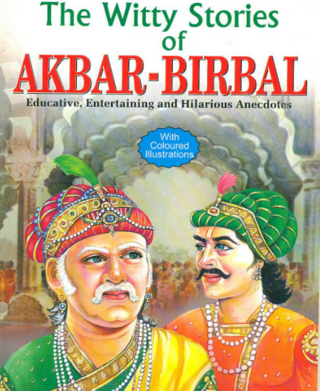
Having commissioned a new suit of armor, the emperor Akbar was now in the process of inspecting it. Installed upon a stone mannequin in the armory workshop, black bell metal and brass accents gleamed back upon the badshah and his vazir Birbal. Fresh from recent campaigns, the emperor now said he wanted to be sure of the quality of protection it offered. And so he called for a lance, with which he reared back and then charged upon the mannequin. He was able, after a few tries, to pierce all the small slits of the helmet. He asked for a sword and tore apart the subtle slits between the body armor and the helmet. He asked for a mace and went at the now headless mannequin and cracked the chain metal links all around its torso. Even now that it had fallen upon the floor of the workshop, Akbar was still working out his PTSD on that prone suit of armor and the lifeless dummy within. When he was done, he looked up and declared it to be a lousy suit, practically the same as wearing nothing at all.
Perhaps you already know the end of this parable? Perhaps you have heard some other version of it? I'm not sure when I first encountered it, either at the back of an Amar Chitra Katha or else perhaps among a collection of stories from Iran. Either way, it has stuck in the mind, long awaiting the unraveling. There is something so shocking about seeing a new suit of armor being destroyed like that, something like a medieval crash test. One knows not what to make of what is going on, nor even how to respond to Akbar's judgement. Is a suit of armor really useless if it cannot survive many minutes of the untamed rage of a battle hardened king?
The badshah is about turn his fury onto his smith, when Birbal suggests that they give him a sharp warning and a week to build another prototype. The next week, when Akbar returns to the workshop to inspect the new piece he finds Birbal already there, wearing the emperor's battle armor and spoiling for sport. It is new and improved, he says, have at me and I'll show you. Akbar is eventually goaded into picking up a lance. He makes straight for Birbal, who steps lithely aside, pulls the lance forward, tripping Akbar forward and landing him on all four. Now that someone's wearing it, he grins, it's begun working pretty well.
On the face of it, this would seem to be a parable about how an artifact changes with use — an early instance of user-centered thinking about human artifacts. But there's something a bit tricky about how a suit of armor is best used and what its function really is. Birbal's response is cryptic, and it forces you to think about the whole the point of battle armor: it must not only resist onslaught, but allow its wearer to move about and conduct battle. This little fable sticks in the mind is because of the way it shifts between offence and defence, between object and agent. That little shift of the mind, between a closed and essentially reactive reference frame and a horizon of open possibilities is sudden and complete. It cannot arise gradually and it has no continuity with that earlier way of thinking.
You will remember, reader, that I've signed up to share a more prosaic kind of story, about the setting up of a new kind of business in a more prosaic time in a global city whose air is already thick with pollution and corruption and crony capitalism.
In his Contra Academicos, Augustine discusses a fragment of Cicero's Academica in which Cicero advances a unique argument for skepticism. Cicero's argument is unique in that it derives, ironically, from a positive epistemic assessment of human judgments. Skeptical arguments usually proceed from negative assessments of human cognition according to which humans cannot tell the true from the false, cannot articulate their reasons, are prone to unreflective dogmatizing, and so on. Those negative assessments are then taken to yield the skeptical outlook. Cicero's argument for skepticism, by contrast, derives from a positive assessment of a subset of human judgments. Let us call it the Red Ribbon Argument (or the Argument from Second Place):
The second prize is given to the Academic (skeptical) wise person by all the self-declared sages from the other schools, since they must obviously claim the first prize for themselves. A persuasive conclusion one can draw from this is that he is right to take the first place in his own judgment given that he has the second place in the judgment of all the others.
Cicero starts from a regular observation about dogmatism: those committed to a view become not only invested in their view, but also less capable of critically reflecting on it. We often form our own theoretical, political, and religious alliances well before we have thoroughly surveyed and critically compared all of the plausible options. That is, we make our allegiances first and critically examine later. As Cicero notes elsewhere in the Academica:
All other people . . . are held in close bondage placed upon them before they were able to judge what doctrine was best, . . . they form judgments about matters as to which they know nothing at the most incompetent time in life, either under the guidance of some friend or the from the first harangue from the first lecture they attend, and cling as to a rock to whatever theory are carried to by stress or weather.
Hence we might say that we are serially confirmationally biased. As we are committed to our beliefs, and loyal to our doctrines, we tend to seek evidence that supports them. And yet we formed these allegiances with almost no judgment at all! And so, Cicero observes, we will of course assign our own view first place when asked to rank all of the views. But this method of ranking obviously is not reliable. And the widespread conflict between votes for first place is testament to it.
So our votes for first place are unreliable. And when we compare the competing views to our own, we likely will succumb to similar distortions; the competing views will be rejected simply on the grounds that they are incompatible with our own view. So our ranking of the competing doctrines against our own are epistemically polluted as well. However, our assessments of the merits of the competing views relative to each other tend not to involve such distortions. Thus Cicero predicts that when enthusiasts of a particular view are asked what the second best view is, they will judge more clearly and less prejudicially. The interesting thought is that the skepticism has massive support as the second best view. According to almost all perspectives, skepticism is the best of the incorrect views.
through the new white sheet of this day’s blank uncertainty it shows as lines of shadow
the absoluteness of the leaf before is now unclear
and as I look ahead and let those pages slip beneath my thumb not only are those leaves all deaf and dumb they turn to mist and fade and fail and disappear
Everyone learns about Pascal's Triangle when they are young. But I, at least, didn't learn all the wonders contained in the Triangle. Indeed, we're still discovering new things!
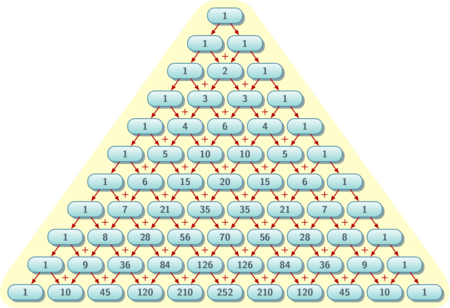
To construct the Triangle is easy enough: you start with 1's down the outside edges and each interior number is gotten by adding together the two numbers just above it. So the third number on the sixth line is a 10 because that's the sum of 4 and 6.
Warning! Actually we will say that 10 is the second number in the fifth line. For reasons which will soon become clear, we will choose to start with zero when we count rows and columns of the Triangle. For example, the second number of the fourth line is a 6.
With the addition rule in hand it's off to the races: the Triangle goes on forever and you can calculate as many rows as your patience allows.
The first 10 rows of the Triangle [1].
Pascal introduced the Triangle in 1653 in Traité du triangle arithmétique as part of his investigation into probability and counting problems. Questions like “If I want to choose two people out of a group of four, how many possible pairs are there?” or “What's the probability of drawing a full house when dealt five cards from a well mixed deck of cards?”. Indeed, Pascal and Fermat essentially invented probability in a series of letters they exchanged around this time. You can see the Pascal's original triangle here.
What does the Triangle have to do with probability? Well, if you want to choose k objects out of a group of n possibilities, then the number of possible choices is precisely the kith number on the nth row of the triangle. Remember, for positions in the Triangle we always count starting from zero! Using this rule we see that there are exactly 6 ways to choose two people out of a group of four. And since 84 is the third number in the ninth row of the triangle, it must be that there are 84 ways to choose three people out of a group of nine. Once you can compute these numbers it's a short step to computing all sorts of probabilities.
Research institutions in the life sciences engage in two types of regular scientific meet-ups: scientific seminars and lab meetings. The structure of scientific seminars is fairly standard. Speakers give Powerpoint presentations (typically 45 to 55 minutes long) which provide the necessary scientific background, summarize their group's recent published scientific work and then (hopefully) present newer, unpublished data. Lab meetings are a rather different affair. The purpose of a lab meeting is to share the scientific work-in-progress with one's peers within a research group and also to update the laboratory heads. Lab meetings are usually less formal than seminars, and all members of a research group are encouraged to critique the presented scientific data and work-in-progress. There is no need to provide much background information because the audience of peers is already well-acquainted with the subject and it is not uncommon to show raw, unprocessed data and images in order to solicit constructive criticism and guidance from lab members and mentors on how to interpret the data. This enables peer review in real-time, so that, hopefully, major errors and flaws can be averted and newer ideas incorporated into the ongoing experiments.
During the past two decades that I have actively participated in biological, psychological and medical research, I have observed very different styles of lab meetings. Some involve brief 5-10 minute updates from each group member; others develop a rotation system in which one lab member has to present the progress of their ongoing work in a seminar-like, polished format with publication-quality images. Some labs have two hour meetings twice a week, other labs meet only every two weeks for an hour. Some groups bring snacks or coffee to lab meetings, others spend a lot of time discussing logistics such as obtaining and sharing biological reagents or establishing timelines for submitting manuscripts and grants. During the first decade of my work as a researcher, I was a trainee and followed the format of whatever group I belonged to. During the past decade, I have been heading my own research group and it has become my responsibility to structure our lab meetings. I do not know which format works best, so I approach lab meetings like our experiments. Developing a good lab meeting structure is a work-in-progress which requires continuous exploration and testing of new approaches. During the current academic year, I decided to try out a new twist: incorporating literature and philosophy into the weekly lab meetings.
Herb Alpert and the Tijuana Brass 1965 My first intimation that food and romance were related
The connection between food and romance has become a cliché, especially around Valentine's Day when even the most desultory couple manages to build a castle with a box of chocolate. But the connection is in fact more profound than a once-a-year phantasm. In fact the connection is deeply rooted in history and seems virtually universal.
Perhaps the most vivid demonstration of a direct link between food and romantic emotion is Laura Esquivel's novel (and subsequent film), Like Water for Chocolate. In this magical realist tale of a turn-of-the-20th-century Mexican family, Tita, the youngest daughter, communicates her emotions to her family through the food she makes for them. As she prepares the food, passion, longing, anger or frustration are transmitted via the food to the people who eat the dish, who then experience similar emotions. When Tita falls in love with Pedro, the Quail in Rose Petal Sauce she serves at a family celebration induces lustful feelings in her sister Gertrudis, who abruptly leaves the ranch while making love to a soldier on the back of a horse. When Tita's older sister, Rosaura, marries Pedro instead, Tita sorrowfully prepares a wedding cake, which throws her guests into paroxysms of longing and melancholy before they become violently ill.
Of course, this novel is pure fantasy, but the idea that food directly stirs our emotions has a long history. The Ancient Greeks, Egyptians, and Romans all entertained folk wisdom that various foods could induce sexual arousal, and the medical science and philosophy of the day was used to support such beliefs. We get the word “aphrodisiac” from Aphrodite, the Greek goddess of romantic love. According to the myth, Aphrodite was born from the sea and came to shore on a scallop shell accompanied by Eros, thus giving birth to the idea that shellfish can arouse sexual desire in lovers. Aphrodite also thought sparrows were particularly lustful and thus Europeans for many centuries considered sparrows to be aphrodisiacs—demonstrating that it doesn't take much to persuade people when the promise of sex is involved.
Sunlight slices through the window, hitting her where she sleeps. Neighborhood kids, already going hard, squeal and play happily somewhere in the distance.
I've been sitting on a cedar chest at the foot of her bed, waiting. I know better than to nudge MK to consciousness; she has a nasty right hook and isn't afraid to use it. It's the one thing her ex-husband, Frankie, a boxer turned philanthropist made sure to teach her before he left with a younger woman. Hit hard and fast. Keep the thumb outside so you don't break it. She remembered that when she slugged him on his way out the door, suitcase in hand.
The lump shifts under the heavy quilt, silver hair peeking out from the top. “Get me some water, will you love?” She doesn't look at me exactly, just gestures in my general direction.
And so our visit begins. Requests for water. For aspirin. For a foot rub. Anything to take the throttle and pain away. I can almost hear her brains sloshing against the side of her skull, eyeballs threatening to eject themselves out of socket. Fog filling the room.
Mary Kelly is no stranger to the Hangover of the Gods.
She lives most days in this fog, not, however, restricted to just her bedroom but to most areas of her life. A heavy, dense fog that moves in and around people until they eventually disappear altogether.
Rumor has it she came out of the womb thirsty.
Not for the sweet, dewy breast milk most babies cried for, that poured freely from the aching breasts of their mothers. Not for the powdery formula that dissolved quickly and easily into water. Milk – natural, manufactured, fresh from the body or out of a canister – did not interest her. MK (as her friends would come to call her) wanted something harder.
This unquenchable thirst sent her into the throes of what would be named, for convenience, or to spare her well-meaning but severely in-the-weeds mother from certain judgments, Gas. Her face all red and scrunched. Arms and legs flailing about like some demonic force had overtaken them. Gas, the doctors would confer proudly and leave the room.
Her mother wept and paced the kitchen and prayed to all the Saints she could remember by name. Help this child. She knew how to cook and sew and even talk about boys but this. She did not know what to do with this.
The local barmaids would insist that a little Guinness should do the trick. “Needs some iron pumping through the veins. Babe's damn near shriveled up.”
Beer into bottle. Bottle to mouth. MK drank. And drank. She drank with a fierceness that frightened her mother and dazzled the other, more seasoned drinkers in the room. “For the love of God, would you look at that!”
Two pints later and mother and child, huddled together on a barstool, breathed in the sudden peacefulness that had, until then, been eluding them both.
At a Christmas gathering at a cousin's house in Maryland I mentioned to my five-year-old nephew that I don't own a television. I was sitting on a couch with him paging through a book about whales and dolphins for the sixth or seventh time. The men in the family were playing gin rummy around the coffee table; the other children were playing video games on their parents' cell phones, and the women were in the open kitchen off to the side making a succession of meals. At that moment and the whole weekend long the flat screen TV that hung above the fireplace was lit and muted. Images of CNN commentators discussing the murder of two NYPD officers, Red Wing hockey and young men singing love songs in music videos formed the backdrop of the holiday. “What's that?” my nephew asked. I looked down at the creature on the page and said, “Some kind of dolphin, I'm not exactly sure.” But I had misunderstood the question. He spoke again: “What's television?”
*
*
“Look at this. This looks like a city. Like a little model of a city. And all the houses, which are here. And streets. This is maybe an elevator to go up, up there. And here are all the wires. These wires, they really take care of all the electrons when they come through there. They take care that they are powerful enough to get all the way through to here.” This is how the musician Björk, describes the circuit board and wires of a television in an old video. She has opened the back of the television, she says, because it's Christmas time and she's been watching lots of television and is curious about how it works to cast its spell on her. She sits at a kitchen table affectionately close to “the beautiful television” and says she wants to understand “how it can put me in all sorts of situations.”
In her quest to understand how television works Björk posits a tongue-in-cheek cultural battle between her native Iceland and its former colonizer, Denmark, framed as a battle between poetry and science. She describes how an Icelandic poet explained to her that television was different from film: “This is millions and millions of little screens that send light, some sort of electric light, I'm not really sure. But because there are so many of them, in fact you are watching very many frames when you are watching TV. Your head is very busy all the time to calculate and put it all together into one picture. And then because you're so busy doing that, you don't watch very carefully what the program you are watching is really about. So you become hypnotized. So all that's on TV, it just goes directly into your brain and you stop judging if it's right or not. You just swallow and swallow.” Björk says that the Icelandic poet's explanation caused her to become so frightened of television that she began to get headaches while watching it.
The cure for poet-induced headaches, she suggests, trying to remain deadpan, is science: “Later on, when I got my Danish book on television, I stopped being afraid because I read the truth, and that's the scientifical truth, which is much better.”
She concludes,”You shouldn't let poets lie to you.”
This is the fourth in a series of brief pieces written from the deep and dark of Startup Tunnel, a new incubator based in New Delhi. You might also want to read dispatches one, two, and three.
We’re fully in the fog of it now. It’s not only the startups that are stumbling and searching and feeling their way forward. The tunnel metaphor would seem to apply to me and the rest of my team as well. Where once we felt clarity and purpose, we’re now lost in detail. Every startup is different, at a different point along the path, and with such different needs. We’re scrambling to serve them all in ways that do them justice.
The initial shock of arrival and feedback taking is over for startup teams. They now have real work to do in building out their product or in making it better. This is a multivariate problem solving process that can overwhelm founders if they don’t have the tools to organize and isolate the challenges they face. It’s with a view to supporting and enhancing their ability to conceptualize, articulate and prototype their product that we led them through two exercises: First a ‘product tour’ and then a ‘customer journey map.’
Is there a method to the madness of Islamist extremism? Yes, if a voluminous literature produced by militants in Arabic and other languages is to be believed. One example of the genre is the militant manual, the Management of Savagery, a text highly influential among Islamist radicals, and translated from Arabic into English by the combating terrorism center at West Point. It is a curious amalgamation of geopolitical analysis, religious propaganda, social psychology, and military tactics. The work has some literary pretensions but it is of uneven quality and gives the impression of being pasted together from disparate sources.
Yet it also outlines a clear, coherent worldview, a theory of geopolitical change, and, when it is not recycling superficial clichés about Western decadence, offers penetrating insight into how terrorist tactics can succeed, even when they appear to fail. It is a call to action that outlines a series of concrete, often diabolically clever steps that have been followed by a wide range of militant groups. There is a striking parallel between the prescriptions in the text and the actions of ISIS, the militant group that now controls a vast chunk of territory in the Arab heartland.
The fall of the Ottoman Caliphate, and the partition of the Middle East by European powers has long been a preoccupation of radicals in their diagnosis of the ills plaguing Arab societies. The text takes the same stance, rejecting not just the current governments that prevail in the Middle East, but the global order as a whole. It sees a world in which major powers in the center – the United States, above all – ally with tyrannies in the periphery, imposing through them a foreign, 'apostate' order in Muslim majority societies.
This historical moment is not unprecedented, it is argued. After the breakdown of political order such as that occurred in the early 20th century there is always a period of transition before a new settled order comes into being. Such a transitional state prevails in the Muslim world today. Militant groups should therefore seek to 'vex' and 'exhaust' the enemy- the regimes ruling their societies, or their Western allies. This will catalyze the breakout of chaos – the weakening of political authority across the land, creating opportunities for militants to 'manage the savagery' successfully, so that the ultimate goal, an Islamic state, may be realized.
I'm on a big boat (which the nautically savvy call ship)
if this ship's a cocoon of light atmosphere its steel will float, but it will tip if its load’s unbalanced— if its equilibrium is off it will start to list, if not corrected it will end a sacrificial goat sucked to bottom as Neptune's universal laws will have directed
New Year's Eve, 2014. Time to ring in the New Year, to reminisce about good times, and remember old friends that have left our lives. No, I'm not referring to relatives who have passed, or ex's that have moved on, I'm talking about … cars.
Now, I'm not a car person like my husband, who has cars like Imelda Marcos has shoes, one for every season, in both of our houses. I like to drive only one car at a time; I grow attached to my car, give it a name, and when necessity demands “out with the old, in with the new,” I shed a silent tear on losing a good friend.
I've not yet taken a picture of a favorite car, though at times I wish I had, unlike my husband, Rick, who has photographed every car he has ever owned, and some he has rented. Rick's first car was a 1957 DeSoto HemiHead V8, shown here.
The next picture shows him as a young assistant professor in 1968, with his powder-blue, 1965 MGB convertible.
He has even photographed some cars that he has rented, such as the memorable black, 100 series BMW hatchback that we drove on the Autobahn in Germany, as you can see in the picture. We even drove this delightful car through the “autos verboten” square near the 500-year-old cathedral in Strasbourg on market day–quite by accident–after bad advice from our GPS.
I searched my photo archives to see if I could find pictures of my own favorite drives, but they exist only incidentally, at the periphery of a family photo, or near a landmark on a vacation trip. I don't need a picture, though, because I remember them all well, every car I ever called my own. I rarely remember the model and the year, but I remember its make and color, “like a girl,” Rick would say.
Flogging newspapers with hate drawn up as free speech is a cheap self serving marketing trick. Nothing new there. Hate sells war. It sells weapons. It sells newspapers. Hate sells.
Floggings and cartoons to caricature Muslims as the newest kid on the block to hate, well that's relatively new in the scheme of history and things. And who does that? The House Saud for one, which has condemned a citizen blogger to a thousand lashes in 20 batches of 50 lashes each for his speech. Public floggings, though this one has been postponed, are routine in the Kingdom of the House Saud. The House Hebdo flogs Muslims too. Both flog and lash Muslims. And neither of them protests or caricatures war. A funny thing happened while the wars were being waged in these last fourteen years—Mecca was transformed into a strip Mall by the House of Saud. Charlie Hebdo and the House of Saud have another thing in common they couldn't give two hoots about the Prophet. They both sneer at him. And both probably consider their own versions of caricatures in the name of the Prophet their most sustainable profit making enterprise.
And both are supported by the so called leaders of freedom of speech. Witness how free speech and freedom were caricatured when those great defenders of human rights and freedom of speech, the Saudi foreign minister, Netanyahu and the President of Gabon formed the frontline at the march in Paris on January 11, 2015. Witness the eulogizing of the chief financier of extremism this week in Riyadh by all these leaders of freedom of speech–sellers of weapons, guzzlers of oil.
But lashes, words and caricatures can be survived. You cannot survive bombs and bullets. The House Saud and stunts like the House Hebdo sell hate and ensure that bombs and bullets will continue to be produced and used without question. France is the largest seller of weapons to Saudi Arabia, followed by the UK and Germany and Sweden and the US. Germany has announced its decision yesterday to stop selling weapons to Saudi Arabia. The majority of the Germans want Germany to stop all trade with Saudi Arabia. That is a good step.