by Monica Westin
The Way of the Shovel, an ambitious group show focused on artistic production as a mode of “history, archaeology, and archival research” opened at the Museum of Contemporary Art in Chicago last month. Much of the work in the show takes the form of documentary photographs and films that attempt to create alternative historical narratives, filling out our everyday understandings of the world and its pasts. In my interview with him last month, curator Dieter Roelstraete noted that the show, based on his previous e-flux essay of the same name, grew out of his observation that
“in the last ten to fifteen years the rhetoric of art has been rephrased in broad terms using the language of research…I really appreciate the ambition of artists to think of themselves as not just working with forms and ornaments, but also with information…. But while I'm interested in the critical charge of art's claim to be some kind of research, the whole discussion of artistic research is a huge one that is also based in the academization of art in recent years. There's increasing pressure on students to present what they do as some kind of intellectual enterprise, which has its own advantages and disadvantages.”
Roelstraete's salient point is that artists are encouraged to frame their work as research at a time when discourses surrounding art are increasingly influenced by science and other academic disciplines. But what practices should “count” as research, and which are just part of the process of art-making?
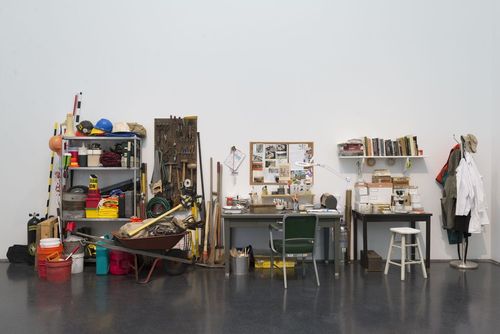
Mark Dion, Concerning the Dig, 2013. Courtesy of the artist and Tanya Bonakdar Gallery, New York. Installation view, The Way of the Shovel: Art as Archaeology, MCA Chicago November 9, 2013 – March 9, 2014.
In the western tradition, we have historically understood artists' contributions to social consciousness as generally either representing/preserving images of the world as it is, or imagining ways it might be otherwise. For the ancient Greeks, art was exclusively concerned with mimesis, or the direct copying of nature, and ancient art criticism judged successful art as that which depicted its subject with the most realism. It wasn't until the second century AD that the sophist Philostratus first argued, in his biography of the mystic Apollonius, that phantasia, or creative imagination, was a more important quality in the artist than mimesis. (And it arguably took centuries after that before western artists themselves began to make this argument for their work and to break from imitation in their practices.) The western history of art can often largely be read as a tension between changing technologies of mimetic representative realism (increasing understanding of perspective in the Renaissance, the invention of the photograph) and intellectual movements towards new modes of phantasia or reaching for that which is beyond the skills of technological reproduction (Mannerism as a reaction to the Renaissance, Impressionism as a reaction to photography).