“And if you can't bear the thought of messing up
your nice, clean soul, you'd better give up the
whole idea of life, and become a saint.”
~ John Osborne, “Look Back in Anger”
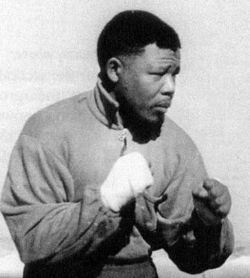
The perpetuation of the saccharine narrative is enabled by, among other things, the cherry-picking of Mandela's own words. One endlessly quoted passage has been the end of Mandela's opening statement at the start of his trial on charges of sabotage, at the Supreme Court of South Africa, on April 20th, 1964:
During my lifetime I have dedicated myself to this struggle of the African people. I have fought against white domination, and I have fought against black domination. I have cherished the ideal of a democratic and free society in which all persons live together in harmony and with equal opportunities. It is an ideal which I hope to live for and to achieve. But if needs be, it is an ideal for which I am prepared to die.
This is stirring stuff, and worthy of being engraved into the marble of a monument, but only if you bother to read the preceding 10,000 words. In a far-reaching statement notable for its pellucidity, Mandela lays out the circumstances and philosophy that resulted in armed struggle against the regime.
I have already mentioned that I was one of the persons who helped to form Umkhonto [we Sizwe, the armed wing of the ANC]. I, and the others who started the organisation, did so for two reasons. Firstly, we believed that as a result of Government policy, violence by the African people had become inevitable, and that unless responsible leadership was given to canalise and control the feelings of our people, there would be outbreaks of terrorism which would produce an intensity of bitterness and hostility between the various races of this country which is not produced even by war. Secondly, we felt that without violence there would be no way open to the African people to succeed in their struggle against the principle of white supremacy. All lawful modes of expressing opposition to this principle had been closed by legislation, and we were placed in a position in which we had either to accept a permanent state of inferiority, or to defy the government. We chose to defy the law. We first broke the law in a way which avoided any recourse to violence; when this form was legislated against, and then the government resorted to a show of force to crush opposition to its policies, only then did we decide to answer violence with violence.
Without this context, Mandela's lofty concluding paragraph is as cheap as a Hallmark card. It's now clear to the reader exactly the lengths to which Mandela would be willing to go to die for his beliefs – not as a lamb to slaughter, but as a fiery revolutionary. It is difficult to conceive of Gandhi initiating such actions. But why was Mandela prepared at that point to resort to violence?