by Grace Boey
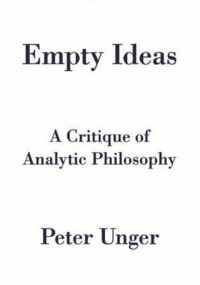
Unger has written extensively over the course of his career on various philosophical topics, and his best-known writings include Ignorance: A Case for Scepticism (1975) and Living High and Letting Die: Our Illusion of Innocence (1995). As a no-holds-barred critique of mainstream analytic philosophy, Empty Ideas is a continuation of Unger's signature provocative style.
As a former student of his, I spoke to Unger in late May about Empty Ideas, his thoughts on the value of philosophy, Wittgenstein, Bertrand Russell, David Lewis, and the difference between philosophy, crystal healing and self-help (the answer: nothing that important).
Philosophers easily get the idea that somehow or other, just by considering things about the world that they already know, they can write up deep stories which are true, or pretty nearly true, about how it is with the world. By that I especially mean the world of things that includes themselves, and everything that’s spatio-temporally related to them, or anything that has a causal effect on anything else, and so on. They think they can tell a deep story about how it is that all of this stuff really hangs together, that’s much deeper, more enlightening and more comprehensive than anything that any scientist can do.
And so philosophers proceed to write up these stories, and they’re under the impression that they’re saying something new and interesting about how it is about the world, when in fact this is all an illusion. To say new and interesting things about the world — and that’s very hard, things of any generality I mean, or even anything interesting — you really have to engage with a lot of science. And very few philosophers do any of that, at least in any relevant way.