by Yohan J. John
I.
Before the scientific age, boundaries between disciplines were not that sharply defined. Many cultures around the world saw art, music, mathematics and theology as reflections of each other. Perhaps the most poetic expression of this idea was the Pythagorean notion of the musica universalis: the harmony of the spheres. According to this conception, there was a deep link between music and celestial motion: the sun, the moon and the planets danced around the Earth to the tune of an inaudible symphony. The heavenly bodies that could be seen with the naked eye were divided into two categories. There were the fixed stars, which were attached to a spherical cosmic canopy that whirled around the Earth, and the wanderers, the sun, the moon and the visible planets, which changed their position with respect to the fixed stars. Each of these wanderers was assigned its own sphere, so the cosmos was a kind of spherical onion, each layer inhabited by a celestial body that contributed its own note to the universal symphony. The tenor for life on Earth was guided by these cosmic vibrations.
Nowadays it seems this conception of the cosmos is only of interest to hippies, mystics and other fringe folk. Compared to the dizzying scale of modern cosmology, the spherical cosmos seems insular, childish, and unacceptably human-centric. The solar system is now viewed with the sun at the center, and the cosmos is recognized as having no center at all. Or rather, the center of the cosmos is everywhere.
Without in any way questioning the importance, power or beauty of the modern scientific worldview, I think it is possible to dust off the discarded image and learn something from it. Not necessarily something about the true nature of the cosmos, but about how we impose notions of beauty and perfection upon reality, and how reality often overturns these notions, leading us to wider and deeper understanding.
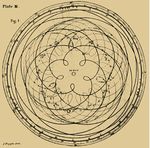
Before we get to the idea of perfection, we can pause in order to just look at the geocentric model. Let's just focus on the example of Venus. How many educated people know what the orbit of Venus looks like from an Earth-centric perspective? There is a popular narrative in science that claims that the geocentric model is just plain wrong, and that it is the Earth that moves, not the sun. But if, as Galileo and Einstein established, all motion must be relative to some frame of reference, then you can pick any position as a stable center and see what the motion looks like from there. Now that the heliocentric model has pride of place, we can look back at the geocentric model purely out of curiosity, and see if there is anything of interest to be found.