by Madhu Kaza


by Madhu Kaza
by Brooks Riley
by Omar Ali
A few days ago, Graeme Wood wrote a piece in the Atlantic that has generated a lot of buzz (and controversy). In this article he noted that:
“The reality is that the Islamic State is Islamic. Very Islamic. Yes, it has attracted psychopaths and adventure seekers, drawn largely from the disaffected populations of the Middle East and Europe. But the religion preached by its most ardent followers derives from coherent and even learned interpretations of Islam”
The article is well worth reading and it certainly does not label all Muslims as closet (or open) ISIS supporters, but it does emphasize that many of the actions of ISIS have support in classical Islamic texts (and not just in fringe Kharijite opinion). This has led to accusations of Islamophobia and critics have been quick to respond. A widely cited response in “Think Progress” quotes Graeme Wood's own primary source (Princeton scholar Bernard Hakykel) as saying:
“I think that ISIS is a product of very contingent, contextual, historical factors. There is nothing predetermined in Islam that would lead to ISIS.”
Indeed. Who could possibly disagree with that? I dont think Graeme Wood disagrees. In fact, he explicitly says he does not. But that statement is a beginning, not a conclusion. What contingent factors and what historical events are important and which ones are a complete distraction from the issue at hand?
Every commentator has his or her (implicit, occasionally explicit) “priors” that determine what gets attention and from what angle; and a lot of confusion clearly comes from a failure to explain (or to grasp) the background assumptions of each analyst. I thought I would put together a post that outlines some of my own background assumptions and arguments in as simple a form as possible and see where it leads. So here, in no particular order, are some random comments about Islam, terrorism and ISIS that I hope will, at a minimum, help me put my own thoughts in order. Without further ado:
1. The early history of Islam is, among other things, the history of a remarkably successful imperium. Like any empire, it was created by conquest. The immediate successors of the prophet launched a war of conquest whose extent and rapidity matched that of the Mongols and the Alexandrian Greeks, and whose successful consolidation, long historical life, and development of an Arabized culture, far outshone the achievements of the Mongols or the Manchus (both of whom adopted the existing deeper rooted religions and cultures of their conquered people rather than impose or develop their own).
by Kathleen Goodwin
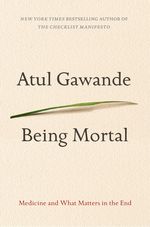
Some healthcare providers have acknowledged that empowering patients and reducing their suffering is a secondary concern in modern medicine and usually far from a priority. A doctor's main goal is to heal but in many cases this seems to lead to a sacrifice of a patient's autonomy and comfort, in the name of an eventual return to full health. It's a practical cost-benefit analysis— distilling years of medical training into layman's terms in order to explain a diagnosis, options for care, and the possible effects of procedures and medications with every individual patient would prevent physicians from having the time to see other patients and would net out to fewer patients healed. In terms of quantifiable success, a patient's experience in a hospital is measured by morbidity and mortality not by the comfort of her stay. Concurrently, in the U.S. healthcare system doctors are generally paid for services rendered and are incentivized to see as many patients as possible.
by Tamuira Reid
I remember being five years old and sitting in the pediatrician's office as my mother explained the problem. She talks in voices, doctor. Three or four of them at a time. I stand by her door and listen and it is frightening, I tell you. Just frightening.
After hours of testing, more to appease my worried mother than anything else, Doctor Wolfe looked gently at the two of us and said, Yes, your daughter does have a special condition. And it is called a wonderful imagination. Mrs. Reid, your daughter is creating stories that she is simply too young to write down.
A few years later, those voices would become my first poems, first one-act plays. They would become my lifeline.
For as easy as writing came to me, the rest of school did not. I'd stare out the window for hours on end, dreaming of what the world had in store for me, instead of learning the algebraic equations my teacher scribbled across the board in front of us. I would read chapbooks during recess and perform monologues out in the open field behind the block of modular classrooms. I was bright but uninspired. I remember tutors being involved. I remember hushed conversations between my parents behind closed doors.
It wasn't until I ran away to college that I began to really engage in my lessons. I remember the first class vividly. Professor Lesy walked into the room with a small grey boom box under one arm and a bundle of books and papers under the other. His hair was long and unkempt, shirt wrinkled. Coke-bottle glasses. When he finally sat down at the head of the table, pushing the play button to release classical music into the air, he looked at each one of us and said, If you can't write from your heart, you have no business writing at all.
Day after day, workshop after workshop, we picked up our essays now covered in ink. He demanded the truth from us; we gave him half of it. We gave him what we thought he wanted to know. As the semester progressed, we began to let go of what we thought we knew about writing and realized we knew nothing at all. That writing is a process, a craft, not necessarily an inherent gift.
I wrote everyday for the entire first year of my college career. I wrote first thing in the morning and last thing at night. I wrote with coffee, I wrote with beer. I wrote until my hands would cramp so badly that I'd be forced to take a break, smoking cigarettes out in the cold New England night.
It wasn't shocking that I connected to writing this way. I'd always loved writing. What was surprising, however, was how I would fall into teaching.
When Lesy would get up in front of the room, he had this incredible, commanding presence that seemed to grab you around the neck and say, Look at me! What I tell you is divine truth! You will never hear anything more interesting than what I'm about to say right now! He had us completely enraptured, under his psychotic but totally intoxicating spell. It was kind of magical.
He gave a solid performance, day in and day out. And that is exactly what it was: a performance.
I wanted to perform.
by Claire Chambers
by Mandy de Waal

“It doesn't matter how much money I earn, I always feel I need more.” As Hugo describes his relationship with money, his speech is carefully measured. The forty-something year old former banker-cum-currency trader pauses for a while during our conversation, and then adds: “It was only recently I realised I have a problem.”
For as long as Hugo can remember money has featured as a complex protagonist in his life. The dominant force in his decision making, this man measures everything in terms of what it will cost him and if the value he'll be getting from the transaction will be worthwhile. It doesn't matter if the transaction is an emergency trip in an ambulance or going into a restaurant for a sirloin.
“Every time a decision needs to be made, the first thing I think about is the financial impact. It doesn't matter what it is. I will always find a money angle to each and every decision,” he says. “If someone has a problem I won't think about the person or the emotion.” For Hugo cash is cognitive king.
“I used to think everyone was like this. That money came first in everyone's lives. It's only during the past couple of years that I've realised this is not the case.” Today Hugo – who doesn't want his identity to be revealed publicly – is in his early forties. Hugo talks about having a problem and about being obsessed with money. A couple of times the word ‘addiction' enters the conversation. “I have an addiction to money,” he says, adding that his ‘obsession' with money causes problems in his interpersonal relationships because he thinks very differently from those he cares about.
OLD FORMS WILL NOT BE ENTERTAINED
(a sign at the India Consulate, New York)
For David Barsamian
Old chants to the Ganges shall not be entertained
Dead cows float in holy water unrestrained
Family roots shall be ascertained
Nationality of mother should reign
Old friends shall not be entertained
I pledge allegiance to the newly-famed
Object of Journey shall be explained
To find out etymology of Kashmir-curfewed
Old profession shall not be entertained
Shall I reincarnate as Poet-un-Chained?
An old form (in triplicate) shall be obtained
First copy drained, second birdbrained, third scatterbrained
Enemy passports will be stamped Foreordained
Will heart-rending appeals ever be sustained?
Alternative gods shall be deported
Against the ruins of a world what is regained?
By Rafiq Kathwari, whose first book of poems is forthcoming in September 2015 from
Doire Press, Ireland. More work here.

Metaphor is a hallmark of human communication, and a vital tool of scientific thinking. Along with its more formal cousin, analogy, metaphor allows us to create linguistic and conceptual bridges from the known to the unknown. Some of the greatest breakthroughs in science began with an analogical leap between seemingly unrelated concepts. Isaac Newton brought the heavens down to earth when he realized that the movement of the moon around the earth was analogous to the motion of a ball thrown so hard that it just keeps falling perpetually. This line of reasoning led Newton to realize that the same deterministic laws held for both terrestrial and cosmic phenomena. The scientific revolution that took place in the wake of this discovery brought Enlightenment thinkers to the conclusion that the universe worked like clockwork: its components interlocking like cogs and gears that whirred with coordinated mechanical precision. The vibrations of a violin string and the propagation of sound and light were linked by analogy with wave motion. Analogies also helped usher in the atomic age: Ernest Rutherford likened the atom to the solar system, with electrons wheeling around a central nucleus like planets around the sun. The twin revolutions of communication and genetics gave rise to one of the world's most powerful and popular scientific metaphors: the idea that the DNA molecule — the bearer of heredity from one generation to the next — was a code, or a blueprint, or even “the book of life”. Phrases like 'genetic code' have become so common that we frequently forget that it is a metaphor at all. [1]
Over the course of a series of essays, I'd like to investigate the metaphor of code, and how it came to dominate biology. Our investigation of the code metaphor must revolve around two related questions. Firstly, how did the nuts-and-bolts talk of cells, membranes, proteins and chemical bonds become engulfed in a sea of words like 'encoding', 'decoding', 'transcription', 'translation' and 'editing' — the language of telecommunication and cryptography? Secondly, despite the successes of the code metaphor, might it obscure some of the most intriguing and difficult problems in biology? Before we even get to biology, it will be useful to lay some groundwork, and understand what modern scientists mean when they use words like “information” and “code”. So in the first part of this series, I'd like to review the seminal work that led to the modern conception of information. [2]
Beginning in the 19th century, successive waves of technological innovation transformed the way humans communicated with each other. Telegraphs and telephones made the near-instantaneous, global exchange of information possible. The technology, and the sheer pace of change, brought new questions to the forefront of scientific thinking. What exactly is happening when we send a telegram, or make a phone call? When we send a message, what is being transmitted along the wires, or through the ether? In other words, what is information?
by Namit Arora
What to make of the verdict in Delhi’s Assembly elections this month? After a dismal show in the national election last year, when many had written it off, the Aam Aadmi (‘common man’) Party achieved a crushing win in Delhi with 67/70 seats. Delhi may be electorally small but being the capital of the nation and of empires past, the headquarters of the national media, and a trendsetter for other regions, its control has great emotional significance—all too evident in AAP’s main rival BJP’s desperate eleventh-hour tactics to win in Delhi.
The verdict has drawn many explanations: AAP’s strategy, grassroots campaign, and populist promises; people’s disaffection with the fueling of communal strife by RSS, VHP, and other BJP-affiliated Hindu right-wingers; the invisibility of BJP’s much-hyped ‘development’; BJP’s arrogance, disorganization in Delhi, and its dirty campaign; AAP’s success in framing this as a two-way contest which enabled anti-BJP votes to consolidate behind AAP; Modi’s $18K splurge on a suit—in retrospect, a major wardrobe malfunction, and so on. Whatever the mix of factors, last year’s ‘Modi wave’ now seems subdued, if not stalled.
Various polls show that AAP won due to greater support from the poor, the rural sections, slum dwellers, lower castes and Dalits, religious minorities, students, and women voters of Delhi—an enviable constituency for social liberal democrats like me. I’m not a member of AAP or any other party but I wanted AAP to win—not only because the alternatives were much worse but also because, despite some lamentable populism, there are many hopeful and progressive things in AAP’s politics and 70-point manifesto. These include two innovations it already practices: transparency in campaign finance and ensuring candidates have no heinous criminal charges. AAP’s win may bolster BJP’s opposition in upcoming state elections. It may even slow the rise of BJP’s communalism and its model of development in which corporate sector growth is prioritized far above social welfare and primary services—a GDP-growth led model akin to neoliberalism and almost always marked by rising disparity, shrinking safety nets, crony capitalism, and faster ecological damage. Indeed, why pursue GDP and corporate sector growth if not to primarily help increase human knowledge and reduce human suffering?
by Brooks Riley
by Lisa Lieberman
He had told me that he shredded street posters himself to uncover the ones hidden beneath the newer strata. He pulled the strips down layer by layer and photographed them meticulously, stage by stage, down to the last scraps of paper that remained on the billboard or stone wall.
Patrick Modiano, “Afterimage”
I picked up Suspended Sentences after Patrick Modiano won the Nobel Prize for Literature this past fall and was immediately reminded of an Alain Resnais film—not that I'm the first to draw a connection between the two memory-obsessed artists. Modiano himself acknowledged a debt to the late filmmaker when accepting a prize from the Bibliothèque nationale for his body of work in 2011. “During my childhood, I saw Alain Resnais's documentary Toute la mémoire du monde (1956) [All the World's Memories] about the journey of a book arriving at the Bibliothèque nationale,” he said, “and the film made me want to write.”
Resnais made the All the World's Memories after his documentary about the death camps, Night and Fog (1955). In contrast to the brutal manner in which memory is evoked in this film and the accusatory tone of the narration, All the World's Memories is irreverent and light-hearted. I can easily imagine the ten-year-old Modiano being drawn in by Resnais's gently ironic depiction of the great library as a fortress dedicated to preserving memory at any cost. Words are captured and confined, books imprisoned, never to leave. Issued with an identity card, “the prisoner awaits the day it will be filed,” we are told, but lest we worry, Resnais is quick to assure us that this incarceration is entirely beneficial. Books are treated well. Scientific expertise is deployed to stave off the destruction of perishable documents: “An ointment is applied to preserve bindings, the writings of vanished civilizations are restored, books are vaccinated, shrouded, holes made by insects are filled in, loose pages glued back in.” Those of us old enough to remember card catalogues will appreciate hearing them described here as “the brain of the Bibliothèque nationale.” And if you were fortunate enough to conduct research in the vast reading room under the glass dome, as I was, you'll be charmed by the birds-eye view of the rows of readers seated “like paper-crunching insects” at those long tables, “each in front of his own morsels of universal memory.”
This standalone piece is part of a special series on Startup Tunnel, a new incubator based in New Delhi. Links to earlier articles appear at the end of the article.
Folks seemed to shift uncomfortably in their seats… apparently not. Why not? I asked. Do you mean like a public sector company, someone said. Ah, ah, ah, no, I said, realizing that the term monopoly wasn’t an abstract concept in the Indian context, but a real and oppressive part of our not-so-distant past. Yes, perhaps I’m being a bit loose with the term monopoly — I don’t mean state-sanctioned and absolute monopoly — I mean the kind of market leadership, let’s say more than 50% market-share, that can resemble monopolistic dominance. Don’t you want that? Well, VCs want to know that the space is real, said one founder. We want to work in an area where there is a good chance of success, said another, and that means there will already be competitors.
But isn’t that a problem? I asked. If the area you’re working in can already be defined as a competitive landscape it isn’t really all that new. In which case, how innovative is your startup concept? Think of any major startup that you’re inspired by these days and you’ll see they’re all near monopolies: SpaceX, Tesla, Airbnb, Dropbox, Snapchat. Before they came along, no one was doing what they’re doing. Now that they exist, people will come along and try to emulate them, but they’ve actually created a new market, in which they’ll continue to enjoy dominance. In some sense, that’s the only way these kinds of valuations can even be justified, either economically or socially or even in terms of the public good. These startups have created fundamentally new value and new social-technological possibilities that never existed before.
by Carl Pierer
Madam,
Thank you for opening my eyes concerning the question whether students should be beaten to study Maths up to the age of 18. Your well-argued and logically impeccable column in the Times establishes beyond reasonable doubt that no one needs to know any Maths further and above the mere basics. It is absolutely clear what those basics are, and they don't need further definition (obviously, knowing times tables is essential and needed, whereas being able to solve quadratic equations is far beyond basic).
Moreover, you successfully avoid the many times rehashed bad arguments in debates about education. Instead, you focus on the points that do indeed form the basis of any good and progressive line of argument. These are: (i) to think about reforms in terms of the education currently successful people have had, (ii) to do away with skepticism about inductive inferences, (iii) to consider a general education system in terms of highly talented and successful people, (iv) to not let yourself be confused by the subtleties of the subject matter as there really is just one thing at stake, (v) to insist that there is something wrong with the subject itself if the curriculum doesn't teach what is “useful”. Unfortunately, the brevity of your column prevented you from exploring the full force of your arguments. Allow me to do so on your behalf.
With one of your examples you solve two age-old problems in philosophy. You write: “The top western country [in the Pisa international league tables] is Liechtenstein. Know anyone who has changed the world who was educated in Liechtenstein? I don't either, but that is the European country we are hoping to emulate.” First off, this solves the problem of induction. The problem is that the inference from “All Swans I've observed so far are white” to “All swans are white” is not necessarily true, i.e. it's logically possible that “All swans I've observed so far are white” is true and “Not all swans are white” is true as well. But why do people wrack their brains over this? Your argument establishes that we merely need to assert the conclusion, isn't it just trivially true that since you don't know anyone who was educated in Liechtenstein and changed the world, there is nobody? At least 200 years of philosophy over and done with.
This conclusion is also a very important one, because obviously if Liechtenstein is doing well in the Pisa league tables and still there is no one who was educated there and changed the world, then the education in Liechtenstein cannot be that good. At least not as good as in Britain, where plenty of world-changing people were educated. Pisa league tables, your argument shows, are not a suitable means of measuring which educational system produces world-changing people. A general education is precisely about the upbringing of exceptional individuals and not the provision of basic numeracy and literacy. Since the Pisa examinations only manage to test the level of the latter, educational policy makers who are concerned with the questions that really matter should stop emulating countries that do well in the Pisa league tables.
by Hari Balasubramanian
Observations and pictures from a visit in October 2014 to the Andean town of Cuenca and the surrounding area.
1. Surgeries in an Isuzu Truck
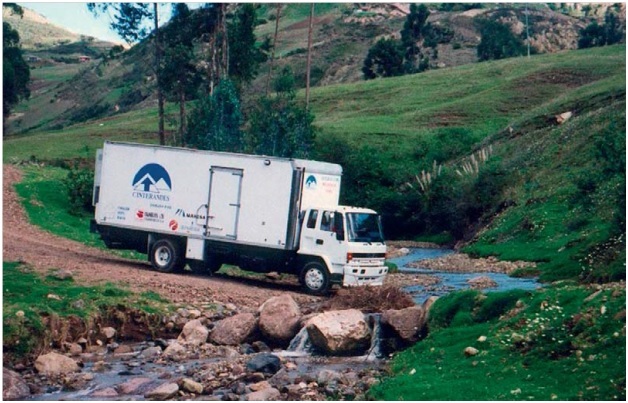
Since 1994, a small team of clinicians has been bringing elective surgeries to Ecuador's remotest towns or villages, places that have do not have hospitals in close proximity. From the city of Cuenca – Ecuador's third largest town, where they are based – the team drives a surgical truck to a distant village or town. Though a small country by area, the barrier of the Andes slices Ecuador into three distinct geographic regions: the Pacific coast in the west; the mountainous spine that runs through the middle; and the tremendously bio-diverse but also oil rich jungle expanse to the east, El Oriente, home to many indigenous tribes. Apart from a few major cities – Quito, Guayaquil, Cuenca – towns and villages tend to be small and remote.
Each year the team goes on 12 surgical missions, roughly one per month. A trip lasts around 4 days: a day's drive to get to the place; 2 days to conduct 20-30 surgeries (sometimes more sometimes less); and then a day to return. Patients pay a nominal/reduced fee if they can: the surgeries are done irrespective of the patient's ability to pay. The clinicians belong to a foundation called Cinterandes (Centro Interandino de Desarollo – Center for Inter-Andean Development).
Amazingly, the very same Isuzu truck (see above) has been in use for more than 850 missions and has seen 7458 surgeries from 1994-2014! The truck itself is not very large; in fact, it cannot be, because it has to reach places that do not have good roads. The mobile surgery program has the lowest rates of infection in the country (see [1] for more details). Not a single patient has been lost. The cases to be operated on have to be carefully chosen. Because of the lack of major facilities nearby, only surgeries with a low risk of complication can be done. Hernias and removal of superficial tumors are the most common. Hernias can be debilitating, yet patients may simply choose to live with them for many years rather than visit a far-off urban hospital. For many, leaving work for a few days and traveling to get a health problem fixed is not an option.
Dis Hate Taste Kiss
Mind is what the brain does.
…………………… —Marvin Minsky
.
………. imagine this:
this morning was so cold I thought, frostbite
and a vision (gloves) occurred
if I hadn’t thought cold
my hands may just as well have felt
they were in Aruba, and gloves absurd
………. then the wind hissed
.
.
being mindful is
the best way to miss frostbite
know bliss dis hate taste kiss
.
by Jim Culleny
2/13/14
by Charlie Huenemann
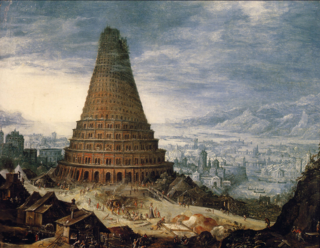
We might resign ourselves to this fact – the inescapable limits of what's sayable – but in fact a great many minds have sought to construct the perfect language, one that carves reality at its joints and captures the grand shebang of human experience. Presumably God was speaking such a language when he spoke the world into being, and perhaps he taught this language to Adam. Or perhaps the perfect language need only be carefully constructed from given, atomic elements that reflect the most basic concepts a mind can have, with rules that keep it innocent from the goofy twisting and mashing that the accidents of history impart to our tongues. Or perhaps we can cook up a language that, like physics, captures the essence of phenomena and parses away every nonessential feature. The payoffs would be inestimable: we would have not only a language that could not possibly confuse, but a language – like that of Jonathan Swift's horsey Houyhnhnms – whose very grammar would preclude ever saying the thing which was not.
This was a hope that inspired the young Gottfried Wilhelm von Leibniz. He recalled that, as a teenager studying Aristotle, he arrived at “this remarkable thought, namely that a kind of alphabet of human thoughts can be worked out and that everything can be discovered and judged by the comparison of the letters of this alphabet and an analysis of the words made from them.” Leibniz's fundamental idea was to identify radically atomic concepts and compose molecular sentences out of them, so that once we translated our thoughts into legitimate terms, we could see whether they were true, possibly true, or totally confused.
This dream – the creation of a characteristica universalis – became Leibniz's lifelong project. His earliest publication, “A Dissertation on the Art of Combinations” (1666), aimed to do for metaphysics and science what Euclid had done for geometry. Before long, Leibniz sought to make his perfect language susceptible to mechanized computation. Fundamentally, his idea was to attach atomic concepts to prime numbers, under the guiding metaphor that just as every natural number is the product of primes, so too should every complex concept be the product of atomic concepts.
by Emrys Westacott
So many people have it in for well-intentioned, bleeding-heart, left-leaning liberals.[1] Of course, if the critics are bona fide racists, sexists, homophobes, gun and flag fetishists, religious fundamentalists, anti-government Ayn Randians, coal or oil industry CEOs, or just Fat Cats protecting their pile, then it's to be expected that they'll trash Well-Intentioned, Bleeding-Heart, Left-Leaning Liberals (WIBHLLLs–pronounced “wibbles,” and since I don't like acronyms from here on let's just call them wibbles.). It's part of these critics' job description, since wibbles cherish just what such people despise (and vice versa). What is surprising and disappointing, though, is how often one finds wibbles being attacked, ridiculed, or despised by others who hold progressive values.
George Orwell offers a paradigm example of this sort of hostility towards people who, in the great political scheme of things, are on the same team. In The Road to Wigan Pier, Orwell, a professed socialist, complains about
the horrible, really disquieting prevalence of cranks wherever Socialists are gathered together. One sometimes gets the impression that the mere words ‘Socialism' and ‘Communism' draw toward them with magnetic force every fruit-juice drinker, nudist, sandal-wearer, sex-maniac, ‘Nature-Cure' quack, and feminist in England.
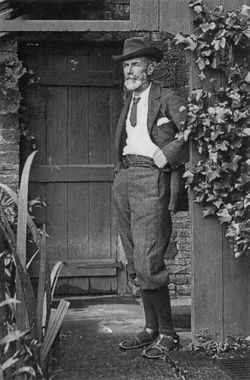
I can't prove this, but I rather suspect he may have had in mind Edward Carpenter (pictured), an English socialist (1844-1929) who would check most of Orwell's boxes. For an example today of a left-wing theorist whose main concern seems to be to criticize those who presumably share some of his basic values, one need look no further than Slavoj Zizek. Zizek scoffs at vegetarians, recyclers, people who buy organic produce, and people who give to charity.[2]In the 2008 documentary Examined Life, he criticizes environmentalists who seek to reduce our alienation from nature by reminding us we are part of nature. In Zizek's view, the possible success of their teaching represents “the greatest danger,” and ecology threatens to become the new “opium of the masses.” For “to confront properly the threat of ecological catastrophe” we need to “cut off [our] roots in nature….We need more alienation from life….We should become more artificial.” Elsewhere he criticizes “tolerant liberal multiculturalism” as really just “barbarism with a human face.”[3]
I have good friends who also seem to hold wibbles–”nice” people, Guardian readers–in special contempt, although “do-gooders” inspire even more hostility. On one occasion the name of Bono came up.”God, I despise Bono!” one friend said. Another heartily agreed. Note, they don't despise rock musicians in general, most of whom (like most of everyone) are politically disengaged. No they despise the one who has campaigned vigorously for many years to alleviate poverty, disease, and debt in the third world. Perhaps they'd respect him more if he spent his free time sleeping off hangovers and playing video games.
by Thomas R. Wells
Some countries are assholes. They trample on international norms about human rights, maritime boundaries, climate change conventions, and so on. They repeatedly make and break promises and then complain indignantly and even violently if they are challenged for it. They bully weaker countries shamelessly to get their way, all the while declaring their commitment to the highest ideals of international peace and justice.
You know the kind of country I'm talking about. The kind that believes in its own moral exceptionalism: Not only does it not feel bound by the ordinary rules; it even demands that other countries acknowledge its moral right to set its interests above their own or the international peace. Take Russia. Its behaviour in Ukraine (and elsewhere in recent years) is classic assholism and is systematic and comprehensive enough to warrant the conclusion that Russia is a true asshole nation. I'm sure you can think of others.
I
The term “asshole nation” is inspired by Aaron James's neat little book Assholes: A Theory in which he defines the asshole individual as someone who in interpersonal or cooperative relations,
1. allows himself to enjoy special advantages and does so systematically;
2. does this out of an entrenched sense of entitlement; and
3. is immunized by his sense of entitlement against the complaints of other people. (p.5)
James' theory is directed at the anti-social behaviour of individuals. It covers much of the same ground that organizational psychologists have mapped as the ‘dark triad' of anti-social personality types – narcissism, Machiavellianism, and sub-clinical psychopathy – which will be unfortunately familiar to most people who have worked in any large organization. But James adds two things. First, his account is a thoroughly moral one: the asshole is morally repugnant because of his fundamental lack of respect for the moral status of those he interacts with: He doesn't register other people as morally real. Second, because James' account starts from the moral requirements of participation in cooperative relations rather than from human psychology it is more general than that produced by organisational psychologists. I believe it can also be helpfully applied to non-human agents, such as countries.
Just as some individuals seem to think that every day is their birthday and they deserve special consideration from everyone else – and a general exemption from rules intended for the general benefit which happen to be inconvenient to them, like using their phone in the movie theatre or speeding through school zones when they're running late – so some countries seem to think that their sovereignty is more important than the sovereignty of other nations.
by Randolyn Zinn
Walking down from the cathedral, our feet hurt from the rocky Andalusian pavement that bites into your soles with every step. When a café appeared in the middle of the piazza we stopped to rest and fortify ourselves with a thimble of fino.
The slow and regular tapping we heard seemed to be coming from an intersecting alleyway. Then two young boys came into view practicing an elaborate ritual.
The grim-faced lad in back seemed to be in charge as he pounded a wooden stick on the pavement. His friend strode ahead as solemn as a deacon in time to the beat, balancing a chair smothered in carnations atop his head. Every fifth tap he would stop to kneel on the cobbled street and then hold the pose for two counts before continuing forward.
It wasn’t until they stopped to buy a pack of gum that I saw it wasn't Jesus lashed to the cross, but a G. I. Joe action figure.
I caught the boy’s eye, smiled and asked if we could take his picture. He stood still and stoic then moved on to follow the demand of his friend’s stick.
I remembered what a fervent little believer I’d been as a girl, walking in stately procession with other maidens in church, intoning a litany of praises to the Virgin Mary during her holy month of May. One lucky student (never me) was chosen to crown Her statue with a wreath of roses. It was like a religious beauty pageant where the winner was always the same: the mother of Jesus.
What was the intention of those two little boys in Arcos, I wondered? Not surprisingly, this is the town where penitents crawl on hands and knees up to the cathedral to atone for their sins. Perhaps the boys didn’t consciously know why they were doing what they were doing. Perhaps they were instinctively following the impulses to art-making that Catholicism has inspired for centuries: to render the beauty of martyrdom, to reach for perfection, and that only through suffering can we hope to achieve salvation – ideas I had forsworn but, truth be told, never completely abandoned.
G. I. Joe as a stand-in for Jesus might be laughably kitsch-y, but those boys were not being ironic. They were practicing atonement or spiritual discipline or reverence – who knows what they had in mind—but their seriousness of purpose was exactly what I had come to Spain to find.
Photo by the author
Postcard From Spain is an ongoing series of images and text on 3QuarksDaily by Randolyn Zinn. Click below for the first installments and feel free to engage with me in the comments section below. Hasta pronto!
https://3quarksdaily.com/3quarksdaily/2014/10/postcard-from-spain.html
https://3quarksdaily.com/3quarksdaily/2014/12/postcard-from-spain-2-by-randolyn-zinn.html