by Paul Braterman
In my last post, I said that the right way to undermine creationism is to promote appreciation of the science of evolution, by presenting it in ways that are engaging, enjoyable, and above all personal. In this post, I review two more books that succeed in doing this; Alice Roberts' The Incredible Unlikeliness of Being and Jonathan Tweet's Grandmother Fish.
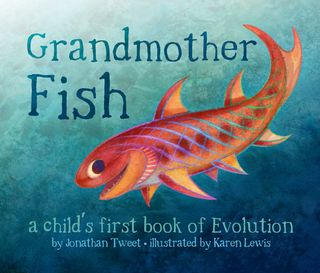
We start with a delightfully drawn Grandmother Fish, who lived a long, long, long, long, long time ago and could wiggle and swim fast and had jaws to chomp with. At once, this is made personally relevant: “Can you wiggle? … Can you chomp?” We proceed by way of Grandmother Reptile, Grandmother Mammal and Grandmother Ape, to Grandmother Human, who lived a long time ago, could walk on two feet and talk and tell stories, and whose many different grandchildren
could wiggle and chomp and crawl and breathe and squeak and cuddle and grab and hoot and
walk and talk, and I see one of them … right here!
Each stage has its own little phylogenetic tree, with the various descendants of each successive “grandmother” shown as each other's cousins, and there is an overall tree, covering all living things, that anyone (of any age) will find interesting to browse on. Finally, after some 20 pages of simple text and lavish illustration, there are around 4 pages of more detailed information, directed at the adult reading the book, but to which I expect children to return, as they mature, remembering the book with affection, as they surely will, years or even decades later.