by Brooks Riley
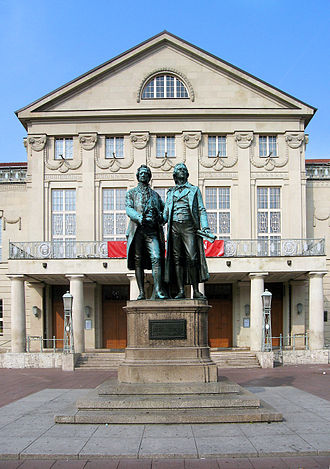
National Theater, Goethe and Schiller
To paraphrase Heinrich Heine, I dream of Weimar in the night—not the era, but the town of Weimar, a lovely word on its own, one steeped in intellectual significance, historical resonance, cultural audacity, political and artistic enlightenment, philosophical bravura–and in modern times monstrous atrocity.
I remember the first time I heard the word Weimar. It wasn’t that small town in Germany where Goethe, Schiller, Nietzsche, Liszt, Luther, Cranach, Bach, Wagner, Gropius, Klee, Kandinsky, Strauss, Schopenhauer and countless other thinkers and artists once lived–or even where Kafka on a visit fell in love with the daughter of the caretaker of Goethe’s house.
It wasn’t the birthplace of the Bauhaus movement. It wasn’t the place where the new German constitution was signed in 1919 launching the legendary Weimar Republic, that glittering era of promise before the darkness fell. And it wasn’t the town closest to the murderous concentration camp at Buchenwald.
It was our Weimaraner, a hunting dog my father acquired to quell his thirst for a canine to tip the balance in a feline household. But Tonndorf, named for the castle a few miles from Weimar where my father, Artillery Commander of the 6th Armored Division had quartered with his regiment at the end of World War 2, wasn’t allowed in our household, and was banished to the stable with the horses, where he spent hours hoping to catch a rat coming out of a hole in the earthen floor of a stall, successful only once in all his years, when an emerging rat took a wrong turn and landed in his maw.
Weimaraners were exotic in the mid-Fifties. They hadn’t been discovered by William Wegman or immortalized in the Museum of Modern Art. What I remember best about Tonndorf was the color of his coat, my favorite color, taupe. Taupe is the color gray with a smile, a hint of warmth that seeps through the sober neutrality of lightened black. I never think of Weimar without somehow seeing taupe, and when I look at Goethe’s color wheel, I can’t help wishing he had added that smile.
It would be many years before I actually went to Weimar, years before I began to understand the subterranean currents that would lead me there. So many interests of mine had their genesis in Weimar or were inextricably entwined with it. In college, a term paper of mine dealt with Friedrich Schiller’s Wallenstein trilogy, which was written and premiered there. In it, I posited that Schiller might have foreseen the dangers of Napoleon, and had written Wallenstein as a parable. Ironically, Weimar later briefly fell to Napoleon.
Read more »