by Holly A. Case
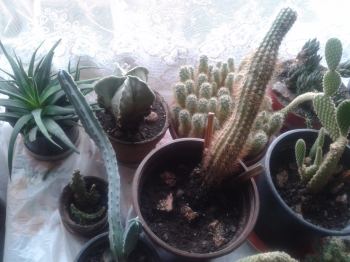
Cacti don't exactly grow on trees in Ukraine. They need a great deal of light or they become deformed. In winter the air temperature has to be maintained at ten degrees Celsius (50 degrees Fahrenheit), which is neither easy nor fun to manage in an apartment. Some cacti require special microclimates with controlled humidity, and most need to be checked almost daily for moth infestation.
I learned all this from the Ukrainian novelist, Andrei Kurkov. A few months ago, a group of us was sitting around a table in the Café Eiles in Vienna when someone pointed out the collection of photographs of famous visitors to the café on an adjacent wall. The conversation turned to collecting: candy canes, baseball cards, chickens… "I had the seventh-largest cactus collection in Soviet Kiev," Andrei submitted.
Many questions spring to mind following such a statement; it's hard to know which to ask first. I opted for "How many did you have?" Hundreds. In his youth, Kurkov's favorite haunt had been the animal market, and especially the cactus section. Since breeding animals and plants was one of the few unregulated economic activities in the Soviet Union, the breeders, growers, and vendors at the market comprised an "oasis" that "did not belong to Soviet reality," he recalled. Soon he joined a local cacti-growers' club and was trading seeds and growing tips with other enthusiasts. "We lived in a small flat," he told us, "only two rooms on the fifth floor and all the windows were covered with shelves of cacti," some from the market, others grown from seed. Hollow plastic building blocks with one side sawed off served as pots, and the young Andrei learned botanical Latin in order to address his protégés by their proper names.
It was during his cactus-collecting phase that Kurkov also discovered the poetry of Osip Mandelstam, Anna Akhmatova, Nikolay Minski, and other offspring of Russian literature's "silver age." Their poems reached him through volumes smuggled into the country by his elder brother's dissident friends (one of whom later died in prison, probably from a beating). The young Andrei would sit and listen to the older boys talk about poetry and bash the Soviet government in the kitchen of his parents' flat. "They were interested in everything that was not allowed," he later told me. "I think I was both frightened and curious. Maybe more curious than frightened." He remembers the time fondly, as one of "poetry and cacti."
At the growers' club he met some of Kiev's top-ranked cactomaniacs, which included an opera singer and a professor at the Kiev Polytechnic Institute, among others.

![[Portrait of Cozy Cole, New York, N.Y.(?), ca. Sept. 1946] (LOC)](https://c1.staticflickr.com/6/5209/5269515180_8d0e6bd3e9.jpg)