by Jessica Collins
This is an attempt to recapture a feeling of queasiness I felt in my early teens, when I was already captivated by mathematics, but didn't yet know much about mathematics. It's an attempt to recapture that feeling of queasiness and then to resolve it in a way that it might have found resolution at the time, had I been asked the right questions.
Puzzle
I'm going to proceed somewhat indirectly and begin with a rather cute little geometrical problem. If you've got a few minutes to spare I encourage you to spend that time with pencil and paper trying to solve this puzzle before proceeding to read the rest of this piece, in which I'll describe three different ways of solving it. Here is the problem:
What is the sum of the three angles that the x-axis makes with the lines joining the origin to the points (1,1), (2,1), and (3,1) respectively?
The three angles are those shown in the following diagrams:
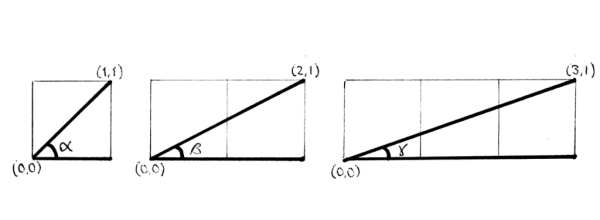
The first angle α is obviously 45°. If you know some trigonometry you'll recall that given a right triangle one of whose other angles is θ, the tangent of the angle θ, tan(θ) for short, is the ratio of the length of the side of the triangle opposite the angle θ to the length of the side adjacent to the angle. Thus we can see from the diagram above that β, the angle that the line joining the origin to the point (2,1) makes with the x-axis, is the angle whose tangent is 1/2, and that the angle γ is the angle whose tangent is 1/3.
This means you could use the arctan
or inverse tan
(tan-1) function of a scientific calculator to find the answer to the question above. The question was asking in effect:
What is: tan-1(1) + tan-1(1/2) + tan-1(1/3) ?
If you do this on a calculator, you'll find that the three values are:
α = 45°
β = 26.565051177077989 . . . °
γ = 18.434948822922011 . . . °
and that these three angles sum exactly to 90°, which was not immediately obvious, at least for me, from looking at the diagram.
But, without recourse to the calculator, can you explain why this is so? Can you find a simple proof that α + β + γ = 90°? We may restate the problem:
Show that the three angles the x-axis make with the points (1,1), (1,2), and (1,3) respectively sum to a right angle.
This is the point at which you might pause for a few minutes with pencil and paper before proceeding to read what follows.