Neural Weather, An Informal Defense of Psychoanalytic Ideas

by Bill Benzon

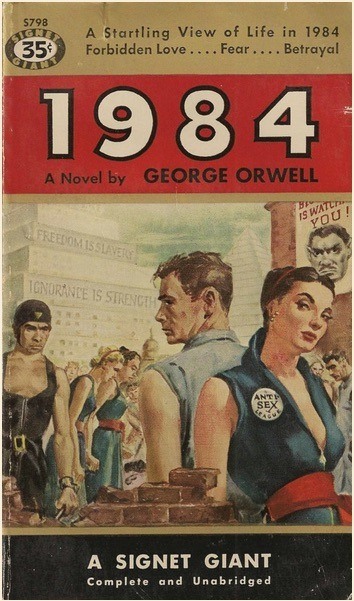
I first found Freud in the basement of the house on Luther Road. There was a small closet in the corner and my father had a box or two of paperback books in it. I don’t remember but a few titles; in fact, I’m only sure of two: Wodehouse on Golf, which I never read, and 1984, which I most certainly did read, as it had a pulpy cover that promised sex – a buxom brunette in a tight blue jumpsuit emblazoned with “Women’s Anti-Sex League” – in THAT costume! Of course, the book wasn’t quite what the cover advertised, but that was OK. I may also have found Brave New World there, I’m not sure. Come to think of it though, that probably IS where I found War of the Worlds. So that’s three titles I’m pretty sure of.

I probably found some Bertrand Russell, too, though just exactly what, I can’t recall. I went on to buy a bunch of Russell, including his history of Western philosophy. I also found something by Theodore Reik (Listening with the Third Ear?), and went on to buy more of THAT. And I found Freud, perhaps Three Essays on the Theory of Sexuality; after all, it has that magic word in the title: S E X.

In the summer between my freshman and sophomore years at Johns Hopkins I read The Interpretation of Dreams. Somewhere in there I picked up a five-volume set of The Collected Papers from a book club. I’ve still got them, though they’re in storage along with some other Freud. But I’ve still got Totem and Taboo, Civilization and It’s Discontents, and The Future of an Illusion on the shelves in my apartment. They’re slender volumes and so don’t take up much space and Civilization plays to my interest in cultural evolution. Read more »

Monday, January 28, 2019

A Puzzle about Ancient Cynicism

by Scott F. Aikin and Robert B. Talisse

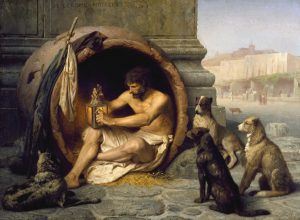
Diogenes of Sinope famously walked the streets of Athens searching for an anthropos. The tale is regularly rendered as him looking for an honest man, but this is too restrictive a translation. Rather, he was looking for a human, in the thick sense of the word. It is like a coach of a soccer team, challenging the squad of players, asking them if they are soccer players. In this regard, the thick sense of the term bears a normative weight, as a success term. And so, when one points to Lionel Messi and says, “Now, that’s a soccer player,” one is not merely saying that Messi plays the game. Rather, one is saying that he plays excellently, that he is exemplary. And so, when Diogenes, with his lit lamp in the daylight, asks people he meets if they are human beings, he is using the term in the thick sense. And given that his search seems to be ongoing, he implicates that everyone is failing to live up to the standard.

The standard that Diogenes — and with him, the ancient Cynic tradition — had in mind is not clear. However, one value at the center of this thick notion of humanity is not in question: that of autarkeia, roughly, independence, self-sufficiency, freedom. The genuine human is free; but, again, Diogenes finds no one fulfilling that standard. Instead, he finds people who are who have lost or given away their independence. Hence a famous Cynic paradox: only the practicing Cynic is free, only the Cynic is rich. How to make sense of these claims? Read more »

A Love Poem

by Amanda Beth Peery

Ms Green isn’t any good with
love poems or tokens, doesn’t like
small, easily lost objects. So she wants
to give him her visions—for example
the wedge of park & slim streetlights
shattering in shallow rainwater
like swarms of bottled fireflies
or clusters of leaping stars.
She wants to give him her gratitude
for life itself: darkness broken by light
days broken by night. The pattern of
dark leaves pressed against the sky.

Here Goes Everything

by Tim Sommers

I know you’ve heard this before. But it’s just too relevant to avoid, so, please, bear with me. It may, or may not, be a garbled version of something Bertrand Russell wrote in Why I am not a Christian, but it has become the equivalent of an urban legend in philosophy. It goes like this. Some famous philosopher or another, maybe Russell, maybe William James, is traveling in some non-Western country, probably India, because of the elephants, and they ask a local informant about their cosmology. The local says, “We believe that the world is a vast sphere resting on the back of four great elephants.”

The philosophy professor says, “But what are the elephants standing on?”

“The elephants are standing on the back of an enormous turtle.”

“What’s the turtle standing on?”

“An even larger turtle.

“But what is that turtle standing on?”

“You are very clever, sir, but I’m afraid it’s turtles all the way down.”

What is that so relevant to? Maybe, the cosmological argument for the existence of God, for one thing, but certainly this. Either the universe has existed in some form or another forever or the universe came into existence out of nothing at some point. That’s not physics or even cosmology. That’s logic. P or not P. Either some turtle is standing on nothing or it’s turtles all the way down. Read more »

I am attempting to Come to Terms with this Big Failure

by Niall Chithelen

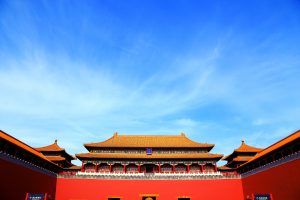
1) I got to see a different side of the Forbidden City when I brought visitors to there on a Monday and learned that the Forbidden City is not open to the public on Mondays. The side of the city that I saw was the outside, because Plan B (improvised) was to walk around the Forbidden City to the park behind it, which amounts largely to walking alongside a large, wide gray wall. Truly remarkable, you know, the immaculate geomancy, the imperial wonders and golden roofs. And then the wall and then us on the other side, strolling around as though I did not just commit a grave and truly ignominious error—strolling in pained, weak silence.

2) On any informal tour I lead, I like to show people the real China, you know, not just the tourist spots. Some people might like to see the inside of the Forbidden City, but for most of its existence, common people could not see the Forbidden City, and so it is more appropriate, I think, to walk around it, as a person would have two or three hundred years ago in order to do whatever business or activity people did at that time in this city—perhaps involving carts, or administration, or workplace conflict resolution. I am not sure about this. This is a more legitimate experience—no ticket required—just a channel into Beijing, feet on the ground in this old city, eyes on those old buildings that have seen so many years of change, an injection of pure Beijing right into your goddamn veins, really. And I try to be informative and even-handed as I dole out history and explain contemporary developments. Is China perfect? No. Is the US perfect? Also no. It is so difficult to judge these things. Read more »

In the Agora of Socrates

by Shadab Zeest Hashmi

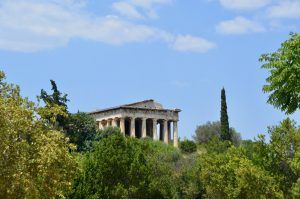
No one knows if it was really in the state prison, the ruins of which are visible today outside the ancient Agora of Athens, that Socrates was kept during the final days before his execution, so many times has the area been destroyed and reconstructed— walking past it sends a chill down my spine. Ancient Greece is visceral and vivid because it entered my imagination early in life; some of the most cherished tales of my childhood came from the crossovers of Hellenistic history and legend, such as the one in which Sikander (Alexander the Great) is accompanied by the Quranic Saint Khizr, in pursuit of “aab e hayat,” the elixir of immortality, or the one about the elephantry in the battle between Sikander and the Indian king Porus, or of the loss of Sikander’s beloved horse Bucephalus on a riverbank not far from Lahore, the city where I was born. I became familiar with ancient Greece through classical Urdu poetry and lore as well as through my study of English literature in Pakistan, but I would read Greek philosophers in depth many years later, as a student at Reed college; I would subsequently discover Greek influence on scholars in the golden age of Muslim civilization while working on a book on al-Andalus— the overlooked, key contribution of Arabic which served as a link between Greek and Latin, and its later offshoots that came to define the cultural and intellectual history of Europe.

Visiting the Agora in the sweltering heat of July, I am amazed by how comfortably these ruins from over two thousand years are nestled in the modern landscaping, park benches and pavements, how familiar the patchy, intensely green grass is, the deep, somnolent shade of oaks— the ancient is home once again, brought down to a child’s scale, at once snug and phantasmagoric, historic and pulsating with new life. Read more »

More Death

by Nickolas Calabrese

1. “…And I, who timidly hate life, fascinatedly fear death.” Fernando Pessoa, The Book of Disquiet.

2. I didn’t ask to be born, yet I’ve been condemned to death. Early on in Plato’s Phaedra, Socrates declares that it’s the job of the philosopher to prepare for death. Addressing Simmias and Cebes he states, “I am afraid that other people do not realize that the one aim of those who practice philosophy in the proper manner is to practice for dying and death.” There is something vulgarly sunny in the way he suggests it, but it also rings clearly true. What philosophers talk about when they talk about ‘the good life’ is a life not regretted when it comes time to exit it. Theirs is the pursuit of truth and understanding, and our own mortality could not be a more present topic to pursue.

3. Quite a few artists are engaged in a similar investigation. Although theirs is not as pure as the philosophers’, the good ones have a strong tendency to make work that both eviscerates vanity and frames mortality. By its very nature, the subject becomes the object. The countless examples of musicians, artists, poets, etc., examining the finitude of their own lives constitutes a vast list. Those who have spent time producing work in this vein are legion: from Bob Dylan to Future, from John Donne to Amiri Baraka, from Cady Noland to Andy Warhol. It comes as no surprise that one’s own death is an attractive topic. After all it’s something that every person ever has either done or will do in their lives. Death is more common than emotions. Not all people are capable of, say, love, but everyone must die. But what artists try to do with their work is antithetical to what Socrates was defining: artists are trying to cheat death. I’ll say more about this further down. Read more »

Monday, January 21, 2019

The Chinese Governance System: Impressive Strengths and Appalling Flaws

by Pranab Bardhan

This is the 40th anniversary of the onset of economic ‘reform and opening-up’ (gaige kaifang) in China under the leadership of Deng Xiaoping, which eventually led to a dramatic transformation of its economy and global status. It is, however, remarkable that China’s current supreme leader, Xi Jinping, marked the anniversary in a speech in the Great Hall of People in Beijing mainly emphasizing the Party’s pervasive control. It is also remarkable that in recent years this leadership seems to have forsaken Deng’s earlier advice of tao guang yang hui (“keep a low profile”). In the flush of Chinese nationalist glory, Xi explicitly stated in the 19th Party Congress that China has now entered a “new era”, when its model “offers a new option for other countries and nations who want to speed up their development while preserving their independence”. Many people both in rich and poor countries seem to be already awe-struck by this model.

What are the special characteristics of the Chinese development model? Briefly, it’s a model of essentially capitalist development under authoritarian leadership and purposive governance, with a vertical production structure where basic capital goods are produced in monopoly state-owned enterprises and the much-larger rest of the economy is under private ownership, with a state-guided nationalist industrial policy and finance, with subsidized access to land and credit for state-favored business and repression of labor rights, massive investments in infrastructure funded by a very high national savings rate (particularly on account of large undistributed profits of companies), with rural industrialization in a decentralized framework of jurisdictional competition, and openness to foreign trade and acquisition and learning of foreign technology.  It has produced a rapid pace of economic growth over the last three decades and lifted hundreds of millions of people above the poverty line—undoubtedly a spectacular historic feat for any developing country. The recent slowing of the growth rate does not tarnish the long-term shining performance so far.

I have discussed some of these features of Chinese development, particularly in a comparative assessment with Indian development, in my book Awakening Giants, Feet of Clay (Princeton, 2013)—incidentally, I should mention here that when a Chinese translation of this book came out in Beijing, the translator thought it fit or prudential to take out, without my permission, some of the passages in the book that criticized Chinese policy, while those critical of Indian policy remained.

I believe the Chinese governance system is a crucial part of the China development model, and in this article I shall concentrate on its special features, both positive and negative, which tend to be overlooked in the simplistic discussion on authoritarianism vs. democracy that tends to dominate the usual observations on the system. Authoritarianism is neither necessary nor sufficient for some of those special features. In many ways these features undergirding the Chinese polity and economy are quite distinctive, and their roots go long back in history. I shall focus here on the aspects of governance that affect economic development and less on their clearly repressive police-state aspects and gross abuse of basic human rights. Read more »

The Met Museum’s Scholarly Looter

by Thomas O’Dwyer

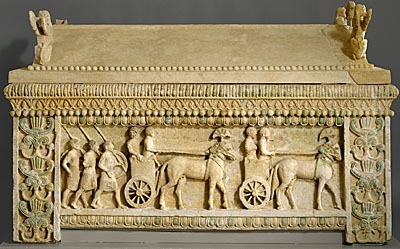
Limestone sarcophagus from the Met Cesnola Collection
The Amathus sarcophagus from the Met Cesnola Collection

French President Emmanuel Macron has set a very large cat among the pigeons of global antiquities trading and curating. The cat – catalogue – is a report he commissioned in March 2018 and it’s named The Restitution of African Cultural Heritage: Toward a New Relational Ethics. It identifies tens of thousands of cultural artifacts looted from Africa in French colonial days that could be repatriated. France’s national syndicate of antique dealers has already howled in protest at the report. In a letter to the culture minister, the Syndicat National des Antiquaires wrote: “The risks of extensions to other geographical areas and periods of history do not seem to have been anticipated.” In a separate statement, the syndicate expressed concern that the proposed repatriations would cover objects from the Americas, Asia, the Mediterranean and European countries.

A debate on Western theft from foreign cultures has been around since the nineteenth century. Only now is it gathering real momentum. It is a controversy which rumbles on in specialist magazines and art sections of various media. It erupts at times into open public rows over the most notorious cases – the theft of the Greek Parthenon Marbles by Britain’s Lord Eglin, for instance. There have been vocal demands from Greece, Egypt, Italy, Thailand and China for the return of treasures stolen by colonial marauders. Moral arguments abound over the sale of art pieces that Hitler’s Nazis plundered from European Jews. Such treasures now are often restored to surviving Jewish family members and their descendants. The moral case is that when buyers pay for art objects in good faith, it does not erase the original crime that makes such transactions possible. It is now being argued that this could apply to the millions of stolen artifacts laid out in the dusty cabinets of the world’s great museums. Read more »

Why Teach Math? Two Voices from the 1920s

by Jeroen Bouterse

Tatiana Ehrenfest-Afanassjewa

“Am I ever going to use this later?” As a math teacher, I seem to be getting this question about once a month (which is actually less frequently than I would have predicted). It is asked with varying degrees of openness to the idea that a satisfying reply is even conceivable, but almost invariably by students who are probably justified in believing that their tertiary education or future career is going to involve few linear equations indeed.

Rather than trying to conjure up some practical situation in which one might need to solve a fractional equation, I usually suggest that math may be worthwhile even if it turns out you can safely forget the techniques you learned in school. Isn’t this puzzle fun, doesn’t it make for good mental exercise, don’t you feel yourself getting a little bit smarter? Implicitly, I am banking on the idea that math improves your thinking. But what does that mean?

Recently, I stumbled upon a pamphlet from the 1920s that turned out to be both a feast of recognition and a source of further questions. Its author was Tatiana Ehrenfest-Afanassjewa. A Russian mathematician and physicist, Ehrenfest-Afanassjewa spent much of her time teaching mathematics and developing a program of mathematical pedagogy. Having worked in St Petersburg, she moved to the Netherlands in the 1910s when her husband, Paul Ehrenfest, became a professor of physics at Leiden University. Read more »

The Typewriter Lives

by Mary Hrovat

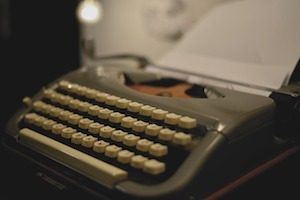
Photograph of typewriter with paper rolled up ready to typeI wrote the first draft of this post on my typewriter. Like much of my other writing, this piece began as handwritten notes and drafts typed on a nice little portable typewriter, which is a little younger than I am and which I expect to use for the rest of my life.

I first thought about using a typewriter because I wanted fewer distractions when I write. One of the beauties of the typewriter is that it does just one thing. You can’t check your email or anything else; you can’t multitask. You can’t follow any of the myriad paths that the Internet opens up. You can write whatever you want to, but all you can do is write.

Another reason I chose to do some of my work on a typewriter is that the computer has become associated in my mind with various types of paid online work—office jobs that were ultimately tedious, and more recently, my current editing work. These days when I face a piece of text on the computer and have to interact with it (rather than read it), my default attitude is finicky, and I always have an eye to the ways that others will evaluate my work. This makes it harder to move out of editor mode and into writing mode when I’m working on the computer. I thought a typewriter might provide a more friendly environment for writing, especially in the early stages, when ideas are often at their most nebulous and easily scattered, and when I’m most easily discouraged or overwhelmed. Read more »

Open Borders

by Ashutosh Jogalekar

The traveler comes to a divide. In front of him lies a forest. Behind him lies a deep ravine. He is sure about what he has seen but he isn’t sure what lies ahead. The mostly barren shreds of expectations or the glorious trappings of lands unknown, both are up for grabs in the great casino of life.
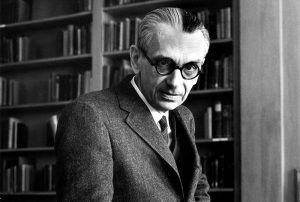
First came the numbers, then the symbols encoding the symbols, then symbols encoding the symbols. A festive smattering of metamaniacal creations from the thicket of conjectures populating the hive mind of creative consciousness. Even Kurt Gödel could not grasp the final import of the generations of ideas his self-consuming monster creation would spawn in the future. It would plough a deep, indestructible furrow through biology and computation. Before and after that it would lay men’s ambitions of conquering knowledge to final rest, like a giant thorn that splits open dreams along their wide central artery.

Code. Growing mountains of self-replicating code. Scattered like gems in the weird and wonderful passage of spacetime, stupefying itself with its endless bifurcations. Engrossed in their celebratory outbursts of draconian superiority, humans hardly noticed it. Bits and bytes wending and winding their way through increasingly Byzantine corridors of power, promise and pleasure. Riding on the backs of great expectations, bellowing their heart out without pondering the implications. What do they expect when they are confronted, finally, with the picture-perfect contours of their creations, when the stagehands have finally taken care of the props and the game is finally on? Shantih, shantih, shantih, I say. Read more »

Revisiting Racism

by Adele A Wilby

Although we know bias and racism exists in most societies, when put into coherent terms in the form of research the impact is stark and exposes just how much a part of life racism is for so many people. Booth and Mohdin’s (The Guardian 2018) article ‘Revealed: the stark evidence of everyday bias in Britain’ setting out the findings of a poll on the levels of negative experience, more often associated with racism, by Black, Asian and minority and ethnic groups in the United Kingdom(UK) does just that. Thus, for example, from amongst its many findings the survey revealed that 43% of those from a minority background had been overlooked for work promotion in the last five years in comparison with only 18% of white people who reported the same experience. Likewise, 38% of people from ethnic minorities said they had been wrongly suspected of shop lifting in the last five years, in comparison with 14% of white people. Significantly, 53% of people from a minority background believed they had been treated differently because of their hair, clothes and appearance, in comparison with 29% of white people. In the work-place also 57% of minorities said they felt they had to work harder to succeed in Britain because of their ethnicity, and 40% said they earned less.
That racism, and indeed anti-Semitism, should be relegated to the dustbin of history is an aspiration shared by many. Of course, it is doubtful that there has ever been a society where racism has not been present. Nevertheless, that is not an excuse for it to become an acceptable phenomenon; it is a scourge on humanity, and has been the source of barbarity and brutality, cruelty and humiliation amongst fellow human beings. Its perpetual presence also serves to remind us of just how little we have learned from its devastating and harmful impact on peoples and societies throughout history. Thus, the recent research and reports of racism in the UK evoked reflection, and reminded me of my personal experience of racism in the United Kingdom, and how I realised the full weight of the phenomenon after the death of my husband. Read more »

Poem by Rafiq Kathwari

THE VALE OF SAINTS

I drove up the Himalayan foothills
to Baba’s shrine
with my friend Masood

in a tired white Gypsy
with dodgy brakes,
urged on by my 94-year-old

mother at Hebrew Home
The Bronx
who said her father,

a wealthy ring-shawl merchant
patronized by the Maharajah,
had married three times

hoping to produce an heir,
but his wives proved barren.
Perhaps it was him,

Mother said.
Yet, he rode his Tonga
to the foothills, then trekked

to the thatched-roof shrine
where he tied a thread
to carved wooden roses,

prayed for a son.
Faith in Sufi mysticism
defined Islam in Kashmir,

commanding awe & respect
never shock & suspicion. Read more »

Way Back When: 1999

by Gabrielle C. Durham

In the immortal words of Prince Rogers Nelson’s party gem from 1982:

“But life is just a party, and parties weren’t meant to last . . .

“So tonight I’m gonna party like it’s 1999.”

So much fun stuff happened in 1999: rampant concern about Y2K; the movie “The Matrix” came out; Bill Clinton’s ongoing inability to keep his dick in his pants and subsequent impeachment and acquittal; former pro wrestler Jesse Ventura became governor of Minnesota; U.S. military college The Citadel graduated its first female cadet; the Elian Gonzalez controversy raged in the States; and Cher’s single “Believe” was released.

But do you remember what you said? Do you remember when something made you laugh, not LOL? It was not actually all that long ago, TBH. Back in 1999, reading a text typically meant applying a highlighter, most likely in neon yellow, to the testable information in a book or handout that the teacher assigned. It has a very different meaning from today’s pithier text message. In a score of years, English has changed. Duh, language is always changing; that’s how it stays alive. But if we think about it at all, we think of language change as being in evolutionary terms – something that takes generations, but it actually happens much more quickly. Read more »