Stakes and Ladders

by Brooks Riley

The Alps are much grander this morning. I like to think they tiptoed closer in the night, but it’s only an optical illusion created by a local high-pressure system called föhn, which magnifies them and everything else on the horizon. Sitting outside in the loggia, a spacious recessed balcony that resembles a box at the opera, I am audience to many forms of entertainment—weather theater, rainbow theater, sunrise theater, moonrise theater, but best of all, avian theater with its motley cast of bird species performing their life cycles like variations on a theme, in full view.

To really see, sometimes you must simply sit still. You sit still and let it come to you—a thought, an image, a realization, a metaphor, an epiphany, a living creature. High up in a fourth-floor aerie, I see things I never would have noticed in the thick of life when I bustled among my own kind in cities overwhelmingly populated by my own kind. Now I see birds. Watching their performances, I see their consciousness as clearly as I recognize my own. I don’t need to make eye contact to know that they see me too, like actors aware of an audience. It’s an empirical observation but there are stories to back it up. In the great debate over animal consciousness, sometimes less is more, sometimes what you see is what you get, not what you’ve gleaned from neurological mapping or fancy tests. Science and philosophy merely obfuscate the obvious.

Any view can become tiresome over time. The eye begins to explore the details. Up here in the loggia, it is the birds that came into focus, performing center stage on a ladder that runs up the side of a thick chimney across the street. There’s not one bird in the neighborhood who hasn’t perched atop that ladder for whatever reason—ravens, turtle doves, magpies, merles, even a great tit or two. They come with dramaturgy, poignant narratives of survival strategies and competition, of empathy and antagonism, of mutual need and sharing, of joy—the stuff of life no matter what species you belong to. Read more »
Which way does art go?

by Nickolas Calabrese

When one makes an artwork, something flows from artist to audience. The thing flowing is actually several: concepts, ideas, aesthetic experiences, duration itself, beliefs, attitudes, and probably much more. Artworks work in a similar way to language, although it would be foolish to believe that artworks are language. Their similarities to language end at the transmission from one to another of the things flowing. That’s how language works as well. But for art, as with something like emotion, the flow is vague in how it is sent and received. It seems to me that the best linguistic analogy for what artworks do is located in assertion. Artworks assert a position. Of course it is entirely possible, and even the norm, that their version of assertion is cryptic to the point of being sometimes unintelligible. But assertions don’t need to be crystal clear. One can assert their dominance over another through a series of non-linguistic subtle bodily movements. Likewise, artworks can make assertions through their physical presence.

Formally, an artwork is perched somewhere, on the floor or the wall, installed somewhere in a public park, and so on. The physical position is exceptionally important to the artist. The way the artwork sits is, or should be, crucial to how the artist wants the piece to function. It has an attitude. If we are again to follow the metaphor using language, we could say that an artwork is a propositional attitude, such that it contains the beliefs or disbeliefs of the artist, the series of mental states that amount to this singular crystallization of an artist’s thought. That the work does this duty is critical, otherwise it says nothing and does nothing, and then, what’s the point of making anything at all? No, an artwork has a job to do in the world. Read more »

Monday, February 18, 2019

What AI Fails to Understand – For Now

by Ali Minai

Most people see understanding as a fundamental characteristic of intelligence. One of the main critiques directed at AI is that, well, computers may be able to “calculate” and “compute”, but they don’t really “understand”. What, then, is understanding? And is this critique of AI justified?

Broadly speaking, there are two overlapping approaches that account for most of the work done in the field of AI since its inception in the 1950s – though, as I will argue, it is a third approach that is likelier to succeed. The first of the popular approaches may be termed algorithmic, where the focus is on procedure. This is grounded in the very formal and computational notion that the solution to every problem – even the very complicated problems solved by intelligence – requires a procedure, and if this procedure can be found, the problem would be solved. Given the algorithmic nature of computation, this view suggests that computers should be able to replicate intelligence.

Early work on AI was dominated by this approach. It also had a further commitment to the use of symbols as the carriers of information – presumably inspired by mathematics and language. This symbolic-algorithmic vision of AI produced a lot of work but limited success. In the 1990s, a very different approach came to the fore – though it had existed since the very beginning. This can be termed the pattern-recognition view, and it was fundamentally more empirical than the algorithmic approach. It was made possible by the development of methods that could lead a rather generally defined system to learn useful things from data, coming to recognize patterns and using this ability to accomplish intelligent tasks. The quintessential model for this are neural networks – distributed computational systems inspired by the brain. Read more »

Monday Poem

Did an Historical Christ Exist

by now, does it matter?
time and myth have done their work: hope anoints
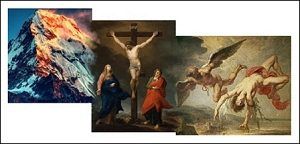
trying to get to the bottom of it would be like chipping Everest
with a balsa chisel and rubber mallet down to a grain of sand
or explaining to Icarus the practicality of an altimeter
—by the time you got anywhere
it’d be a moot point

all that’s left is faith
which is delicate
and shatters

Jim Culleny
12/26/15

On Not Knowing: Innocence, Dearie

by Emily Ogden

Blossom Dearie: incredibly, it was her legal name. The pianist and jazz singer was born Margrethe Blossom Dearie in 1924; all she had to do to get her stage name was to drop the Margrethe. The name perhaps overdetermines the voice. But you’ve got to hear the voice. Light and slim, with little to no vibrato, Dearie’s voice is ingenuous to such a degree that you begin to wonder whether it isn’t, in fact, the least ingenuous thing you have ever heard. It echoes with the four-square court—or was that the tomb? Imagine a sphinx posing her fatal riddle to Oedipus. Then ditch the immortal growl and try hearing, instead, a girl. That’s Dearie, singing her riddles of love and disaster. But unlike the sphinx, she wagers her own life, not other people’s. She knows the stakes, and still, that light, slim voice, with no vibrato, comes floating onto the air.
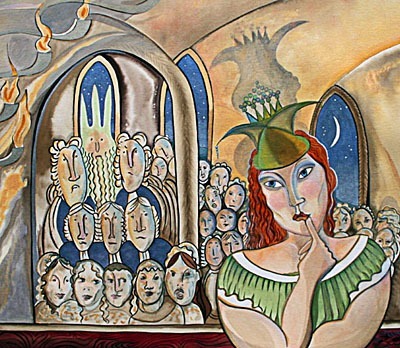

Hearing Dearie sing, you might find that innocence means something that it never meant before. We tend to think the innocent are young, and the jaded are old. Not so. The age we ought to calculate is not the questioner’s, but the world’s. The jaded think the world is in its adulthood, maybe even its senescence. An old world won’t change much. But a young world—now, such a world could change; it could metamorphose, even. The innocent think the world is young. Whatever they might have come to know about this life, and to their cost, they live as though there’s another world coming, right around the corner. It just hasn’t come as yet. The odds of change are bad, says Experience. They’re pretty good, says Innocence. Who’s making the better bet? Nobody knows. They’re only odds. Read more »

Perceptions

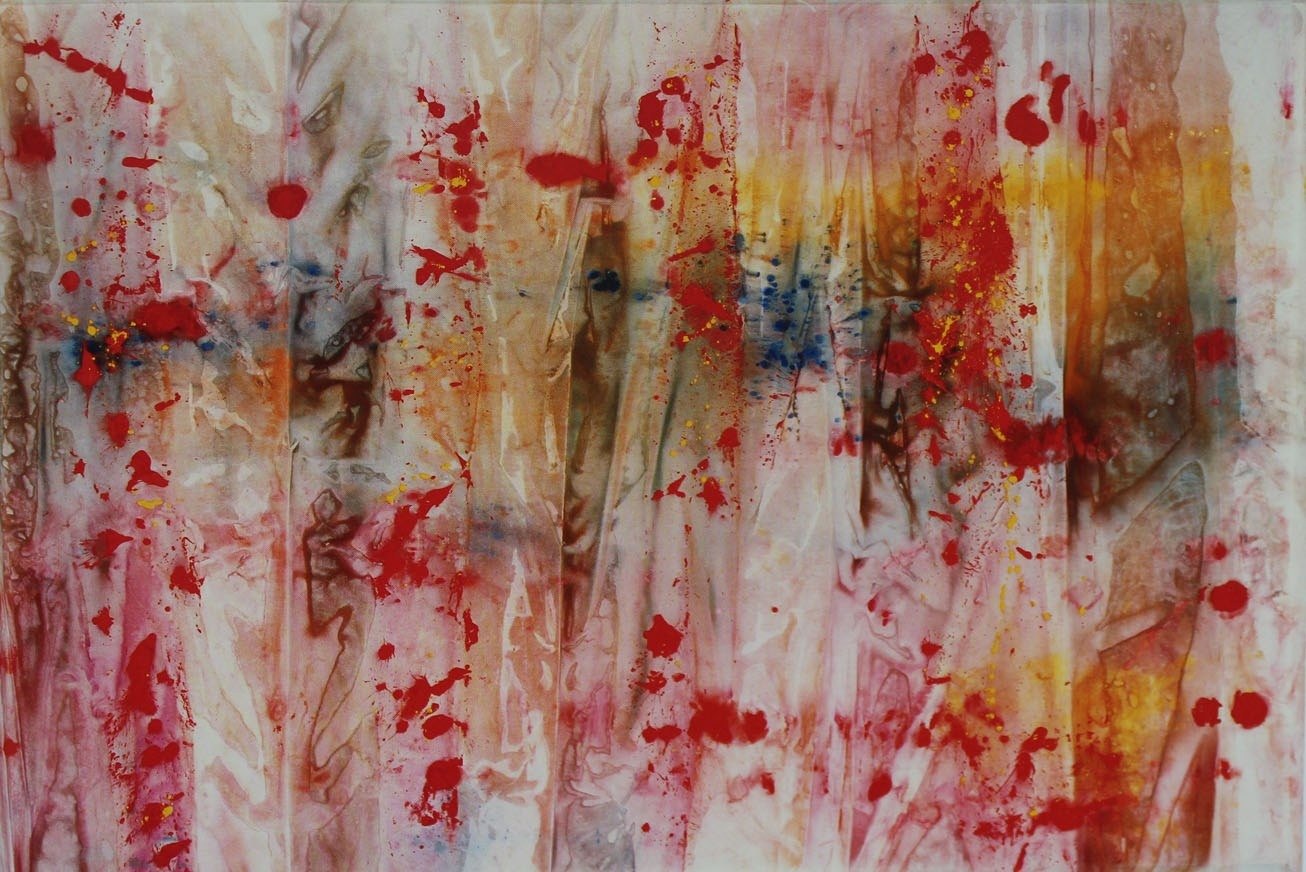
Sam Gilliam. Red April, 1970.

“TWO YEARS AFTER MARTIN LUTHER KING JR. was assassinated on April 4, 1968, Sam Gilliam created “Red April.” The draped canvas makes a bold statement with its candid reference to splattered blood in the wake of an assassin’s bullet. Gilliam, an internationally known artist whose work is influenced by Abstract Expressionism, is recognized for his Color Field paintings and pioneering works on unsupported canvases which he first introduced in 1965. His poignant interpretation of King’s murder, a major turning point in civil rights history, is not the kind of visual most people conjure when the think about the movement. ”

More here, here, and here.

How Now, You Secret, Black And Midnight Hags

by Thomas O’Dwyer

The Midnight Court: Men on trial
The Midnight Court: Men on trial. (Art: Pauline Bewick)

As Valentine’s Day fades away and the world returns to slippery gender normality, many Western men may still have some nagging questions. What did I do wrong this time? What do women want? Are we still on trial here? Older men may mutter that the male half of the young population has changed from manly men into little boys lost. Well, they have no one to blame but themselves. After centuries of entitled domination, some loutish cockerels have come home to roost. If manhood is on trial, it is for the bad attitudes, and worse, which it has long meted out to the other half of the population. Women are revolting only because male behaviour has been so revolting.

Yet, female rebellion is neither as new nor as rare as one might imagine. Women have often risen up against that most macho of male hobbies – warfare. The most famous example was the sex strike in the ancient Greek comedy Lysistrata by Aristophanes. Led by Lysistrata, the women withhold sex from their husbands as a strategy to end the Peloponnesian War.

In a modern re-enactment in 2003, Leymah Gbowee and the Women of Liberia Mass Action for Peace organized protests that included a sex strike. They brought peace to Liberia after a 14-year civil war and won the election of Ellen Johnson Sirleaf, the country’s first woman president. (Ms. Gbowee won the 2011 Nobel Peace Prize). Read more »

That Time Petrarch Yelled at a Doctor for Dozens of Pages

by Jeroen Bouterse

I don’t know how much you know about Petrarch. My guess is that you know him as a poet, primarily for his sonnets. Maybe you associate him with early Italian humanism and its reinvigorated dedication to the wisdom of classical Antiquity. Or perhaps you think of him as someone who expressed transcendental truths about the soul and its searching and wandering nature.

All of this may be true. As of recently, however, I can’t help but think of him as that guy who spent dozens of pages (more than 80, in a modern printed edition) yelling at a physician.

Or yelling at all physicians, possibly. Petrarch is slightly abstruse about the extent to which he seeks to put down physicians in general, or some subclass of physicians, or this singularly annoying physician in particular.

Petrarch never set much store by physicians. He lived through the horrors of the Black Death, and seems to have concluded from the destruction caused by the Plague that medical professionals were as powerless as anyone against the will of God. When the pope in Avignon fell ill (with a different illness), Petrarch thought it prudent to advise him, in writing, against relying on his doctors. The doctors were none too pleased, and one of them must have written a rebuttal of Petrarch’s letter. It is to this doctor that Petrarch devoted what grew into four books of seething invective. Read more »

Poem

Translating a Few Lines by Rehman Rahi
(With a news peg in parenthesis)

Melting snow
a breeze,

(a car explodes,
flesh and bones

litter the road,
the bomber

spliced
to a metal chunk.)

The breeze is a spy.
Here, can’t even

Wailaikum
someone,

and they speak
of dialogue.

To live,
people die.

O Spring
be a witness:

Dumbstruck,
we sing.

Kashmir, 14 February 2019

Rehman Rahi, b.1925, recipient of several top literary awards in India, is the greatest living poet of the Kashmiri language. He has published five collections of poems and seven books of literary criticism. Rahi lives in Srinagar.

Translated from the original Kashmiri by Rafiq Kathwari / @brownpundit

Writing Women into History

by Adele A Wilby

History has not always been fair to women: their contributions to history have been either marginalised or, not infrequently, unacknowledged. However, the three books, Nadine Akkerman’s (2018) Invisible Agents: Women and Espionage in Seventeenth Century Britain, Nan Sloane’s (2018) The Women in the Room: Labour’s Forgotten History, and Cathy Newman’s (2018) Bloody Brilliant Women, are examples of excellent research and scholarship that documents many women’s contributions to historical events.
Akkerman’s Invisible Agents is ‘the first full-length study of women’s espionage in seventeenth century Britain…arguably the decades that witnessed a significant increase of female participation in the trade of confidential information.’ Indeed, Akkerman asserts that, ‘female spying activities were at the very heart of British international relations in the mid-seventeenth century’. Her book therefore, has significance for a wider understanding of just how far women were instrumental in shaping the politics of the time. Read more »

Cursing

by Gabrielle C. Durham

A friend asked me to write a column about Russian cursing a few months ago. I do try to be accommodating, so I looked at several sites to get a better handle on it. In case you were not familiar, cursing in Russian is rich, much more calorically dense than most of what we have in English, except in the rarest cases of accomplished cussers. The problem for me is the translation; it would be so much more gratifying for you to read and imagine the vile torrents of insults than to read a lumpen approximation in English. Therefore, I decided to open up this column to the more universal topic of cursing.



What constitutes cursing? The intention I have in mind is not the imprecations hurled in movies at unsuspecting victims to drag down imminent posterity. No, I mean uttering profanities. Delicious four-letter words that got our knuckles rapped, our mouths washed out with soap, and led to smirking asides through our intentional and unintentional double entendres as teenagers. An excellent overview of dirty words, aka vulgarity, is the classic George Carlin bit on the seven dirty words. Read more »

Billy, and Bounce

by Christopher Bacas

“I don’t think everyone should have money. It shouldn’t be for everybody—you wouldn’t know who was important. How boring. Who would you gossip about? Who would you put down? Never that great feeling of somebody saying “Can I borrow twenty-five dollars” —Andy Warhol

It starts with the phone. On a nightstand, in the pocket, or ringing under a falling tree in that hypothetical forest. If they offer a gig, unless it’s on a sacred day, you take it. No, is the road less travelled, yes, an adventure. Not often the trailblazing kind. You may work for intrepid souls, but you’ll be chopping wood or carrying quarter notes.

I got a preparatory call. A pianist buddy sounded me about dates, explaining that Billy, a singer, had been off the scene for a while. He sold me on the band, a very strong lineup. The pay was above average, too. Billy called me in a few minutes. We hadn’t met and he never heard me play, but he piled up awkward compliments.

Billy was the son of diplomats, educated in the finest schools and an attorney. Past, present, future, he never once mentioned his own work. The first gigs were an education. We packed a sextet around a piano bar in the city’s fanciest hotel. Attending, high rollers and local television personalities. Joining us, duetting singers and jazz royalty. The duets weren’t rehearsed, a fact Billy aggressively promoted. The other singers were always so highly skilled and poised that his apologies came off as false modesty. The jazz greats were gracious. Billy also introduced any substitute players with the unsmiling caveat “I don’t know him. My pianist recommended him.” Read more »

February’s Feeture

by Max Sirak

Step-by-step, breath-by-breath, thought-by-thought, our feet carry us toward our future. (How Things Find Us, Kevin Dann)

All of our contact with the world starts with our feet… (Yoga Ranger Studio, Aprille Walker)

They are our vehicle. They move us in any direction we choose. They are the first impression we make. They are our calling card, hug, and handshake with the world.

They are our feet.

It Was A Day Like Any Other 

I needed a new pair of shoes. Need is the appropriate word. Despite my intellectual acceptance of impermanence, I think anything I buy should last forever. (See this shirt?  I bought it at a concert in high school.)

It’s also fair to note – sartorial excess isn’t a vice I embrace. For example, I own a single pair of jeans. When they begin to fall apart, I’ll get a new pair. This is the general way I approach my wardrobe.

So, as I was trying to tape my left shoe back together, it became apparent the time for patchwork fixes had come and gone. There was no re-attaching my sole.

It was time to discard the old that I might regard new.

My first instinct was to go online. It is, after all, 2019. I have the power to click buttons and make things appear, as if by magic, at my door. However, having been burnt once or twice (three times a lady?), I’m wary when it comes to ordering online the wears I wear. Read more »

Monday, February 11, 2019

The Duty To Forgive Murderers

by Thomas R. Wells

There are people living among us who have done terrible things to other human beings – murder and rape, for example – yet who nonetheless deserve society’s forgiveness. They have been convicted for their crimes and punished by the laws we collectively agreed such moral transgressions deserve. Now they deserve something other than punishment. They deserve to be treated with respect rather than resentment, contempt, and suspicion. They deserve a real chance to overcome their history and make something of their life.

I

When someone commits a morally terrible act against another that is a concern for the whole society rather than only the victim. Hence the institutions of police, courts and prisons administered by the state on behalf of the people. These systems are designed to discover the moral facts of each case: how bad the crime was, how responsible the perpetrator, and how much they deserve to be punished. This is important to make sure that we punish the people who do terrible things (and only those people), and also that we punish them to the degree that they deserve it and no more.

The last point is essential. We have a duty to punish the people who do bad things, but we have no right to punish them more than they deserve. For the same reason that it is wrongful to punish the wrong person for a crime, it is wrongful to punish the right person in the wrong way. This is why it is important for us to leave the judging to specialist institutions with the resources and authority to do it properly. When we try to do it ourselves we get mob justice – i.e. punishment only stops when those with the most extreme feelings about the case are satisfied.

In most developed countries the criminal justice system is trusted well enough to decide who is guilty and deserves punishment, i.e. who is a criminal. However, it seems that some people hold a lingering belief in their personal right to decide how much punishment criminals deserve to receive, and to inflict that privately if they have the chance. Thus, people with convictions for murder are routinely harassed and denied employment or access to opportunities like university education. Read more »

Cultural Appropriation, Camp, and Israel’s bid for the Eurovision

by Abigail Akavia

Conchita Wurst (by Ailura)

As was to be expected, artists are now calling to relocate the next Eurovision Song Contest, which is to be held in Israel in May. No less predictably, supporters are saying, more or less, “let’s leave politics out of it”. As if the Eurovision is nothing but a celebration of music, a friendly competition where sportsmanship is what counts above else. As if, indeed, athletic competitions have nothing to do with politics. The Eurovision has been described as the “Gay Olympics” or the “Gay World Cup.” The analogy brings to mind the controversies surrounding Russia’s hosting of the 2018 world cup games, despite the country’s well-documented violations of human rights. The example of Russia is telling, since there was quite a lot of criticism aimed at FIFA this summer, not for allowing Russia to host per se, but for failing to secure the games as a racism-free zone. In the 2014 Eurovision held in Copenhagen, the Russian representatives were loudly booed in response to Russia’s recent annexation of Crimea and its stance on gay rights. Like it or not, Eurovision participants are held as representatives of their nation, and are judged as such. Thus, even though Eurovision fans display a “playful nationalism” in their celebratory participation in the events, and often support not only their nation’s song but also the one they deem most worthy, the Eurovision remains an overt political arena where two issues are at stake: nationalism and queerness.

A local controversy surrounding one of the runner-ups to become Israel’s contestant to the Eurovision illuminates these two contexts and how they intersect. The next performer to represent Israel on the Eurovision Song Contest will be chosen in a pre-competition reality show called “The Next Star.” Since the competition began two and half months ago, one of the contestants has gained particular attention. Rotem Shefi, a Jewish Israeli singer, performs under the stage-persona of Shefita, an Arab diva, whose props include tacky gowns, heavy jewelry, a glittery walking-cane (yup), and, the most important in her toolbox, a thick Arabic accent. Shefi’s songs in the competition have so far been almost exclusively covers, remakes of rock and pop hits rendered in a non-specific Middle Eastern, pseudo-Arabic sound, performed in English. Despite some signs of unease, especially among one of the show’s judges, Shefita is consistently voted up, and is still presented as a likely contender to win and become Israel’s representative to the Eurovision. Read more »

Our Own Private Waste Lands

by Shawn Crawford

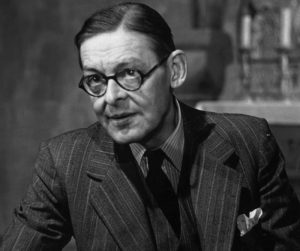
T. S. Eliot. Poet. Nobel laureate. Cheese maven.

If T.S. Eliot’s “The Waste Land” is the sacred text of Modernist poetry (With Joyce’s Ulysses the sacred novel), then his essay “Tradition and the Individual Talent” provides the theology to interpret and understand the poem’s byzantine lines and obscure references. How we pored over both, seeking to fathom the mysteries locked inside.

For a Kansas kid raised in a strict Baptist home, the delight of not only reading literature but being surrounded by others with the same desire, cannot be adequately described. “What are you going to do with an English degree?” people would always ask. I knew exactly: I was going To Know, to master the most beautifully written words–the ones that gave me an electric thrill and transcended my shyness and fears—words that provided a solace from the nagging worry about the disposition of my eternal soul. Those words offered salvation of an entirely different kind than the Bible.

Eliot seemed to offer up the perfect life; like many converts to a new religion or culture, he became more British than the British. He had achieved inclusion in the Norton Anthology of English Literature as well as the American Literature anthology. Eliot’s family came from St. Louis, and he was born there. My girlfriend’s family lived in St. Louis. Shocking. Unlike Ezra Pound, who always played with a bumpkin persona he called Uncle Ez, Eliot worked to obliterate all traces of his American identity.

How could he achieve this as an artist, and in his case, as a person? Read more »

The Social Aspects of Illness

by Joan Harvey

Like most people of a certain age, at any one time I have the unfortunate experience of knowing several people, some close, some not, who have cancer. It has become standard for the friend or spouse of the ill person to join one of the many message boards devoted to the subject and post updates to keep their friends and relatives informed. Others use Facebook to share information. Currently there are three people whose lives I follow, mostly from a distance, all with serious forms of cancer, one newly diagnosed but metastasized, two others who have been fighting for months and months.

I began to think more about the social aspects of illness when today’s usual protocol was not followed. It’s a truism to say we often notice things more in their absence, and it was the lack of shared information when someone I cared for was dying that made me aware how accustomed we are to being included in the progress (or lack thereof) of the cancer patient and how we come to depend on receiving a steady stream of updates on the ill. When this doesn’t happen and we aren’t notified of all the steps toward healing or death along the way, we feel cut off, and this can create a sense of deprivation. Read more »