
by Jonathan Kujawa
I just returned from the joint Vietnam-US math conference held at the International Center for Interdisciplinary Science and Education in beautiful Quy Nhon, Vietnam.
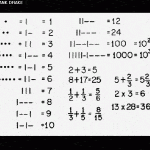
While it is a human endeavor, mathematics doesn’t care about gender, race, wealth, or nationality. One of the great pleasures of the math community is finding yourself on common ground with people from around the world. It is for good reason movie aliens usually first communicate using prime numbers and we chose to include math on the Voyager spacecraft’s Golden Record [1].

In this spirit, the American Mathematical Society and the Vietnamese Mathematical Society organized a joint meeting to encourage connections, collaborations, and friendship between the two countries’ mathematical communities. Given the fraught history between the two countries, the importance and symbolism of the conference were especially notable. During the cold war, even innocuous communication between mathematicians on the two sides was quite difficult. Even sending a letter, nevermind a conference to meet in person, was a rare event. More than a few results were discovered independently on both sides of the Iron Curtain. Progress was often held up due to not knowing of the latest advances on the other side. The Soviet Union, for example, made it difficult for its citizens to participate in the International Congress of Mathematicians. In an age where internationalism and science are treated with skepticism, building direct connections between countries’ citizens is a wonderful thing. The conference even made the local evening news!
Another great thing about these sorts of conferences is the breadth of mathematics covered. This meeting covered everything from topology to mathematical physics, from modeling natural gas flows in pipelines to groups and representations (my own area of research). As part of this, the meeting had six plenary talks by eminent mathematicians covering the various fields represented at the conference.
One of the speakers was Henry Cohn, arguably the world expert on sphere packings. Dr. Cohn gave a fantastic talk about the latest breakthroughs in this area. Nearly three years ago here at 3QD we talked about an amazing breakthrough in sphere packing. This included work by Dr. Cohn. As we’ll see, Dr. Cohn and his collaborators haven’t been napping. Read more »

 Racing down a German autobahn at impossible speeds is like running past a smorgasbord when you don’t have time to eat. Exit signs fly by, pointing to delicious, iconic destinations that whet the appetite but that one has no time for: Hameln, Wittenberg, Quedlinburg, Eisenach, Erfurt, Altenburg, Jena, Weimar, Dessau—markers of histories whose tentacles reach into the present in ways that belie their sleepy status on the map. You suppress the urge to slow down and take the off-ramp instead of moving right along to a big-city destination You opt to remain on the asphalt treadmill with arrival anxiety, telling yourself that one day you will take the time to explore all this, just not right now.
 Two weeks ago the 9th US Circuit Court heard


 The Big Bang Theory has been one of the most successful sitcoms in TV history. Last month it ended. In many ways, it ended a long way from where it had begun; many commentators have noticed how the show
 The Doomsday Scenario, also known as the Copernican Principle, refers to a framework for thinking about the death of humanity. One can read all about it in a recent
 ![Henri Matisse created many paintings titled 'The Conversation'. This, from 2012, is of the artist with his wife, Amélie. [Hermitage Museum, St. Petersburg, Russia].](https://3quarksdaily.com/wp-content/uploads/2019/06/Matisse_Conversation-360x292.jpg)
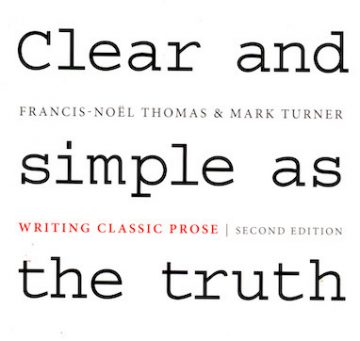 Books about how to write are so frequently described as life-changing and essential (usually by publishers, but sometimes by reviewers) that I was initially unmoved by enthusiastic reviews of Clear and Simple as the Truth: Writing Classic Prose, by Francis-Noël Thomas and Mark Turner. However, the praise seemed to focus on the fact that the book had changed the reviewers’ attitudes toward what writing is and how it works, and that interested me. I decided to get a copy, and I’m glad I did. The book describes and illustrates a particular style of writing but also, and perhaps more importantly, it really did give me a different framework for thinking about what style is and, yes, what writing is.
 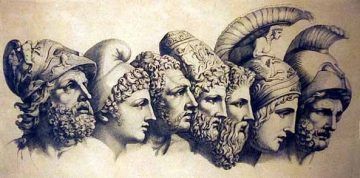 Did completing your taxes seem a Herculean task? Did cleaning your adolescent bedroom compare to mucking the Augean stables? Are you more jovial or saturnine by nature? Do you or anyone you know suffer from narcissism? Did you see the movie Titanic? Have you ever been hypnotized? Do you want to go on an odyssey? These questions are all so tantalizing, no?