
by Christopher Horner

Adolf Eichmann was hanged in Jerusalem on June 1st 1962, a little after midnight. He had been found guilty by an Israeli court of ‘crimes against the Jewish people’ and ‘crimes against humanity’. One of the reasons he is still remembered – apart from the sheer scale of the crimes committed by him – is the he became the subject of a famous book: Eichmann in Jerusalem, by Hannah Arendt. It is a troubling and controversial text, but, I think, one that holds a good deal of interest for us today. For it hs something to say about the modern subject and the way we live today. Eichmann’s significance takes us to the heart of Arendt’s central concern – the very possibility of living together politically in the contemporary world. This is an issue of obvious concern to all of us.
The Banality of Evil
Arendt’s term for what she saw and heard in Eichmann has become famous: ‘The banality of evil’: Arendt’s identification of Eichmann as a somehow thoughtless man, one who replaced reflection on the murder he was committing by clichés and formulae has become famous, so much so that it too risks joining the army of clichés, another formula to replace thought. Yet the question remains: what was it about Eichmann that she saw as significant? What Arendt saw in Eichmann was something that remains present and troubling today. This was the abdication from genuine thinking and judging that she named, an absence that accompanied him through his role in the central crime of the Twentieth Century. The high-ranking Nazi, an agent of genocide was just a colourless bureaucrat. And the manner in which this functionary did evil was as far from the demonic or sadistic as one could imagine –it was banal indeed. Arendt did not claim that evil is a banal concept, but that those who sit in offices and bring it about it are just that: not monsters but ordinary people who do not think. This banality, or ordinariness, is the disturbing reality that makes Eichmann a kind of negative exemplar, a representative figure for our times. The trial gave Arendt the opportunity to encounter the phenomenon right in front of her eyes. Read more »

 Daniel Everett’s 2008 book, Don’t Sleep, There are Snakes (Life and Language in the Amazonian Jungle), threw what seemed to be a pebble into the world of linguistics – but it is a pebble whose ripples have continued to expand. This might be thought surprising, in view of its curious construction. It contains a detailed description of the writer’s encounters with a small, remote Amazonian tribe, whom he calls the Pirahã (pronounced something like ‘Pidahañ’), but who apparently call themselves the Hi’aiti’ihi, roughly translated as “the straight ones.” They live beside the Maici River, a tributary of a tributary of the Amazon, which is nonetheless two hundred metres wide at its mouth.
 Sometime before Ashok Rudra and I started on our large-scale data collection, I was already doing some theoretical and conceptual work on agrarian relations. My first, mainly theoretical, paper on share-cropping (jointly with TN) came out in American Economic Review in 1971. That paper was unsatisfactory and had quite a few loose strands, but it was one of the first papers to look theoretically into an economic-institutional arrangement of a developing country at the micro-level. This was a time when development economics was preoccupied with macro-issues like the structural transformation of the whole economy involving transition from agriculture to industrialization or problems of its aggregate interaction with more developed economies.
 A provocative title, perhaps, and perhaps also counterintuitive. One thinks in the language one speaks, everybody knows that. Why would anyone ask bilingual speakers which language they think in (or dream in) otherwise?
 The slim, green book Natural History of Western Massachusetts is one of my favorites. Compressed into its hundred odd pages are articles and visuals that describe the essential natural features of the Amherst region, where I’ve lived since 2008. I turn to it every time something outdoors piques my interest — a new tree, bird or mammal, a geological feature.
 Everything in the universe that’s visible from your location on Earth passes by overhead every day. We’re usually able see only the stars, galaxies, planets, and so on that are in the sky when the sun is not; we become aware of them when the sun sets and Earth’s shadow rises from the eastern horizon. But all of them are there at some point in the day. We picnic beneath the winter constellation Orion in summer and walk beneath the Summer Triangle on the short days of winter. The moon also crosses the sky every day, sometimes in the daytime, and sometimes too close to the sun to be seen.
 I had my first panic attack at age sixteen, which was (deargod) over 35 years ago. It happened during school, much to my teenage mortification. Some friends and I were hanging out in our high school newspaper office during a free period, sprawled on one of the crapped-out couches under the blinking fluorescent lights, just shooting the shit. All of a sudden, a wave of horror swept over me—no, that’s not the right word. It was a feeling of fear mixed with a kind of existential dread, washing over me in waves, and then my heart was pounding, the walls were closing in, and I was gripped with an intense feeling of unreality. (This is something that people with panic disorder don’t often explain—or maybe it’s different for everyone. But for me the worst part of a panic attack is the
  Sughra Raza. Another Morning. Venice, July 2012.
 We primates of the




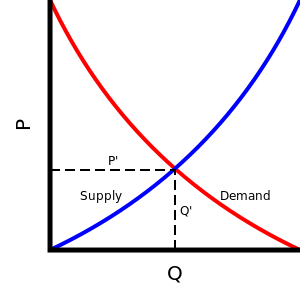 Every Econ 101 student learns the basic model of demand and supply. It’s pretty straight forward. Picture a graph with the price of a product or service on the vertical axis and the quantity supplied and demanded on the horizontal axis. There are two curves drawn on this graph: the demand curve and the supply curve. The demand curve is downward sloping because as prices decrease, consumers are willing to buy more. The supply curve is upward sloping because producers are willing to supply more when they are paid more. The “competitive equilibrium price” of the product or service is where supply equals demand: two curves intersect. When prices are higher than the equilibrium price, supply is greater than demand: there is “excess supply”. This makes sense: at higher prices, suppliers are going to be happy to sell more, but consumers aren’t willing to buy as much.