
by Kevin Lively
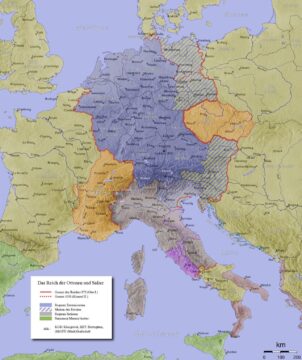
Nietzsche saw it coming early. The Europeans drowned God in the gore of Lotharingia during WWI. They dismembered the body on the Marca Geronis in WWII. They immolated the corpse with a funeral pyre made from human beings during the Holocaust. Purging these residual “ethnic impurities” sealed the millennia of ritualistic slaughter which constituted the history of nation-state formation in Europe from Charlemagne until the modern system of international relations.
With the latest brazen attack by the United States on a sovereign nation in utter disregard for the legal formalism of international diplomacy, the current framework of diplomacy between states is likewise prostrate upon the altar, with another pyre in the making.
The Fading of Past International Orders
The organs of International Law which were instituted after the conclusion of WWII were intended to be the framework in which nation-states non-violently adjudicate disagreements between themselves. Due to centuries of expanding and re-expanding the Marches, by 1945 the empires of Western Europe, the USA and the Soviet Union were in direct control of, or possessed a preponderance of influence over, the bulk of the world’s labor capacity and resources. However, by squinting somewhat, one can see an analogy of limited usefulness between the United Nations and some aspects of the various roles the Catholic Church played for the centuries from about 920 AD until about the Protestant reformation circa the 1520s.
That is to say, the church was a long-lived institutional and cultural supra-structure which transcended the loss of power by any one individual or group of individuals. The Church claimed some universalistic authority over moral approval of conflicts between the various medieval warlords and regional hegemons. Similarly, the UN of course is theoretically invested with the capacity to collectively approve of inter-state war or sanctions under some semi-transparent legalistic process.
Crucially the Church also played a central role in the moral and legal framework determining the parameters of armed conflict outside of Christendom. Of course, the Church around 1000 AD could summon many fighting men to its banner. For example Pope Leo IX, with the backing of Emperor Heinrich III, led an ill-fated army in 1053 against the Christian Norman Lords who had cut the heads off various Emirs of Sicily and occupied the south of Italy. One can see vague parallels in the UN-Army which invaded the Korean peninsula under American leadership in 1950.
Throughout the interminable cycle of Crusades from 1095 to 1699, the armed hosts and hordes of ragged peasants which went east were under little to no centralized supervision outside the decades long coalescing Teutonic Orders and Knights Templar. There were also frequent Papal Bulls – read policy memoranda – detailing, for example, when it was acceptable to enslave Muslims and African pagans in 1452. These proclamations created the moral precursors to later justification of mass enslavement of Africans and Native Americans. Broadly speaking, such pronouncements created a broad-based moral and proto-legalistic framework which formed an intellectual substrate to how Christian thinkers 100 years later would assess their relationship with the lands they had savagely depopulated in the Caribbean.
As with the modern day UN, the sanctimonious, though ultimately vacuous and hypocritical, admonishments of the church concerning violence internal to Christendom were variously acknowledged by the heavily armored warlords. Their day-to-day concern was naturally squabbling over the principle economic resources circa 1000 AD. These were arable land, peasants to work it, and Slavic pagan slaves from the marches to be sold into the far more globally integrated trade networks of the Caliphates to the south and east. Recall that the Islamic world was simultaneously in its metropolitan golden age and was enmeshed within the highly lucrative and relatively stable Indian Ocean trade routes connecting Madagascar, India, Indonesia and China.
The “peace movement” within the Church may be relatively obscure to many modern readers. Take for instance the movements around 989-1027 AD which advocated for the “Peace of God” and the “Truce of God”. The former sought to enforce protections of non-violence on or towards Church property, farmland, productive peasant capacity and churchmen. The latter sought to further impose a blanket prohibition on the slaughtering and raping of the productive capacity on Thursdays through Sundays. In certain times and places this work-shy pinko woke nonsense was buoyed by a parallel confluence of trends. It is thought that hegemonic centralization in e.g. Normandy suppressed the violent feuding of local lords, while a climactic warm period and agricultural surplus expanded the life-security of more of the population than in the proceeding 800s-900s.
To be clear, this (occasional) imploring of the church to tone it down a notch when settling internal disputes was routinely ignored. An arbitrary example is the murder of the Archbishop of Canterbury inside his Cathedral by followers of the Norman-English king Henry II in 1170. Nonetheless, there was still some quasi-formal capacity for bishops and various representatives of the church to adjudicate violent disputes.
Over time however, the legitimacy of the church as a valid arbiter eroded. In particular after the Protestant Reformation circa the 1520s when bishops and abbots, many of whom spent much of their time scheming and conniving against each other, suddenly had a radical new distinction between them. Lords either adopted Protestant or Catholic holy men to their side, weakening the possibility that any one order of God’s representatives could act as universally accepted interlocutors. This destabilization of the established order further ignited a general peasant’s revolt in central western Germany, which was brutally suppressed. Martin Luther, in panic at having inadvertently lit the spark, penned a polemic entitled, “Against the Murderous, Thieving Hordes of Peasants“.
After over a century of truly immense bloodletting, there was a culmination in the simultaneous end of the Thirty Years’ War in Germany and the Eighty Years’ War between France and England. In the German case, it is estimated that up to 50% of Germany’s population was consumed between 1618 and 1648.
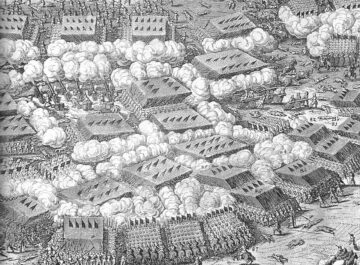
The peace treaty which concluded this ancient apocalypse was the Peace of Westphalia, sometimes remembered by laymen from the Monty Python sketch about the event. For students of International Relations however, the Treaty of Westphalia is the bedrock of their field, essentially inventing the modern western concept of state sovereignty. This was a strong step towards centralization for the previously loose collections of kingdoms bound by nominally hegemonic dynasties.
The innovations developed through these ceaseless wars are sometimes credited with finally giving the Europeans a military edge, or at least parity, with their Eurasian neighbors. These included massed artillery, mobile cannon formations and advancements in making fortifications based around gunpowder-based siege warfare. In conjunction with standing armies, this constituted what has been described as a Military Revolution by historian Michael Roberts.
Upon adopting the Chinese idea of a civil service examination around the 1800s, the professionalization and centralization of post-Napoleonic state bureaucracies introduced the next step towards humanity’s current geopolitical organization: state-nationalism. This involved the centralization of institutions and the linking of them to ethnic identity. For example standardization of language and dialect and centralized long-term resource management. As a side-effect mixed ethno-linguistic composition became a serious political liability to armed centers of power. This of course contributed to the collapse of the Austro-Hungarian empire after WWI, which effectively opened up the Eastern Marches again as a source of war and opportunity for national self-determination, and Soviet shenanigans.
This combination of ideas, which almost necessitates centralization of armed polities along ethnic lines, was subsequently violently exported across much of the planet. The series of escalating global conflicts which ensued, ultimately led to God’s coup de grâce and the emergence of the current International Order from his corpse.
The Fading of the Current International Order
With the unilateral decision of the US to bomb Iranian nuclear facilities on June 22, it appears that the United Nations Charter and International Law are now drifting towards similar levels of vacuous, hypocritical and irrelevant pageantry as the Early Medieval adomishments of the Church. For example, in response, the Russian Ministry of Foreign Affairs announced that it
“resolutely condemns [the] reckless decision to launch missile and aerial strikes on the territory of a sovereign state, regardless of the justifications offered, [which constitute] a blatant violation of international law, the UN Charter and relevant resolutions by the UN Security Council”.
Of course we rightly dismiss this as a meaningless collection of pro-forma noises issued from the mouths of hypocritical war-criminals. Although, in isolation, this statement is perfectly valid. Recall that the UN Charter holds the weight of US law due to its formal ratification by the Senate. We may further note that while Iran is a signatory to the Treaty on the Non-Proliferation of Nuclear Weapons, Israel, the US vassal-state whom this act was done in support of, is not.
Israel’s nuclear weapons stockpile has been assiduously avoided as an inconvenient topic by US administrations since Apartheid South Africa helped them obtain the bomb in 1979. Probably this is because public acknowledgment of this fact would then invoke the 1977 Glenn Amendment to the US’s Arms Export Control Act which would ban military-logistic sales and support to Israel. This widely known “secret” was recently flaunted by Israeli television — with multi-part documentaries detailing this abrogation and contravention of International and US domestic law. Nonetheless as Ted Cruz has indirectly pointed out F-16 and Israeli-modified F-35I fighter jets manufactured by the American firm Lockheed-Martin form the back-bone of the Israeli air force outside of their ageing fleets of modified McDonnell-Douglas-Boeing F-15s from the late 70s. The tactical flexibility Israel demonstrated in Iranian airspace clearly showed that, “We now have complete and total control of the skies over Iran.”, as the president posted.
I am not wading into the question of one nation’s claim of defense as justification for external military strikes, or another nation’s right to refine nuclear fuel under rigorous inspection by the International Atomic Energy Agency. What I am trying to emphasize here is that there was no serious attempt made at any point, to my knowledge, to appeal to international adjudication by any party in the conflict. There were not, to my knowledge, even vacuous noises made in that direction by the US administration throughout the 12-day war.
There is of course a long history of contempt and disregard for International Law between both Republican and Democratic administrations. However, some token genuflection to the concept of multilateralism was at least sometimes attempted — even by otherwise rabidly militaristic neoconservative elements in both Bush administrations.
Take for example UN Security Council Resolution 1386, approving the deployment of the International Security Assistance Force into Afghanistan between 2001-2014 under the auspices of NATO. For a military pact with North Atlantic in the name, this is a pretty far-afield out-of-theater campaign. Russia, which has consistently been very vocally opposed to NATO enlargement into eastern Europe and conducting of bombing operations in the former Yugoslavia, nonetheless contributed logistic support in Afghanistan. China also voted in favor on the Security Council despite having a small land border with the Central Asian country in question. However, the argument has also been made that the internationalization of a “war on terror” narrative helped cement legitimacy for Russia’s ongoing struggles in the Muslim Chechnyan Marches and China’s growing problems with the Muslim Uyghurs in the Xinjiang March bordering Afghanistan.
Even a decade prior to 9/11, even George H. W. Bush obtained Security Council Approval for coalition hostilities against Iraq in 1991. This was likely some vague token of good faith to mulitateralism on an issue with broad support. In any case, it helped build perceptions of US commitment to engagement with Eurasian powers after a minor escapade in the Meso-American March of Panama in 1989 which displaced at least 20,000 people and killed a few thousand civilians.
Such token genuflections have contributed to the consensus framing within US media such as the New York Times, Wall Street Journal, as well as international relations think-tanks such as the Council on Foreign Relations (CFR) that the USA is the leader of an international “rules-based order”. With resolute and determined blindness, one can attempt to overlook the rich history of abrogations to the “rules based order” in just the Middle East Marches in just this century. However, to understand the challenge posed in achieving this level of deliberate ignorance, it is worth reminding ourselves of the reverence with which recent US administrations have held up their own order which led to an estimated direct and indirect death toll of 4.5-4.7 million people.
The Middle Eastern Marches
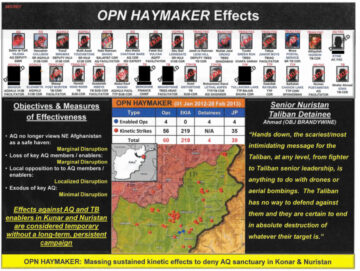
The most obvious examples are the Bush II administration’s invasion of Iraq and the Obama administration’s far-flung and well honed assassination complex spanning virtually all the Marches in the area: Somalia, Yemen, Afghanistan, Iraq, Syria and Pakistan. Obama, being the legal scholar and Nobel Peace Laureate that he is, tried to at least dress the murder system left to him by Bush in the flowery pedantry of legalism.
The selected targets ripe for assassination, including at least four US citizens, had their information collected into “Baseball Cards” which would be perused in a menu of death on roughly a weekly basis circa 2012. Selection by the judge, jury and executioner – read US President – meant courteous assistance in shuffling off the mortal coil within another week or so by drone or aerial assault forces. Collection of information on the now ex-target’s friends and family would lead to the next round of assassinations being queued up, according to Jeremy Scahills’ investigative reporting. This “rapid mission tempo” strategy is further attested to in the CFR insider account from Sean Naylor. In total over his presidency, Obama approved strikes which killed approximately 3,800 people including scores of women and children. They hardly slowed down to explain the 4 US citizens already killed by 2013.
Being a internationalist-oriented liberal, Obama was nonetheless a believer in some inter-state diplomacy, even if the sub-state terrorist networks and the communities they operate in were only worthy of contemptuous bombing. The 2015 negotiation of the Joint Comprehensive Plan of Action (the Iran Deal) was a genuine multilateral settlement which included Europe, China and Russia, and was a positive step towards normalization of US-Iranian relations.
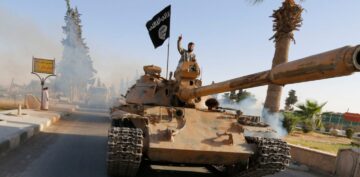
However, the whole tenor of the situation in the Mesopotamian Marches changed after the emergence of the Islamic Caliphate (ISIS) in 2014. In contrast to the preceding decade-long slog of low- to medium-grade counter-insurgency in Iraq and Afghanistan, the emergence of a highly coordinated state-like structure, armed to the teeth with virtually the entirety of the abandoned military equipment of the now dissolved US vassal state in Iraq actually posed an imminent threat to the interests of most of the regional powers: the US, Russia, Iran, Israel and Turkey.
Unlike those low-level insurgencies, as horrible as the daily — but on average lower number of — civilian casualties were, the formation of a new functionally armed contingent cutting through the lines of the Picot-Sykes agreement was serious business. This couldn’t be handled by “precise and coordinated targeted killings” from afar. No light scale privatization through mercenary firms or funneling trillions of dollars through lucrative contracts would do here. This was a nation-state like army in uniform, and a serious threat to virtually every actor’s interests in the region. There’s really only one tried and true solution for that kind of thing: a lot of people need to die.
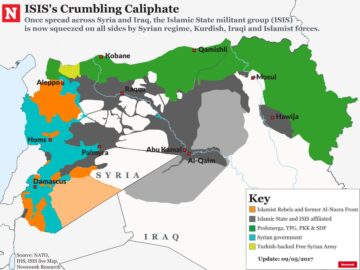
The Russians for their part arguably applied the lessons of Chechnya to back the Assad government in the west, annihilating whole city blocks in the process. The Americans meanwhile went to a mostly air-war footing focused on the center with Kurdish and allied ground forces providing the necessary boots on the ground. It’s important to note that this greatly empowered the Kurds, a cross-border ethnic group whose fluctuating desire for unity within a nation-state has been a bane to Turkey and Saddam Hussein alike for decades – thus at odds with many interests of the NATO keystone keeping Russia hemmed into the Black Sea. The final Battle of Raqqa in 2017, then the de-facto capitol of ISIS, was, in the words of one US commander, “some of the most intense urban fighting since WWII”. About 80% of the city was destroyed through what ultimately amounted to staggered carpet bombing, resulting in thousands of civilians killed and at least 90% of the population of the city, some 270,000 people, dispersed as refugees.
Meticulously documented and researched investigative journalism in collaboration with Airwars and other nongovernmental organizations reported on this campaign in the New York Times. Authoritative on-the-ground samples of interviews with survivors in 2017 indicate that the proportion of strikes which involved civilian casualties was about 31 times higher than the coalition had reported. This bombing campaign drew no major attention in the US media, nor sparked any major public protest while it was underway. Likely the public was inured to the reality of the bombing by the long standing assertions that precision bombing via laser- and satellite- guided munitions minimizes civilian casualties – along with panic at the prisoner-beheading Caliphate. During his 2016 presidential bid, there was barely any push back to Ted Cruz suggesting to bomb to the point of seeing if “sand can glow in the dark”.
Iran for its part played a nuanced role. To divert the very real threat of invasion, it had been infiltrating and to some extent agitating the insurgency in Iraq to keep the US bogged down there. Now Iran found itself marching its Quds force openly into the east of what was once Iraq in order to put down ISIS, which it was mortally opposed to. General Stanley McChrystal who oversaw the Iraqi theater for the USA until 2008 has described the Quds as a combination of the CIA and the Joint Special Operations Command JSOC — which is the aforementioned ground / aerial assault arm of the US assassination complex. For context, Seal Team Six, which took out Osama Bin Ladin, is a subdivision of JSOC. If you’re interested in learning more about these assassins, see the first few episodes in the podcast by ex-JSOC operative Jocko Willink on his time serving in Iraq as the occupation was shifting into a counter-insurgency stance, or this lecture by Sean Naylor of the CFR mentioned above.
Thus, there was the bizarre circumstance of US air power bombing in a strategic theater where Iranian ground troops had overlapping tactical interests, yet there was, apparently, little to no direct communication or coordination between the two forces. Trump, bringing his unique blend of mafioso charm and criminal energy, dispensed with the ritual incantations of legalism and instead opted to destroy the Iran deal and assassinate the leader of the Quds as thanks for their help. Now he strikes Iran directly when he sees a moment of weakness.
It is patently obvious that the natural and logical conclusion Iran will draw from this conflict is that further talks with the west would be madness. Especially when they were sitting at the negotiating table as the USA helped to run logistics behind the sneak attack which ultimately murdered over 900 Iranian civilians and wounded over 3,000 others. Indeed it seems that the only reasonable route they have to prevent further attacks is to develop a nuclear deterrent: have you seen any serious proposals recently to attack North Korea? Naturally, another authoritarian and nuclear-armed nation, which is in perennial low-level conflict with its neighbors is, as we’ve just seen from the India-Pakistan spat, an incredibly destructive outcome for the region and for the share of the Iranian population who wish for internal reform.
Yet the USA and Europe seem unconditionally supportive of propping up the current Israeli government’s military hegemony in the region, no matter what atrocities it performs, even as it prolongs the war in a desperate bid to stay in power. Thus, the possibility of any negotiated settlements to determine an acceptable regional security architecture is vanishing under the rain of rockets falling from the sky.
Conclusion
In summation it appears that in the planning centers of the global hegemon, Human Rights law, the Geneva conventions and the UN Security Council have been abandoned as relevant factors. Instead we have naked power plays displaying contempt for civilian life, and open aggression without even the pretense of attempting to adjudicate conflicts with anything other than “kinetic options“. The kinetic option after all comprises one of America’s last remaining comparative advantages on the world stage . . . besides the wildly asymmetric dominance in technological and corporate markets throughout Europe.
So is International Law as a meaningful moral framework as dead as the charred bones of God’s corpse? Given the interminable litany of US, USSR, French, English and even Dutch backed coups and wars around the world from 1945 onwards, did it ever truly exist or was it merely an elaborate pretext for sanitizing the concept of Great Power politics? Was the legalism all just vacuous busy-work for liberally minded academics and pundits within the hegemonic states? The present criminally brief and insubstantial summarizing of facts which, in a functioning media and educational ecosystem, would be much more commonly understood within a much broader context, brings home the seriousness of these questions.
Our paper-thin shield of genuflection to Human Rights and International Law has been put to the sword by blood-soaked warlords. Let us pray that spontaneous evolution of our neocortexes will rapidly allow us to abandon these catastrophic blood feuds. While we wait, if you happen live in the United States, call your goddamn Congressional representatives to ask them why they don’t care about enforcing the War Power Resolutions Act, International treaties bearing the weight of US law, or indeed domestic US law.
Meanwhile, if you live in a NATO country, agitate your representatives to ensure that the reinvigorated role the alliance seeks to have will truly be defensive and that the investment in defense isn’t squandered on purely kinetic options. Functioning digital, physical and social infrastructure is just as, if not more, crucial to defense than mobilizing surplus war production or funneling European and Canadian tax dollars into US “defense” companies.
Meaningful democratic oversight of human affairs cannot be drowned in blood, because we know full well what we would be left with. Quite frankly, it doesn’t look much different to what we have now. With the coming waves of climate-refugees and authoritarian states disrupted by ever more desperate populations, there must be an increased awareness of, and active opposition to, the churning slaughter of humanity which the fruit of our labor has yielded for decades, if not millennia. Coalitions among a spectrum of anti-war oriented opinion must settle their differences long enough to be arrayed in defense of the sanctity of all human life. Resisting or not, we will all be judged by what we leave behind.
Enjoying the content on 3QD? Help keep us going by donating now.