No Time for Wisdom

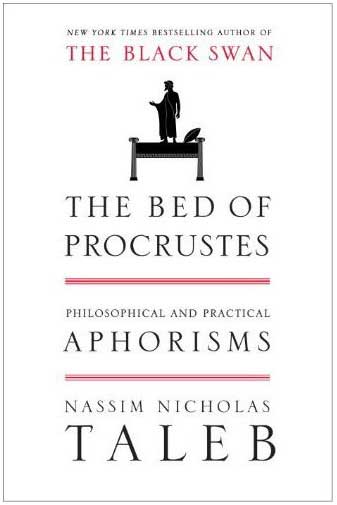
BedOfProcrustes It’s been roughly 20 years since I’ve purchased a book with the intention of gaining insight into life lived wisely. Like nearly everyone else, nearly all of the time, I have read for other reasons: as an engaging diversion, to reinforce things I already believed, to further my knowledge relevant to my career, to get some concrete piece of practical information, etc.

And so it was when I bought Nassim Nicolas Taleb’s latest book, Bed of Procrustes. Since it is a book of aphorisms from the iconoclastic ex-financier, I expected to grab some zingers on the misuse of statistics and economic theory. What I found, to my embarrassment, was a man focused on the problem of wisdom. Not “wisdom” with respect to predicting the future in financial contexts, but wisdom in something close to the classic sense of a well-lived life–a contemporary version of the Aristotelian megalopsychos. And to be clear: I was embarrassed for myself, not for Taleb.

The aphorism as an art form has been malnourished, humbled and neglected long enough that today it lives a life on the margins. In public media, the aphorism is replaced by the soundbite or the slogan: one meant for evanescent consumption and the other meant to preclude thought rather than stimulate it. Where the transmission of aphorisms survives, it is often reduced to the conveyance of a clever or uplifting saying. For millions of managers and executives, their most frequent contact is probably their daily industry newsletter from SmartBrief, where at the bottom of the list of stories every day is an out-of-context bon mot from a philosopher, statesman, famous wit, or business “thought leader.” (Example: “The difference between getting somewhere and nowhere is the courage to make an early start. The fellow who sits still and does just what he is told will never be told to do big things.”–Charles Schwab, entrepreneur)

Given this background, Taleb’s book, with all its crabby scorn, is a welcome effort. It is more than an attempt to rehabilitate the aphorism in the service of a well-lived life. It is also part of Taleb’s self-conscious rejection of common presumptions about knowledge (self-knowledge, business knowledge, academic knowledge) and value (the value of work, qualities of greatness).

The left holds that because markets are stupid models should be smart; the right believes that because models are stupid markets should be smart. Alas, it never hit both sides that both markets and models are very stupid.

The weak shows his strength and hides his weaknesses; the magnificent exhibits his weaknesses like ornaments.

As with Nietzsche, embracing the encapsulated form of the aphorism expresses an attitude towards knowledge of the human condition: as much a rejection of helpless formal systems in philosophy as of false precision in social science. At the same time, an aphorism is itself a bed of Procrustes. It cuts the observable complexity down to a kernel that can be more easily digested and retransmitted. Many of the best aphorisms also contain metaphors; they falsify when taken literally and break down if pushed too hard.

Read more »

Monday, October 25, 2010

Statistics – Destroyer of Superstitious Pretension

Statistics-education-research-day1 In Philip Ball’s Critical Mass: How One Thing Leads to Another, he articulates something rather profound: statistics destroys superstition. The idea, once expressed, is simple but does not stem its profundity. Incidents in small numbers sometimes become ‘miraculous’ only because they appear unique, within a context that fuels such thinking. Ball’s own example is Uri Geller: in the 1970’s, the self-proclaimed psychic stated he would stop the watches of several viewers. He, perhaps, twisted his face and furrowed his brow and all over America watches stopped. America, no doubt, turned into an exclamation mark of incredulity. What takes the incident out of the sphere of the miraculous, however, is the consideration of statistics: With so many millions of people watching, what was the likelihood of at least some people’s watches stopping anyway? What about all those watches that did not stop?

Our psychological make-up seeks a chain in disparate events. Our mind is a bridge-builder across chasms of unrelated incidents; a credulity stone-hopper, crouching at each juncture awaiting the next link in a chain of causality. To paraphrase David Hume, we tend to see armies in the clouds, faces in trees, ghosts in shadows, and god in pizza-slices.

Many incidents that people refer to as miraculous, supernatural, and so on, become trivial when placed within their proper context. Consider the implications of this: Nicholas Leblanc, a French chemist, committed suicide in 1806; Ludwig Boltzmann, the physicist who explained the ‘arrow of time’ and gave us the Boltzmann Constant, committed suicide in 1906; his successor, Paul Ehrenfest, also committed suicide, in 1933; the American chemist Wallace Hume Carothers, credited with inventing Nylon, killed himself in 1937. This seems to ‘imply’ a strong link between suicide and science. Of course, as Ball indicates himself, we must look at the contexts: We must ask what the suicide-rating of these different demographics was in general: of Americans, Europeans, males, and any other demographic.

Read more »

Monday, September 6, 2010

And Another ‘Thing’ : Sci-Fi Truths and Nature’s Errors

by Daniel Rourke

In my last 3quarksdaily article I considered the ability of science-fiction – and the impossible objects it contains – to highlight the gap between us and ‘The Thing Itself’ (the fundamental reality underlying all phenomena). In this follow-up I ask whether the way these fictional ‘Things’ determine their continued existence – by copying, cloning or imitation – can teach us about our conception of nature.

Seth Brundle: What’s there to take? The disease has just revealed its purpose. We don’t have to worry about contagion anymore… I know what the disease wants.

Ronnie: What does the disease want?

Seth Brundle: It wants to… turn me into something else. That’s not too terrible is it? Most people would give anything to be turned into something else.

Ronnie: Turned into what?

Seth Brundle: Whaddaya think? A fly. Am I becoming a hundred-and-eighty-five-pound fly? No, I’m becoming something that never existed before. I’m becoming… Brundlefly. Don’t you think that’s worth a Nobel Prize or two?

The Fly, 1986

In David Cronenberg’s movie The Fly (1986) we watch through slotted fingers as the body of Seth Brundle is horrifically transformed. Piece by piece Seth becomes Brundlefly: a genetic monster, fused together in a teleportation experiment gone awry. In one tele-pod steps Seth, accompanied by an unwelcome house-fly; from the other pod emerges a single Thing born of their two genetic identities. The computer algorithm designed to deconstruct and reconstruct biology as pure matter cannot distinguish between one entity and another. The parable, as Cronenberg draws it, is simple: if all the world is code then ‘all the world’ is all there is.

Vincent Price in 'The Fly', 1958Science fiction is full of liminal beings. Creatures caught in the phase between animal and human, between alien and Earthly, between the material and the spirit. Flowing directly from the patterns of myth Brundlefly is a modern day Minotaur: a manifestation of our deep yearning to coalesce with natural forces we can’t understand. The searing passions of the bull, its towering stature, are fused in the figure of the Minotaur with those of man. The resultant creature is too fearsome for this world, too Earthly to exist in the other, and so is forced to wander through a labyrinth hovering impossibly between the two. Perhaps Brundlefly’s labyrinth is the computer algorithm winding its path through his genetic code. As a liminal being, Brundlefly is capable of understanding both worlds from a sacred position, between realities. His goal is reached, but at a cost too great for an Earthly being to understand. Seth the scientist sacrifices himself and there is no Ariadne’s thread to lead him back.

In her book on monsters, aliens and Others Elaine L. Graham reminds us of the thresholds these ‘Things’ linger on:

“[H]uman imagination, by giving birth to fantastic, monstrous and alien figures, has… always eschewed the fiction of fixed species. Hybrids and monsters are the vehicles through which it is possible to understand the fabricated character of all things, by virtue of the boundaries they cross and the limits they unsettle.”

Elaine L. Graham, Representations of the Post/Human

Read more »

Monday, August 9, 2010

‘The Thing Itself’ : A Sci-Fi Archaeology

by Daniel Rourke

Mid-way through H.G.Wells’ The Time Machine, the protagonist stumbles into a sprawling abandoned museum. Sweeping the dust off ancient relics he ponders his machine’s ability to hasten their decay. It is at this point that The Time Traveller has an astounding revelation. The museum is filled with artefacts not from his past, but from his own future: The Time Traveller is surrounded by relics whose potential to speak slipped away with the civilisation that created them.

Having bypassed the normal laws of causality The Time Traveller is doomed to inhabit strands of history plucked from time’s grander web. Unable to grasp a people’s history – the conditions that determine them – one will always misunderstand them.

Archaeology derives from the Greek word arche, which literally means the moment of arising. Aristotle foregrounded the meaning of arche as the element or principle of a Thing, which although indemonstrable and intangible in Itself, provides the conditions of the possibility of that Thing. In a sense, archaeology is as much about the present instant, as it is about the fragmentary past. We work on what remains through the artefacts that make it into our museums, our senses and even our language. But to re-energise those artefacts, to bring them back to life, the tools we have access to do much of the speaking.

The Things ThemselvesLike the unseen civilisations of H.G.Wells’ museum, these Things in Themselves lurk beyond the veil of our perceptions. It is the world in and of Itself; the Thing as it exists distinct from perceptions, from emotions, sensations, from all phenomenon, that sets the conditions of the world available to those senses. Perceiving the world, sweeping dust away from the objects around us, is a constant act of archaeology.

Kant called this veiled reality the noumenon, a label he interchanged with The-Thing-Itself (Ding an Sich). That which truly underlies what one may only infer through the senses. For Kant, and many philosophers that followed, The Thing Itself is impossible to grasp directly. The senses we use to search the world also wrap that world in a cloudy haze of perceptions, misconceptions and untrustworthy phenomena.

In another science fiction classic, Polish writer Stanislaw Lem considered the problem of The Thing Itself as one of communication. His Master’s Voice (HMV), written at the height of The Cold War, tells the story of a team of scientists and their attempts to decipher an ancient, alien message transmitted on the neutrino static streaming from a distant star. The protagonist of this tale, one Peter Hogarth, recounts the failed attempts at translation with a knowing, deeply considered cynicism. To Peter, and to Stanislaw Lem himself, true contact with an alien intelligence is an absolute impossibility:

“In the course of my work… I began to suspect that the ‘letter from the stars’ was, for us who attempted to decipher it, a kind of psychological association test, a particularly complex Rorschach test. For as a subject, believing he sees in the coloured blotches angels or birds of ill omen, in reality fills in the vagueness of the thing shown with what is ‘on his mind’, so did we attempt, behind the veil of incomprehensible signs, to discern the presence of what lay, first and foremost, within ourselves.”

Stanislaw Lem, His Master’s Voice

Read more »