
So You Want to Be a Scientist?

by David Kordahl

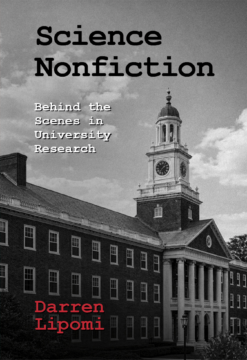
Cover of "Science Nonfiction" by Darren Lipomi

When I was a physics graduate student at Arizona State, one of my fellow grad students had a roommate who, after obtaining an undergraduate business degree, got a job as an office assistant for an economics professor. The roommate (remember, not a grad student) was earning like a young professional, not a wizard’s apprentice. “You know what he’s doing this week?” the grad student told us during a typical lunchtime rant. “He’s downloading files one by one from a dot-gov website and copying them into spreadsheets. A week of work, for what I could write as a five-minute script! And he’s getting $60,000 a year for this!”

Whether or not $60,000 sounds like a lot of money depends on one’s position. My whole life, I have seen claims the median physics B.S. graduate makes that much, but I personally didn’t make $60,000 until my third year as an assistant professor—and, even then, only after getting another job and negotiating a raise.

Science Nonfiction: Behind the Scenes in University Research, the new memoir from Dr. Darren Lipomi, chair of the Department of Chemical and Sustainability Engineering at the University of Rochester, addresses such issues bluntly—until it doesn’t. “There is a fair case to be made that the financial burden of research is borne not by the taxpayer,” Lipomi writes, “but by the ‘forever trainee’—the twenty-two-year-old PhD student who becomes a postdoctoral scholar at twenty-nine, and an untenured research scientist at thirty-four.” But now in his mid-forties, having more or less figured the system out, Lipomi is doing better than fine, and his memoir charts an uneasy path between celebration and critique. Read more »
Monday, June 6, 2022

Against the Erasure of Dissent

A Conversation between Andrea Scrima and Anike Joyce Sadiq

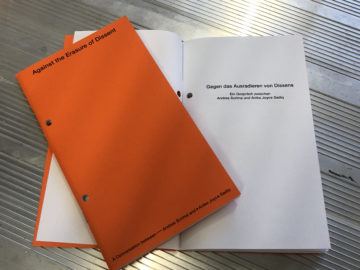
“Against the Erasure of Dissent,” part of the exhibition “Mit Glück hat es nichts zu tun” (It has nothing to do with luck), Anike Joyce Sadiq at the Künstlerhaus Stuttgart, Germany (2022). Photo: Andrea Scrima

The following conversation took place from November 2021 to February 2022 via e-mail in reaction to a general meeting of the Villa Romana Association that took place on October 28, 2021 in Martin-Gropius-Bau, Berlin. The authors participated in this meeting in their function as members, having been actively involved for two years in a group of artists that had formed in response to a new funding situation. When there was no longer any way to prevent a simultaneous changeover in directors, the group sought to at least preserve the Villa Romana as a place created by artists for artists and to ensure that the general direction of the program established under Angelika Stepken be continued.

The Villa Romana was founded in 1905 as a German art association in Florence. In addition to an exhibition program and numerous collaborations with artists as well as with art and cultural institutions both local and international, the Villa Romana Prize is awarded each year to four artists or collectives from Germany in the form of a ten-month residency and grant.

This conversation attempts, from the authors’ perspective, to reconstruct, contextualize, and archive the discussions that occurred between artist members and the board and the course these took over time. It poses questions about membership and the extent of agency it allows, and inquires into the role artists play in shaping institutional structures. Financial and political dependencies, the seeming openness of a diversity-based policy toward art and culture, and the (re)distribution of the real and symbolic capital that becomes legitimized by a non-profit status are subjects of investigation. Read more »