
Philip Ball in Prospect Magazine:
 Most AI systems used today—whether for language translation, playing chess, driving cars, face recognition or medical diagnosis—deploy a technique called machine learning. So-called “convolutional neural -networks,” a silicon-chip version of the highly-interconnected web of neurons in our brains, are trained to spot patterns in data. During training, the strengths of the interconnections between the nodes in the neural network are adjusted until the system can reliably make the right classifications. It might learn, for example, to spot cats in a digital image, or to generate passable translations from Chinese to English. Although the ideas behind neural networks and machine learning go back decades, this type of AI really took off in the 2010s with the introduction of “deep learning”: in essence adding more layers of nodes between the input and output. That’s why DeepMind’s programme AlphaGo is able to defeat expert human players in the very complex board game Go, and Google Translate is now so much better than in its comically clumsy youth (although it’s still not perfect, for reasons I’ll come back to).
In Artificial Intelligence, Melanie Mitchell delivers an authoritative stroll through the development and state of play of this field. A computer scientist who began her career by persuading cognitive-science guru Douglas Hofstadter to be her doctoral supervisor, she explains how the breathless expectations of the late 1950s were left unfulfilled until deep learning came along. She also explains why AI’s impressive feats to date are now hitting the buffers because of the gap between narrow specialisation and human-like general intelligence. The problem is that deep learning has no way of checking its deductions against “common sense,” and so can make ridiculous errors. It is, say Marcus and Davis, “a kind of idiot savant, with miraculous perceptual abilities, but very little overall comprehension.” In image -classification, not only can this shortcoming lead to absurd results but the system can also be fooled by carefully constructed “adversarial” examples. Pixels can be rejigged in ways that look to us indistinguishable from the original but which AI confidently garbles, so that a van or a puppy is declared an ostrich. By the same token, images can be constructed from what looks to the human eye like random pixels but which AI will identify as an armadillo or a peacock.
More here.
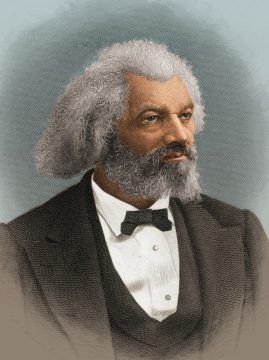 I have had but one idea for the last three years to present to the American people, and the phraseology in which I clothe it is the old abolition phraseology. I am for the “immediate, unconditional, and universal” enfranchisement of the black man, in every State in the Union. [Loud applause.] Without this, his liberty is a mockery; without this, you might as well almost retain the old name of slavery for his condition; for in fact, if he is not the slave of the individual master, he is the slave of society, and holds his liberty as a privilege, not as a right. He is at the mercy of the mob, and has no means of protecting himself.
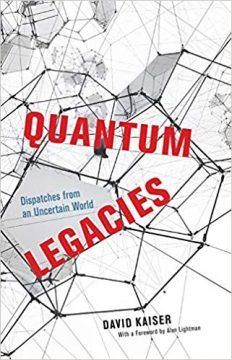 Michael D. Gordin in the LA Review of Books:
 Alexander Klein in Aeon:
 Alan Livsey in the FT:
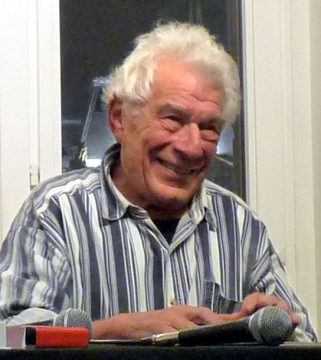 Bruce Robbins in The Nation:
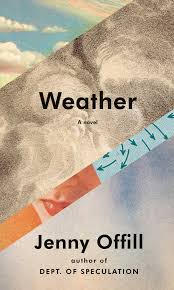 Offill’s writing is shrewd on the question of whether intense psychic suffering heightens your awareness of the pain of others, or makes you blind to it. The answer, of course, is that it can do both; that it inevitably does both. Sometimes Offill’s narrators seem vulnerable to the delusion that their dysfunction sets them apart — that they are breaking down against the backdrop of others’ composure, which can come across as self-deprecation but is actually its own form of egotism. But part of the brilliance of Offill’s fiction is how it pushes back against this self-deception: “Stay, just stay,” the wife in “Dept. of Speculation” tells her suicidal student, a girl overcome by pain of her own; while Lizzie’s meditation teacher, who believes in reincarnation, insists that “everyone here has done everything to everyone else.” Lizzie is often overwhelmed by her interior landscape, but she is also often aware that everyone around her inhabits an interior landscape that feels just as intense; and that they are all inhabiting an exterior landscape with intensities of its own.
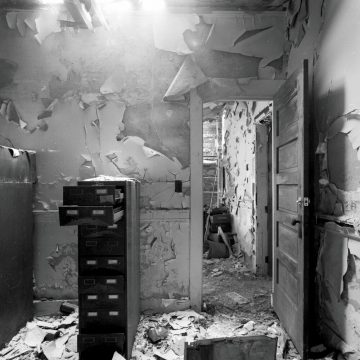 What makes industrial landscapes unique is that they fascinate regardless of whether they’re operating. The hellish Moloch of a petrochemical refinery is as captivating as one of the many abandoned factories one passes by train, and vice versa. That doesn’t mean, though, that all industrial landscapes are created equal. Urban manufacturing factories are considered beautiful—tastefully articulated on the outside, their large windows flooding their vast internal volumes with light; they are frequently rehabilitated into spaces for living and retail or otherwise colonized by local universities. The dilapidated factory, crumbling and overgrown by vegetation, now inhabits that strange space between natural and man-made, historical and contemporary, lovely and sad. The power plant, mine, or refinery invokes strong feelings of awe and fear. And then there are some, such as the Superfund site—remediated or not—whose parklike appearance and sinister ambience remains aesthetically elusive.
 This week, Nature is publishing a suite of papers that sheds new light on the
 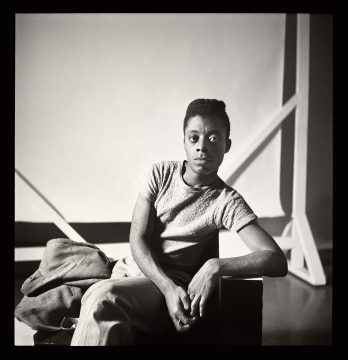 I was icily determined—more determined, really, than I then knew—never to make my peace with the ghetto but to die and go to Hell before I would let any white man spit on me, before I would accept my “place” in this republic. I did not intend to allow the white people of this country to tell me who I was, and limit me that way, and polish me off that way. And yet, of course, at the same time, I was being spat on and defined and described and limited, and could have been polished off with no effort whatever. Every Negro boy—in my situation during those years, at least—who reaches this point realizes, at once, profoundly, because he wants to live, that he stands in great peril and must find, with speed, a “thing,” a gimmick, to lift him out, to start him on his way. And it does not matter what the gimmick is.
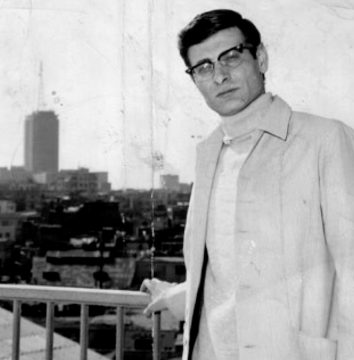 The late Palestinian poet Mahmoud Darwish (1941–2008) liked to write in the mornings, preferably in a narrow room with a window overlooking a tree. He required solitude and coffee; he wrote in black ink on loose, thick, white paper. He often listened to music. His poems, he told the journalist and fellow poet Abbas Beydoun in 1995, always started out as a cadence, a tempo. “My mornings are sad,” Darwish said. But his afternoons and evenings could be joyful, for as he explained to Beydoun:
 Picture a calm river. Now picture a torrent of white water. What is the difference between the two? To mathematicians and physicists it’s this: The smooth river flows in one direction, while the torrent flows in many different directions at once.
 What if everything you think you know about politics is wrong? What if there aren’t really American swing voters—or not enough, anyway, to pick the next president? What if it doesn’t matter much who the Democratic nominee is? What if there is no such thing as “the center,” and the party in power can govern however it wants for two years, because the results of that first midterm are going to be bad regardless? What if the Democrats’ big 41-seat midterm victory in 2018 didn’t happen because candidates focused on health care and kitchen-table issues, but simply because they were running against the party in the White House? What if the outcome in 2020 is pretty much foreordained, too?
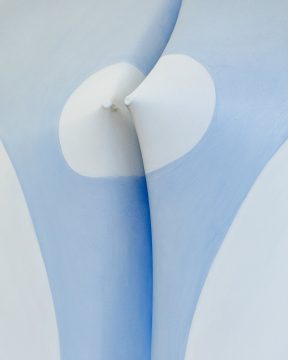 The Cuban-born Ms. Sánchez, who will turn 94 this summer, has spent some 50 years making abstract, shaped, sculptural paintings, and is still at work. While modern art has a firmly established tradition of objects that simultaneously hang on the wall and jut into space (think of Robert Rauschenberg’s collagelike “
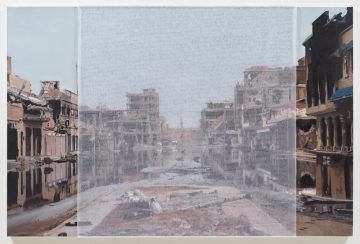 Aesthetically the artworks are strangely, hauntingly beautiful. They spark a desire to sojourn a while with the images, sensing that each one offers something that is difficult to refuse, difficult to ignore. In this regard, the collection of works compel the viewer to experience their testimony. Without this aesthetic intervention, the paintings might lack force and simply read as interesting comments on a political moment. Instead, it is an evocation of a sense of vulnerability and beauty that is the enlivening force in this body of work.
 And yet there were probably also ways in which the characters we created revealed something about us. I liked outsiders of various kinds, half-orcs and thieves, sympathetic fringe types; partly, no doubt, because I never stayed anywhere long enough in my childhood to be an insider. For some reason, I also preferred shorter races, halflings and dwarves, and identified with the Bilbos and Gimlis of the world rather than the Aragorns and Boromirs – the tall, powerful men – although I was six foot six (and a deeply frustrated benchwarmer on the basketball team) by the time I finished high school. D&D grew out of Middle Earth and drew on William Morris-style fantasies of medievalism. I read Morris, too (The Defence of Guenevere), and like any good American loved the Cotswolds (which we day-tripped into during our Oxford years). The charm of the English countryside suggests a life in which you can walk out of one small world, through fields, hills and countryside, to enter another, and this is also the romance of Dungeons & Dragons.
 The Voting Rights Act of 1965, signed into law by President Lyndon B. Johnson, aimed to overcome legal barriers at the state and local levels that prevented African Americans from exercising their right to vote as guaranteed under the 15th Amendment to the U.S. Constitution. The Voting Rights Act is considered one of the most far-reaching pieces of civil rights legislation in U.S. history.