
From American Radio Works:
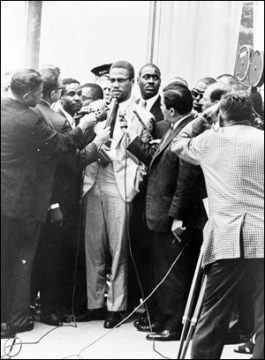 Whenever the Negroes keep the Democrats in power they’re keeping the Dixiecrats in power. This is true! A vote for a Democrat is nothing but a vote for a Dixiecrat. I know you don’t like me saying that. I’m not the kind of person who come here to say what you like. I’m going to tell you the truth whether you like it or not. [applause] Up here in the North you have the same thing. The Democratic Party don’t – they don’t do it that way. They got a thing they call gerrymandering. They maneuver you out of power. Even though you can vote they fix it so you’re voting for nobody. They got you going and coming. In the South they’re outright political wolves, in the North they’re political foxes. A fox and a wolf are both canine, both belong to the dog family. [laughter, applause] Now, you take your choice. You going to choose a northern dog or a southern dog? Because either dog you choose, I guarantee you, you’ll still be in the doghouse.
This is why I say it’s the ballot or the bullet. It’s liberty or it’s death. It’s freedom for everybody or freedom for nobody. [applause] America today finds herself in a unique situation. Historically, revolutions are bloody, oh yes they are. They have never had a bloodless revolution. Or a non-violent revolution. That don’t happen even in Hollywood [laughter] You don’t have a revolution in which you love your enemy. And you don’t have a revolution in which you are begging the system of exploitation to integrate you into it. Revolutions overturn systems. Revolutions destroy systems.
A revolution is bloody, but America is in a unique position. She’s the only country in history, in the position actually to become involved in a bloodless revolution. The Russian Revolution was bloody, Chinese Revolution was bloody, French Revolution was bloody, Cuban Revolution was bloody. And there was nothing more bloody than the American Revolution. But today, this country can become involved in a revolution that won’t take bloodshed. All she’s got to do is give the black man in this country everything that’s due him, everything. [applause]
More here. (Note: Throughout February, at least one post will honor The Black History Month. This year’s theme is “African Americans and the Vote.” Readers are encouraged to send in their suggestions)
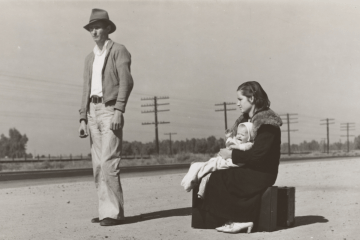 In 1831, Alexis de Tocqueville took a 10-month trip to the United States to study the American penal system. In the resulting book—
 The Greek statesman Demosthenes is credited with saying “I am a citizen of the world,” and the idea that we should take a cosmopolitan view of our common humanity is a compelling one. Not everyone agrees, however; in the words of former British Prime Minister Theresa May, “If you are a citizen of the world, you are a citizen of nowhere.” On the other side of the political spectrum, groups who share a feature of identity — race, ethnicity, gender, sexuality, and others — find it useful to band together to make political progress. Kwame Anthony Appiah is a leading philosopher and cultural theorist who has thought carefully about the tricky issues of cosmopolitanism and identity. We talk about how identities form, why they matter, and how to negotiate the difficult balance between being human and being your particular self.
 You should sit low, not on a chair or a stool or a couch. A small crate will do the job. Or anything that is lower than 9.5 inches from the ground. You can’t shave or cut your hair. You can’t have sex. You shouldn’t take a shower, though you may do some light swabbing of your especially funky bits, as well as dousing your feet and hands in cold water now and again. You can’t greet people in the normal way. You definitely cannot work. No freshly laundered clothes. The list of things you cannot do is long.
 GEORGE STEINER IS A CHARMING
 Men not reading women’s writing is widespread, and they begin not reading early. In the university applications that cross my desk, it’s common for male candidates not to mention a single female author, despite otherwise showing evidence of wide and ambitious reading. The opposite is rare.
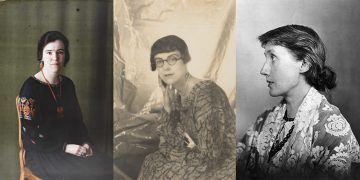 “I would venture to guess that Anon, who wrote so many poems without signing them, was often a woman,” wrote Virginia Woolf in A Room of One’s Own (1929). In that essay, commenting on the fact that women’s lives are “all but absent from history,” she argues that this is not only a consequence of the ways women have been deprived of the material conditions under which their talents can prosper but also reveals the sort of events and lives historians have traditionally considered worth remembering—primarily, the public activities of “great men.” Perusing the index of G. M. Trevelyan’s History of England, Woolf looks up “position of women” and is dismayed to find only a smattering of references, mostly to customs of arranged marriage, wife-beating, and the fictional heroines of Shakespeare. Flicking through chapters on wars and kings, she wonders why so little room is left for women’s activities in the events that “constitute this historian’s view of the past.” It was clear to Woolf that new histories were needed, which would examine the reality of women’s lives, their relationships and activities, and the forces that thwarted their ambitions.
 Sometime around 2 billion years ago, a bacterium slipped inside a larger cell, started producing energy there, and became the indispensable powerhouse we know today as the mitochondrion, so the working theory goes. But that old story now has a new twist. Scientists have detected the organelles outside of cells, apparently functioning perfectly well while drifting around the blood of healthy people, according to findings published recently (January 19) in
 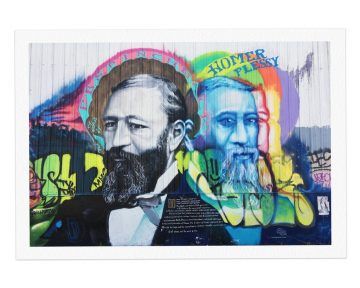 When Homer Plessy boarded the East Louisiana Railway’s No. 8 train in New Orleans on June 7, 1892, he knew his journey to Covington, La., would be brief. He also knew it could have historic implications. Plessy was a racially mixed shoemaker who had agreed to take part in an act of civil disobedience orchestrated by a New Orleans civil rights organization. On that hot, sticky afternoon he walked into the Press Street Depot, purchased a first-class ticket and took a seat in the whites-only car. The civil rights group had chosen Plessy because he could pass for a white man. It was asserted later in a legal brief that he was seven-eighths white. But a conductor, who was also part of the scheme, stopped him and asked if he was “colored.” Plessy responded that he was. “Then you will have to retire to the colored car,” the conductor ordered.
 I believe there is much to be learned philosophically from the study of languages that are spoken by only a small number of people, who lack a high degree of political self-determination and are relatively powerless to impose their conception of history, society, and nature on their neighbours; and who also lack much in the way of a textual literary tradition or formal and recognisably modern institutions of knowledge transmission: which for present purposes we may call “indigenous” languages.
 On the Puerto Rican
 The annual
  For
For