John Heil in IAI News:
 Why is consciousness so perplexing to so many? Perhaps, owing to our being conscious, we regard ourselves as experts on the matter, and it seems to us blindingly obvious that consciousness could not possibly be a brain state or process. We have a front-row seat, an unmediated first-hand awareness of what conscious experiences are like, and we know well-enough what brain processes are like. The two could not be more different. In the hands of philosophers, this sentiment is transmuted into the doctrine that consciousness cannot be identified with, or ‘reduced to’, anything physical. The reduction in question must be a relation among explanations, or predicates, not as it is sometimes cast, a relation among properties. What would it be to reduce something to something else? If the As are not reducible to the Bs, explanations of the As could not be derived from explanations of the Bs, nor could A-terms be analysed or paraphrased in a B-vocabulary.
Why does our confidence in the outré character of consciousness not extend to tables and trees? Take tables. We know what tables are like, and we know what physics reveals about their makeup. Individual tables are solid, coloured, smooth to the touch, but physics tells us that tables are, as Eddington put it, mostly empty space sparsely populated by colourless particles. Or tables might turn out to be perturbations in fields, thickenings in spacetime, or something stranger still. We are content to leave it to physics to discover the nature of whatever it is that makes assertions about individual tables true, thereby telling us what those tables are. Our inability to extract truths about tables from truths about particles or fields is unremarkable: tables are, in this regard, irreducible. What would be remarkable is someone’s insisting that from this it follows that tables could not possibly be clouds of particles or disturbances in fields, because tables obviously differ from such things. Claims to the effect that tables ‘arise’ or ‘emerge’ from clouds of particles or perturbations in fields, while more common, would be no less remarkable.
Why not think the same of consciousness? Why not think that neuroscience, and ultimately physics, might eventually reveal the nature of whatever makes particular ascriptions of consciousness true, what consciousness is?
Two shibboleths bar the way.
More here.

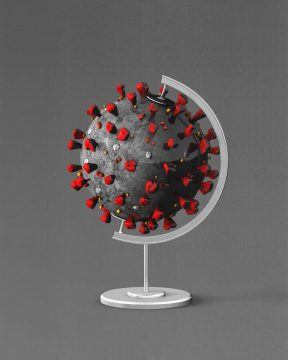 In retrospect—in the rueful retrospect we are living in already—we’ll say that the virus was there all along, in the circumstances that enabled it to spread. It was there in a globally integrated society of travel, work, and commerce, the connecting and conveying powers of which far outstripped the capacity of our health systems to deal with their effects and challenged our willingness to reckon with the downsides of such integration. But it was there, too, in the language and imagery of viruses, which has been commonplace in our society for a couple of decades now—so much so that the ubiquity of virus as metaphor may have left many of us unprepared to recognize and fear the lethal literal viruses circulating among us, and to prepare ourselves and our societies against them.
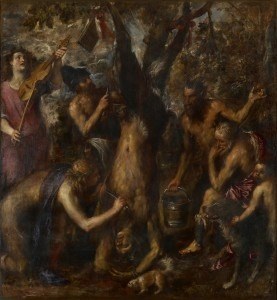 To ‘review’ such supreme paintings is slightly absurd. These are the touchstones from which Rubens, Velazquez and Rembrandt learnt and their successors still do. Van Dyck actually owned ‘Perseus and Andromeda’; Lucian Freud confessed that he, too, would have liked to have had one of these Titians on his wall. He couldn’t choose between ‘Diana and Actaeon’ and ‘Diana and Callisto’, which he considered jointly ‘simply the most beautiful pictures in the world’.
 There are few reading pleasures that compare with a passionate expert describing their work, and Ziminski stands proudly in this field. He is a mason working in the West Country, repairing and restoring prehistoric tombs, stone circles, Roman fragments and Christian churches, all the time trying to adopt the techniques used by the builders of these places. This has allowed him to construct an fascinating and idiosyncratic picture of English history. He travels by bicycle and boat and his mind wanders as he works, conjuring up with remarkable deftness disappeared English worlds and the ordinary people who lived in them. Envisaging the lives of forgotten builders – why they made the choices they did, how they lived, where they went – naturally entails a good deal of supposition, imagination and ‘must have beens’. But Ziminski’s speculations carry unusual authority, as he takes himself to the same places as them, performing the same tasks with the same tools and materials and facing the same problems.
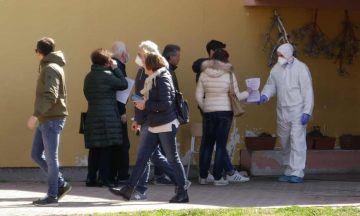 It’s now about one month since Covid-19 began to
 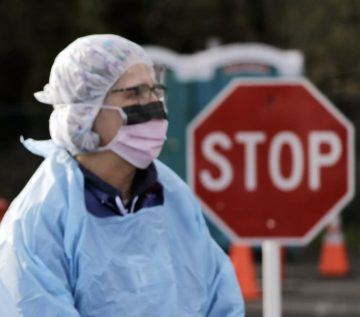 Here’s the grimmest version of life a year from now: More than two million Americans have died from the new coronavirus, almost all mourned without funerals. Countless others have died because hospitals are too overwhelmed to deal adequately with heart attacks, asthma and diabetic crises. The economy has cratered into a depression, for fiscal and monetary policy are ineffective when people fear going out, businesses are closed and tens of millions of people are unemployed. A vaccine still seems far off, immunity among those who have recovered proves fleeting and the coronavirus has joined the seasonal flu as a recurring peril.
 Dearest Rosemary,
 During the Spanish flu of 1918, it was Vick’s VapoRub. During the 1962 Cuban Missile Crisis, it was canned food. Now, as the number of cases of
 I
I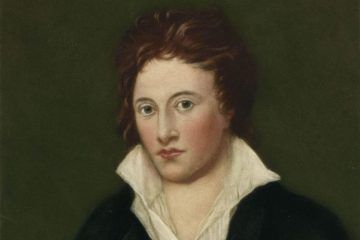 One of English’s great, scornful, scorching political poems was premiered in an unassuming place: the postscript of a letter: “What a state England is in! But you will never write politics.” It was December 1819, and Percy Bysshe Shelley, then 27, was writing another pushily impassioned letter to Leigh Hunt, a poet, a radical, and the founding editor of the Examiner. Since 1818, Shelley and his wife, the novelist Mary Shelley, had been restless expatriates in Italy, never in any one city for long. Dead by drowning three years later, he never revisited his home country and never quite escaped its orbit, gravitationally tugged back by England’s tumultuous politics. However desperate for Hunt’s dispatches (“Why don’t you write to us?” the letter opens), Shelley, never afraid to speak his mind, thought his friend deserved a “scolding”: “I wish, then, that you would write a paper in the Examiner, on the actual state of the country, and what, under all the circumstances of the conflicting passions and interests of men, we are to expect.” Surely Shelley meant wish wholeheartedly, but he was also setting up Hunt for a surprise present, which he introduced, with coy calm, in his postscript. “I send you a sonnet. I do not expect you to publish it, but you may show it to whom you please.”
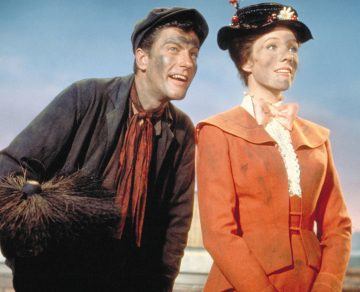 On screen and off, Edwards came to see something in Andrews that Kael—and other critics like her—could not. Underneath her wimple, as the nuns say of Maria, Andrews had curlers in her hair. Yes, in nearly every role she comports herself like the queen of some imaginary, borderless kingdom. But there is also an odd tension beneath the surface of Andrews’s most ostensibly wholesome performances—the kind that can drive a viewer to all sorts of wild speculation about what Mary Poppins gets up to on her days off, and that can inspire an entire volume of queer theory that hinges upon a dissident reading of the boyish Maria von Trapp (see: Stacy Wolf’s 2002 A Problem Like Maria: Gender and Sexuality in the American Musical). Pinning down the hidden complexities and contradictions of Andrews’s stardom is a bit like holding a moonbeam in your hand. As composer and broadcaster Neil Brand put it to The Guardian last year, Andrews may just be “the politest rebel in all cinema.”
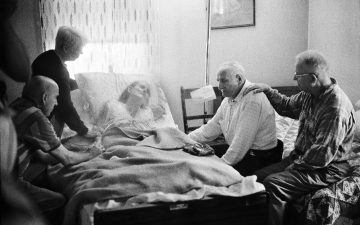 ‘I wouldn’t show them the note,’ a retired nurse, told my mother. It was a request to meet with my father’s physicians. He had undergone a cardiac surgery, and soon after became lethargic and difficult to rouse. The nurses thought he was simply fatigued from his procedure, and my mother didn’t want to question their professional judgment. Two days later, my father suffered an acute respiratory failure and was rushed to the intensive care unit (ICU). He was intubated and remained dependent on a respirator for days. The nurses told my mother that the doctors were considering a tracheostomy, but up to that point no ICU physician (called an ‘intensivist’) had so much as talked to my family.