Chase Quinn in The Guardian:
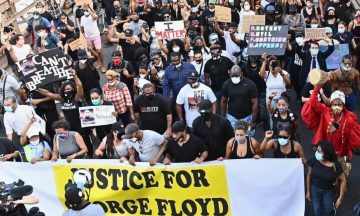 How does it feel to be black in America right now? First, I wonder, do I capitalize the “B”? Is that grammatically correct? More to the point, as an element of style, a choice, does it prove something to you or to me if I don’t? I confess I don’t know any more. These are the petty games that play on my mind as a black American. I cannot speak for all black people, of course. We are not a monolith; you seem to understand this by now. I can only speak for myself – as a black writer. That experience, at least, I know. Instead of worrying about the white man who might murder me in my own home, or on my morning run, what preys on me in the night is how I constructed the sentence as I replay the day, if it was adequately punctuated in its disavowal of racist oppression.
You see, I was raised in the house of “you can be whatever you want – with hard work,” the appendix like the slamming shut of a piano. I’m 33 years old. I was taught to be proud of being black, and I am. There are few things of which I am prouder. No dangling prepositions here, just the facts. I have earned the straight As. I have stayed past the bell. I have pushed myself to raise my hand, to venture an answer, even when I wasn’t sure I understood the question. I was taught that fear, like racial oppression or homophobia, was to be overcome. Walk with your head held high, my mother taught me. Let them admire and be transformed by your strength, by your unassailable conduct. Play it again, Sam – the one that says things will be different in the next life. They’ll look at me and think how far we’ve come. But will they, actually?
I heard from my cousin the other day. She texted me a video of her son on the news. He was protesting in front of the White House. To the newscaster, he said: “They’re not hearing us.” His friend added: “When you talk, it’s just words to them.” Just words indeed. I thought to myself: I should be proud. Proud that my little cousin, who also survived a school shooting just a few years ago, is out on the street, marching, standing up for what is right. Proud of his mother too, for raising a young black man and sending him to college, as a single mother. But instead I felt sorry, like I’d failed him. Like we all had.
More here.

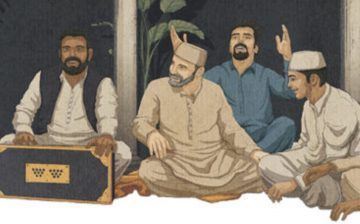 After barreling through the relentlessly flat, verdant Punjabi hinterland in a rented Toyota, stopping briefly for naan, kebabs, and petrol, we hit town at three, four in the morning, and at three, four in the morning, music wafts through the still, sticky summer air. Millions gather each year for ten days in the hilly medieval town of Pakpattan, in Pakistan, to commemorate the death anniversary of the twelfth-century saint Baba Farid, celebrating the reunion of man and his maker with qawwali—call it Muslim soul. When Doc, a pal and Pakpattan regular, urged me to join him on the pilgrimage the night before—it’s Baba’s 776th death anniversary, he informs me—I decided to accompany him. I can’t refuse Doc: I’ve got his back; he’s got mine. And who knows? Perhaps Baba will bless me as well. But you have to believe to be blessed.
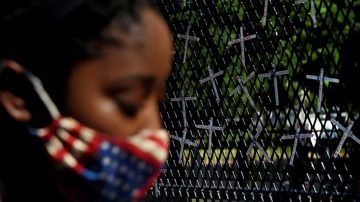 When protests erupted in the US in response to the killing of George Floyd on May 25, the anger over police brutality was also fuelled by a sense of simmering injustice over the impact of coronavirus. Not only have black people died from the disease in disproportionately high numbers: there are early signs they will bear the brunt of the economic fallout too.
 A podcast only hits the century mark once! And for Mindscape, this is it. There have been holiday messages and bonus episodes and the like. But this is the 100th officially-numbered episode. To celebrate, I decided to treat myself to a solo episode in which I reflect, somewhat non-systematically, on the age-old question of the meaning of life. I end up spending a lot (most?) of the time talking about the meaning of “life,” i.e. what it means to be a living organism in a naturalistic universe. But then I go on to muse about the construction of human meaning in a world where values are not imposed on us or objectively grounded in physical facts.
 Less than two weeks after Floyd’s killing, the American death toll from the novel coronavirus has surpassed 100,000. Rates of infection,
  We moved forward with the idea of assembling a canon, aware of the chutzpah, based on a few understandings. One is our belief that even when canon formation is not taking place explicitly in a closed gathering, certain ideas and texts become implicitlycanonical through other means such as compelling presentation, citation, and education. Communities and consensuses can create canon by bringing powerful ideas to life and to market, and by privileging some ideas and texts over others. For example, Yosef H. Yerushalmi’s Zakhor is required reading in dozens of college and graduate school courses in Jewish Studies; it is among the most commonly cited texts in Jewish Studies lectures in both academic and lay settings. No one person decided that the book is important, but the book has emerged over time as a canonical piece of Jewish Studies scholarship with relevance for the larger Jewish community. In engaging actively and directly in canon formation, in naming what we were doing an act of “canonization,” and in inviting commentary from our colleagues we hoped to call attention to the implicit canonization that was already happening and to open a conversation about it.
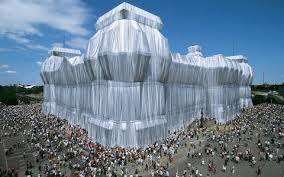 100,000 square metres of fabric was used to wrap the Reichstag in 1995. Christo and Jeanne-Claude said at the time that the project was born out of his ‘acute interest’ as a political refugee in the relationship between East and West: ‘Here they meet in the most dramatic way.’ The event received wide press coverage, like all their projects, but was also the subject of a personal documentary about Christo and Anani. Standing beside the wrapped Reichstag, leaning against the remains of the Berlin Wall, Anani, by then a famous actor, is anguished: ‘I never had Hristo’s energy. He left with a pencil in his pocket and made it. I never dared.’
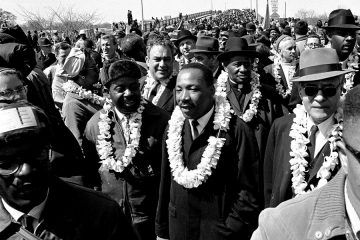 There is an unholy invocation that rises from some Americans in times of racial distress. It is an exclamation from the voices of the status quo, the clarion call of conservative thinking: What would Martin Luther King do? It is as unauthentic and uninspiring as it is ambiguous – and that is the point. Reducing Dr. King’s understanding of racial and social issues to a warped perspective of the “I Have A Dream” speech is propagandist and ahistorical, but it has worked.
 The first thing
 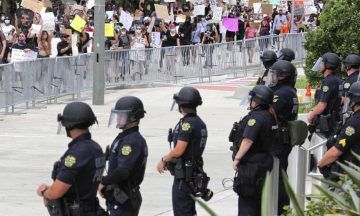 The call to “defund the police” has
  For vonny leclerc
 The largest number of COVID-19 supercomputing projects involves designing drugs. It’s likely to take several effective drugs to treat the disease. Supercomputers allow researchers to take a rational approach and aim to selectively
 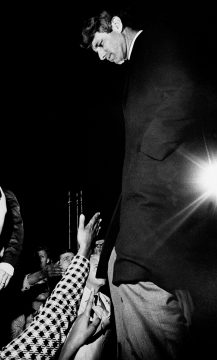 Today marks the anniversary of the death of Robert F. Kennedy, assassinated in 1968 after winning the primary in California, on the way to obtaining the nomination of the Democratic party and, perhaps, the presidency.
 I
I