
 Mona Ali in The Political Quarterly:
In this ongoing catalogue of coronavirus-related disorder – extraordinary death tallies, a global lockdown and chaotic financial markets – history reminds us that it is in precisely these conditions that old doctrines are overturned and new paradigms are ushered in.
Crises catapult changes. Amidst this pandemic there are now mass protests across America following the death of George Floyd, an African American, at the hands of a white police officer. The tear gas and ‘show of force’ tactics deployed by the US police on protesters mark a new inflection point in this crisis, highlighting its perils and possibilities.
This moment, if any, clarifies and crystallises the necessity of a new social contract. Whilst economic thinking might appear distant and removed from more immediate concerns, unequal access to finance and other forms of social provisioning has amplified the suffering of marginalised communities across the world.
Now is the time to conceive and construct a new international monetary system, different to the present which furthers the political and economic dominance of a few to one founded on principles of social justice and sustainability. Lessons learned from the past might guide us as we reimagine global money for the twenty-first century.
More here.
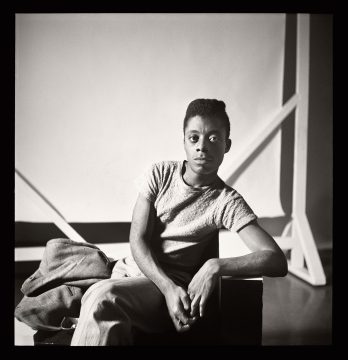 James Baldwin in The New Yorker:
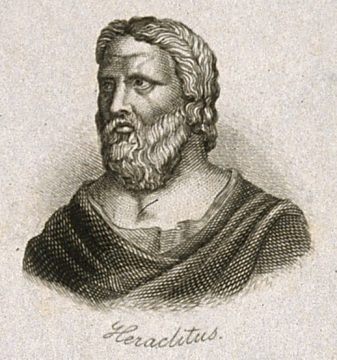 Andrew Hui in Aeon:
 Quinn Slobodian in The Guardian:
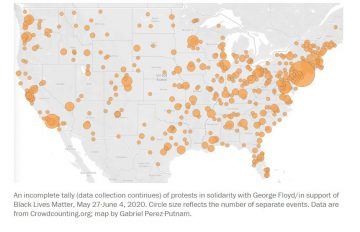 Lara Putnam, Erica Chenoweth and Jeremy Pressman over at the Monkey Cage:
 A
A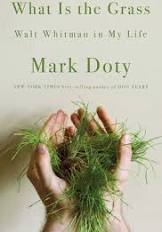 Academic critics of Dryden or Pope were not in the habit, the last time I checked, of interspersing their monographs with reminiscences of sex clubs in Manhattan. An affectionate excursus on that subject in Mark Doty’s What is the Grass announces that this is no ordinary piece of literary criticism. ‘And your very flesh shall be a great poem,’ wrote Doty’s subject, Walt Whitman, who, one suspects, wouldn’t have minded a bit. Perhaps best known for his 1993 collection My Alexandria, prompted by the AIDS pandemic, Doty is one of the most compelling modern singers of ‘the body electric’ and in What is the Grass he has produced an elegant meditation on the great founding father of American poetry. Not only did Whitman’s example fire up the democratic modern lyrics of W C Williams and Allen Ginsberg; it also licensed poets to place themselves centre stage in their prose, from Adrienne Rich in What is Found There to Susan Howe in her prose-poetry hybrids. It is a licence that Doty seizes on greedily.
 Before Italy became a nation, it was made up of a collection of city-states governed by un’autorità superior, in the form of a powerful noble family or a bishop. Siena was an exception in that it favoured civic rule. This partly accounts for the unique character of its art. It produced Ambrogio Lorenzetti’s The Allegory of Good and Bad Government, a series of frescos housed in the Palazzo Pubblico, the civic heart of the city. It is one of the earliest and most significant secular paintings we have. If civic rule were a church, this would be its altarpiece. Siena also imbued its artists with a rare and humanist curiosity that, even in their depictions of religious scenes, involved them in meditations on human psychology and ideas.
 In 1916, the 26-year-old Agatha Christie finished writing her first detective novel at Dartmoor, a quiet upland in Devon, UK, known for its beautiful granite hilltops. Sir Arthur Conan Doyle had published The Hound of the Baskervilles, in 1902, which would become one of the most widely read Sherlock Holmes adventures—and the story was set in this same corner of the world, Dartmoor.
 The
The  As it turns out, humans are wired to worry. Our brains are continually imagining futures that will meet our needs and things that could stand in the way of them. And sometimes any of those needs may be in conflict with each other.
 In the opening lines of Cold Warriors, Duncan White notes that “between February and May 1955, a group covertly funded by the Central Intelligence Agency launched a secret weapon into Communist territory”: balloons carrying copies of George Orwell’s
  In the early nineteen-hundreds, the American writer O. Henry coined the term “banana republic” in a series of
  The idea for publishing a novel posthumously came to Kingston after learning of Mark Twain’s autobiography, which wasn’t released in uncensored form until 2010, a hundred years after his death. If Kingston knew that she wouldn’t have to answer for her work, perhaps she would be able to write more freely. At first, her notes represented an attempt to capture each day’s “intensity,” she said. In time, she realized that she had written about twelve hundred single-spaced pages. She continued writing. She told her agent, Sandy Dijkstra, that the book would remain unpublished for a hundred years. “I was stunned, shocked, and more,” Dijkstra said in an e-mail, “and told her that I could not promise to be a living and functioning agent a century from now.” Kingston has not shown her any of it. “Maybe you can persuade Maxine to show it to us much sooner,” she said. “Magical thinking works on the page, but not so well in real life.”