
Enjoying the content on 3QD? Help keep us going by donating now.
Category: Recommended Reading
The Death and Life of the Straight White Man’s Novel
Marc Tracy at the NY Times:
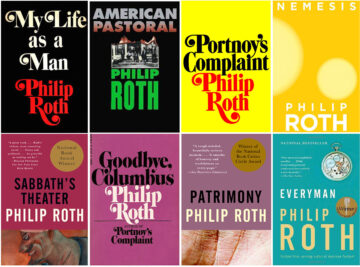 “Unwilling to portray themselves as victims (cringe, politically wrong), or as aggressors (toxic masculinity), unable to assume the authentic voices of others (appropriation), younger white men are no longer capable of describing the world around them,” Savage, who is 41, wrote. What they do write, he added, avoids “grappling directly with the complicated nature of their own experience in contemporary America.”
Savage’s essay has attracted both derision and amens in newspapers and journals, on social media and Substacks, over drinks and in group chats. “I think the nerve I hit is fairly obvious,” Savage said in an interview, adding, “being able to put numbers behind it was cathartic to some people and triggering to others.” Humming underneath the disputation is a less tangible but more significant question. Let us say the perspective of the straight white man is being dampened in the world of literary fiction. Should we care?
more here.
Enjoying the content on 3QD? Help keep us going by donating now.
Thursday Poem
The Where in My Belly
Scientists say my brain and heart
are 73 percent water—
they underestimate me.A small island—minis, I emerged
among Minnesota’s northern lakes,
the where of maanomin—wild rice in my belly.I am from boats and canoes and kayaks,
from tribal ghosts who rise at dawn
dance like wisps of fog on water.My where is White Earth Nation
and white pine forests,
knees summer stained with blueberries,
pink lady slippers open and wild as my feet.I grew up where math was Canasta,
where we recited times tables
while ice fishing at twenty below,
spent nights whistling to Northern Lights.I am from old: medicines barks and teas;
from early—the air damp with cedar
the crack of amik, beaver tails on water.Their echo now a warning to where—
to where fish become a percentage of mercury,
become a poison statistic;
to where copper mines back against
a million blue acres of sacred.I am from nibi and ogichidaakweg
women warriors and water protectors, from seed
gatherers and song makers.The wet where pulse in my belly whispers and repeats
like the endless chant of waves on ledgerock
waves on ledgerock on ledgerock on waves
on water. . .nibiKimberly Blaeser
from Split This Rock
—listen here
Enjoying the content on 3QD? Help keep us going by donating now.
The Exemplary Figures of History
Enjoying the content on 3QD? Help keep us going by donating now.
Against Self-Optimization
David Zahl in Plough:
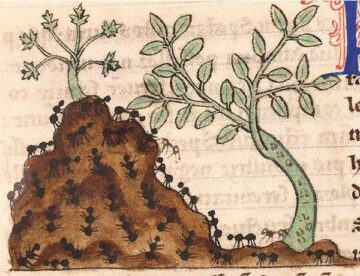 Some people have a gift for polemics. I am not one of them. Two of my personal favorites are Lauren Oyler and Martin Luther. Their takedowns, even when excoriating, are bathed in clarity and passion. But that club is a small one, and even if I possessed the necessary chops – which I do not – I don’t think I’d apply for membership. It is too scary a vocation for someone of my disposition. Only an extraordinarily detestable target could lure me into a screed. I would require a topic that not only reeks of malign associations but gets under my skin in a singular way. Something like, say, optimization.
There is a meme that makes the rounds every new school year among parents of elementary-school-aged children. I’m pretty sure it originates from the initial Covid lockdown, but the punchline still lands. A middle-aged man stands in a crowd with hands on hips, his facial expression the epitome of Not Amused. Above the picture someone has produced a message from a teacher. “Just log into Zabelzoot, scroll down to the Zork! App, and have the kids work through the assignments sent through Kracklezam.”
More here.
Enjoying the content on 3QD? Help keep us going by donating now.
Wednesday, July 2, 2025
She’s Leaving Home, Bye-Bye
Jeannette Cooperman at The Common Reader:
 “How would you feel about living in another country?”
My husband has been worrying for quite some time about—brace for the list—growing social and political instability, rising healthcare and food costs, vanishing protections (for civil rights, the environment, a free press, the arts, food safety, disaster relief, science, and education), and the increasingly atavistic attitude of many Americans. Besides, since boyhood my history-loving husband has yearned to live in a country with a slower pace of life, one that honored custom and tradition without being xenophobic. “A shame,” he used to mock-sigh, “that the Duchy of Grand Fenwick exists only in fiction.”
Now, though, Andrew is serious. And I am overwhelmed. Abandon our friends? Disassemble a house packed with books and the accumulated stuff of a lifetime? The farthest I have ever moved was a fifty-minute drive from our previous home. I am not the transient type.
And yet, in less than a week, I fall in love with the idea.
More here.
Enjoying the content on 3QD? Help keep us going by donating now.
Did Baby Talk Give Rise to Language?
Carl Zimmer in the New York Times:
 If you’ve ever cooed at a baby, you have participated in a very special experience. Indeed, it’s an all but unique one: Whereas humans constantly chatter to their infants, other apes hardly ever do so, a new study reveals.
“It’s a new feature that has evolved and massively expanded in our species,” said Johanna Schick, a linguist at the University of Zurich and an author of the study. And that expansion, Dr. Schick and her colleagues argue, may have been crucial to the evolution of language.
Other mammals can bark, meow, roar and hoot. But no other species can use a set of sounds to produce words, nor build sentences with those words to convey an infinite variety of meaning. To trace the origin of our gift of language, researchers often study apes, our closest living relatives.
More here.
Enjoying the content on 3QD? Help keep us going by donating now.
The Battle For The Future Of AI: Half-hour Documentary
Enjoying the content on 3QD? Help keep us going by donating now.
A Billion Years of Evolution in a Single Afternoon
Enjoying the content on 3QD? Help keep us going by donating now.
Eat Your AI Slop or China Wins
Robert Bellafiore in The New Atlantis:
 From Washington, D.C. to Silicon Valley, champions of new technologies often argue, with good reason, that we must embrace them because, if we don’t, the Chinese will — and then where will we be?
Driven by geopolitical pressures to accelerate technological development, particularly in AI and biotech, we seem to have two options: channeling innovation toward humane ends or protecting ourselves against competitors abroad.
To appreciate the difficulty of this choice, we should take a page from military theorists who have wrestled with what is known as the “security dilemma.” Even though it is one of the most important concepts in international relations, it has been given little attention by those grappling with the promises and challenges of new technologies. But we should, because when we apply its core insights to technological development, we realize that achieving a prosperous human future will be even more difficult than we tend to think.
More here.
Enjoying the content on 3QD? Help keep us going by donating now.
Trump’s Inheritance of the Legacy of the Left
Martin Jay at Salmagundi:
 Leftists argued, with considerable justification, that the MAGAworld response to neo-liberalism was little more than scapegoating where, to cite the Marxist geographer David Harvey, you “blame immigrants, foreign competition, in other words you blame everything except the underlying problems of capital because that is something which you’re allowed to talk about.” But in addition to these diversionary strategies, Trump won his second term in office promising to raise tariffs, bring manufacturing back to America, and defy international economic institutions. Despite his reassurances to powerful corporations that their profits would continue to grow, he managed to convince a sufficient number of aggrieved anti-globalist voters that he was on their side in the battle against unaccountable, unelected elites who sought to run the world on their terms.
Anti-elitism itself became a general rallying cry for MAGA voters, who resented the political and cultural power of those on the coasts and in the mainstream media with fancy college degrees and cosmopolitan disdain for rural and small town America. Although they rarely cited it, C. Wright Mills’ leftist classic, The Power Elite, published in 1956, already targeted the stranglehold that a loose coalition of federal government, large corporations and military leaders, had on ordinary citizens.
more here.
Enjoying the content on 3QD? Help keep us going by donating now.
The Big Heat: Fate’s Network
Jonathan Lethem at The Current:
 It starts with a gun, a hand, a staircase, a clock. A woman descends the stairs at the sound of a shot. A policeman, we are soon to learn, has committed suicide, but the behavior of his fresh-minted widow is coolly utilitarian. She conceals his suicide note, and telephones criminals, rather than police; her call results in further calls, by criminals, to further criminals. The telephone in The Big Heat (1953) will be more than a conveyor of bad news, though it is always that. The opening sequence of calls announces an instant metonym for a power network of dubious alliances stringing a city and civilization together. The mode is one that would have been familiar by 1953: the collective expressive atmosphere that would come to be called “noir”—one that this film’s director, Fritz Lang, had famously helped to invent. We are secure in the company of a master of cinematic evidence-gathering: the exacting hand and the pitiless eye of Lang—the most accomplished, imperious, and notorious of the contingent of German émigré directors in 1930s Hollywood.
Lang fled the Nazis in 1933, arriving first in Paris, where (like Vladimir Nabokov) he created one French-language work before crossing the Atlantic to make a life’s creative home in exile. His recruitment to the American studio system was news: Germany’s most prominent director arrived trailing fame, his stylized science-fiction epic Metropolis (1927) among the most legendary of silent films, his M (1931) enshrined as a modernist masterwork of the early sound era.
more here.
Enjoying the content on 3QD? Help keep us going by donating now.
Why aren’t Italians as obese as Americans? It’s not really what they eat.
Tamar Haspel in The Washington Post:
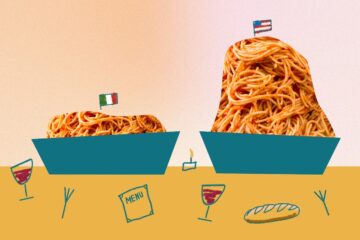 I had the great good fortune to spend the entire month of May in Italy. And if you’ve heard the reports of people going there on vacation, eating their way through the country, and miraculously coming home a few pounds lighter, I’m here to tell you it doesn’t always work out that way. Those folks, though, often come home scratching their head about why Italians are so much thinner than Americans. And, when you go to Italy, or even read about going to Italy, it does make you wonder. They eat cookies for breakfast. Lunch and dinner are typically multicourse meals, with a pasta or risotto as a first course and a meat dish as a second. There are sometimes antipasti as well. Even schoolkids often get multicourse meals.
And the foods! Charcuterie! Cheese! Ravioli! Pizza! Focaccia! Gelato! On its face, it doesn’t seem like a recipe for avoiding weight gain. Yet, according to the U.N.’s Food and Agriculture Organization, the obesity rate among Italian adults was 17 percent in 2022. In the United States, it was 42 percent.
More here.
Enjoying the content on 3QD? Help keep us going by donating now.
Muharram Qawwali
Enjoying the content on 3QD? Help keep us going by donating now.
Wednesday Poem
Pike
I take it he doesn’t think at all,
But muscles his slippery fight, an engine
Green deep, powering his belly flash
In his water mother, his horizonless well;
The hooked gill the fault in the world
Of his will, his preying paradise.
Near enough to net I have him,
And the murk of his body is my fear
Of our meeting somehow equally.
He pauses on the strain of my line;
I have him netted, sluicing the air,
How pure and brave my wet thrasher, my enemy.
by John Bruce
from Canadian Poetry Online
Enjoying the content on 3QD? Help keep us going by donating now.
Tuesday, July 1, 2025
Hong Sang-soo | Directors Dialogue
Enjoying the content on 3QD? Help keep us going by donating now.
How Societies Morph With the Seasons
Cecilia Padilla-Iglesias in Sapiens:
 If you ask a BaYaka Forager in the Central African rainforest, “Where do you live?,” they often reply with a question of their own: “Mouanga or Pela?”
You’ll get the same response for nearly any question about their lives: Who do you live with? Who is this camp’s leader? How do you mourn the dead?
“Mouanga or Pela?”—meaning, “dry or wet season?” The BaYaka’s social world shifts throughout the year. The location and size of their homes, the materials used to build them, leadership, funerals—all transform depending on the season.
As an evolutionary anthropologist working with the BaYaka, I initially presumed people simply adjusted because of the seasonal availability of different foods. But their changes extended way beyond sustenance into the realms of politics, economics, rituals, and relationships.
More here.
Enjoying the content on 3QD? Help keep us going by donating now.
On Hong Sangsoo
Andrew Eckholm at n+1:
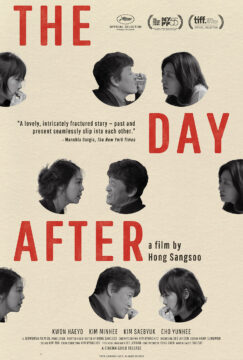 The narrative premises of Hong Sangsoo’s films tend to be simple. A chance encounter on the street. A quick trip to a nearby town. A man walks into a bar. Where the films of a director like, say, his countryman Bong Joon-Ho unfold through the exposition of a concept, Hong’s films are not built around ideas. The plot is not contained in the premise. Instead, he presents you with a place, an actor, a situation. From there the movie proceeds with an aleatory nimbleness, noticing details—a repeated gesture, a revealing bit of dialogue—that accumulate to reveal the characters and story. The director’s camera technique is likewise simple: extraordinarily long, single-shot, carefully composed scenes of people, often drunk at a table and trending toward conflict; roving zooms and pans, more likely to settle on a listener than a speaker; opening or concluding camera drifts that call attention to some stray object, animal, or landscape feature.
The 64-year-old South Korean director—who to date has made thirty-four films—is probably most famed for his lightweight production methods.
more here.
Enjoying the content on 3QD? Help keep us going by donating now.
A shark scientist reflects on the movie”Jaws” at 50
Jennifer Ouellette at Ars Technica:
 Today marks the 50th anniversary of Jaws, Steven Spielberg’s blockbuster horror movie based on the bestselling novel by Peter Benchley. We’re marking the occasion with a tribute to this classic film and its enduring impact on the popular perception of sharks, shark conservation efforts, and our culture at large.
(Many spoilers below.)
Jaws tells the story of Chief Martin Brody (Roy Scheider), the new police chief for Amity Island, a New England beach town and prime summer tourist attraction. But that thriving industry is threatened by a series of shark attacks, although the local mayor, Larry Vaughn (Murray Hamilton), initially dismisses the possibility, ridiculing the findings of visiting marine biologist Matt Hooper (Richard Dreyfuss). The attacks keep escalating and the body count grows, until the town hires a grizzled shark hunter named Quint (Robert Shaw) to hunt down and kill the great white shark, with the help of Brody and Hooper.
Benchley wrote his novel after reading about a sports fisherman named Frank Mundus, who captured a very large shark in 1964; in fact, the character of Quint is loosely based on Mundus.
More here.
Enjoying the content on 3QD? Help keep us going by donating now.
What Goes Wrong When We Write Ghazals in English
Anthony Madrid at the Paris Review:
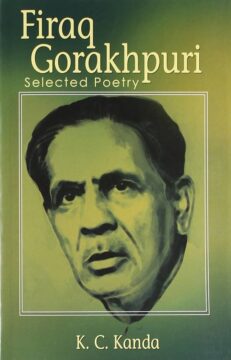 Everybody likes ghazals. Or they do when they learn what they are: A ghazal is a poetic form originating in and strongly associated with the Islamic cultural sphere. It is a medieval thing—or what Westerners would call medieval. Many famous Persian poets are famous for their ghazals. Likewise, Arabic poets, Turkish, Urdu … The ready-to-hand comparison is with the Italian sonnet. Ghazals are a lot like that: song length, rhyme heavy, lots of lovey-doveyness, lots of over-the-top cosmic reasoning.
It took forever for modern English-language poets to pick up on the existence of the ghazal, but once the word got out, plenty of smart people started trying to write original ghazals in English, with differing commitments to the formal rules. I’m one of these poets.
This piece is about translation, but it’s also about writing original poetry in one’s own language while following the rules developed for a different language. I want to talk about English ghazals, but (for lots of good reasons) I’m going to start in left field … with haiku.
more here.
Enjoying the content on 3QD? Help keep us going by donating now.