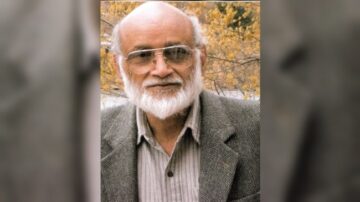
Richard Foreman

Andrew Lampert at Artforum:

Google “Richard Foreman” and one of your first hits will invariably be the treasured playwright and director’s New York Times obit, which lists a cavalcade of prestigious awards as calculable proof of both his profound significance and old-school avant-garde don’t-give-’em-what-they-want bona fides. The first search page will inevitably include a link to Ontological.com, homepage of the Ontological-Hysteric Theater, the company Foreman established in 1968 to stage Angelface, his first produced play, at Jonas Mekas’s Film-Makers’ Cinematheque in New York. While the site could use updating, it contains info galore on the eighty shows that Foreman wrote and directed himself or staged by other authors; the films and videos he sporadically created; and the numerous books he published, including scripts, manifestos, essays, and one 1997 novel, No-body. The transcribed “notebooks” section of the site features more than fifty downloadable files of free-floating dialogue that he offered up for others to use in their own productions. Not enough? You should visit the Foreman page at the PennSound website, a virtual trove of performance documentation, interviews, readings, and even the sound loops from his 2001 show Now That Communism Is Dead My Life Feels Empty! Too much? You could simply skim Foreman’s bountiful Wikipedia page, given that I just corrected it. Someone had named the artist Kate Manheim—Foreman’s remarkable widow, who for many years was his star actress—as being his first wife. She was his second. The brilliant film critic Amy Taubin preceded her. Now you know!

more here.

Enjoying the content on 3QD? Help keep us going by donating now.

Cancer-fighting immune cells could soon be engineered inside our bodies

Cassandra Willyard in Nature:

“This whole process, it’s just inefficient,” says Saar Gill, a haematologist and oncologist also at the Perelman School of Medicine. “If I’ve got a patient with cancer, I can prescribe chemotherapy and they’ll get it tomorrow.” With commercial CAR T, however, people have to wait weeks for treatment. That delay, along with the high cost of the therapy, plus the need for chemotherapy before people receive the CAR T cells, means many people who could benefit from CAR T never receive it. “We all want to get to a situation where CAR T cells are more like a drug,” says Gill.

Some biotechnology companies have an answer: alter T cells inside the body instead. Treatments that deliver a gene for the CAR protein to cells in the blood could be mass produced and available on demand — theoretically, at a much lower price than current CAR-T therapies. A single dose of commercial CAR-T therapy costs around $500,000. A vial of in vivo treatment might cost an order of magnitude less.

More here.

Enjoying the content on 3QD? Help keep us going by donating now.

Tuesday Poem

—after Pedro Pietri

Diasporican Rechristening

We work.
We are sometimes on time.
We are sometimes late.
We are sometimes
coming up with the excuses
for why we can’t make it
even as we know we have to.
Some of us are trying to be American
and some of us are trying to be boricua
and some of us are trying. We are relearning
Spanish or we are practicing Spanglish or
we are remembering that language
is just another tool of empire.
We are dreaming of the archipelago
and we are not. We are dreaming
of returning to Puerto Rico and
we are dreaming of returning to Nueva York
and we are dreaming of creating
our own chain of islands throughout
this sprawling continent. We are
taking too long with goodbyes
at every party and we leave
singing Maelo through the streets
and we leave singing Héctor
through the streets and we leave
singing Yolanda Rivera through the streets
and we are always leaving but we are alive,
we are alive, we are alive, we are alive—
Juan, Miguel, Milagros, Olga, Manuel, we are alive.
Reborn, rebooted, renamed, but we are alive.

by Malcolm Friend

Enjoying the content on 3QD? Help keep us going by donating now.

Monday, May 26, 2025

Hari Kunzru Reflects on Edward Said’s “Culture and Imperialism” Thirty Years After Publication

Hari Kunzru at Literary Hub:

When Edward Said’s book, Orientalism, was published in 1978, it became an instant landmark of scholarship about the European imagination of “the East.” The construction of an alternate world of passion, sensuousness, despotism, and irrationality flattered Western sensibilities during the colonial period, and licensed brutality that otherwise might have seemed to run counter to the ideals of Christianity and the Enlightenment. After its publication, Said realized he wanted to think further about imperialism and the various ways in which colonized people resisted it. He also wanted to understand how the experience of empire marked the culture of the colonizers.

Culture and Imperialism, the book that resulted from this research, is above all about the novel, “the aesthetic object whose connection to the expanding societies of Britain and France is particularly interesting to study.” Said’s readings have become canonical. No scholar of Heart of Darkness can avoid reckoning with the way Conrad’s “exilic marginality” complicates the novel’s imperialist politics and aesthetics. Likewise the écriture blanche of Camus’s The Stranger no longer seems like the innocent vehicle for the expression of existentialist universals about “the human condition” but a style invested in a certain sort of willful silence about history.

More here.

Enjoying the content on 3QD? Help keep us going by donating now.

H-bomb creator Richard Garwin was a giant in science, technology and policy

Matthew Bunn in The Conversation:

Richard Garwin, who died on May 13, 2025, at the age of 97, was sometimes called “the most influential scientist you’ve never heard of.” He got his Ph.D. in physics at 21 under Enrico Fermi – a Nobel Prize winner and friend of Einstein’s – who called Garwin “the only true genius” he’d ever met.

A polymath curious about almost everything, he was one of the few people elected to the National Academy of Sciences, the National Academy of Engineering and the National Academy of Medicine for pathbreaking contributions in all of those fields. He held 47 patents and published over 500 scientific papers. A giant trove of his papers and talks can be found in the Garwin Archive at the Federation of American Scientists.

Garwin was best known for having done the engineering design for the first-ever thermonuclear explosion, turning the Teller-Ulam idea of triggering a fusion reaction with radiation pressure into a working hydrogen bomb – one with roughly 700 times the power of the Hiroshima bomb. He did that over the summer when he was 23.

More here.

Enjoying the content on 3QD? Help keep us going by donating now.

Former Israeli PM Calls Gaza Assault ‘War Crimes’

Kelby Vera at Huffpost:

Israel’s former Prime Minister Ehud Olmert says he now believes his country’s relentless assault on the Palestinian people amounts to “war crimes” and must be stopped.

Addressing the people of Israel in an article written in Hebrew and published by Haaretz on Thursday, Olmert, who served from 2006 to 2009, condemned current Prime Minister Benjamin Netanyahu and his government for “waging a pointless war, without a clear goal or plan, and with no chance of success,” according to Google’s translation of the piece.

While Olmert wrote that he had previously defended his country against “accusations of genocide and war crimes,” the Israeli politician said he can no longer see the widespread slaughter of civilians, including women, children and the elderly, or the campaign to starve Gaza as mere collateral damage in “a brutal war.”

More here.

Enjoying the content on 3QD? Help keep us going by donating now.

From the Creator of ‘Succession,’ a Delicious Satire of the Tech Right

Michelle Goldberg in The New York Times:

In November, when the “Succession” creator Jesse Armstrong got the idea for his caustic new movie, “Mountainhead,” he knew he wanted to do it fast. He wrote the script, about grandiose, nihilistic tech oligarchs holed up in a mountain mansion in Utah, in January and February, as a very similar set of oligarchs was coalescing behind Donald Trump’s inauguration. Then he shot the film, his first, over five weeks this spring. It premiers on Saturday on HBO — an astonishingly compressed timeline. With events cascading so quickly that last year often feels like another era, Armstrong wanted to create what he called, when I spoke to him last week, “a feeling of nowness.”

He’s succeeded. Much of the pleasure of “Mountainhead” is in the lens it offers on our preposterous nightmare world. I spend a lot of my time saucer-eyed with horror at the rapid degeneration of this country, agog at the terrifying power amassed by Silicon Valley big shots who sound like stoned Bond villains. No one, I suspect, can fully process the cavalcade of absurdities and atrocities that make up each day’s news cycle. But art can help; it’s not fun to live in a dawning age of technofeudalism, but it is satisfying to see it channeled into comedy.

More here.

Enjoying the content on 3QD? Help keep us going by donating now.

The Wary Gaze of Amy Sherald

Jerry Saltz at Vulture:

The artist Amy Sherald is best known for her magnificent 2018 portrait Michelle LaVaughn Robinson Obama, which has been looked at, studied, and written about as much as any portrait in the 21st century. It features Obama resting her chin on her right wrist, her gaze both self-aware and probing. She seems to be sizing us up as much as the other way around, forcing the viewer back on their own preconceptions about the first Black First Lady. Wearing a wonderful quiltlike sleeveless maxi dress by designer Michelle Smith, this woman radiates a casual gravitas. She is suspended in a field of turquoise paint, her skin tone a pewter-gray grisaille, which removes her from our realm and gives her an almost alien interiority and agency.

Most people only know Sherald through photographs of this one work. But as Sherald has said, “I had a career before Michelle Obama.” This is more than evident in her new mid-career survey at the Whitney, “American Sublime,” an experience in having your breath taken away.

more here.

Enjoying the content on 3QD? Help keep us going by donating now.

Gertrude Stein: An Afterlife

Sophie Oliver at Literary Review:

It’s not often that a biography really gets going after the author has reached the subject’s death. Gertrude Stein herself predicted that she would only be understood in the future: ‘For a very long time everybody refuses and then almost without a pause almost everybody accepts.’ She wasn’t entirely right, but Francesca Wade’s new ‘afterlife’ of Stein takes the sentiment seriously. The revolutions in language that preoccupied Stein in life were slowly appreciated after her death in 1946. Despite having an unpromising cast of scholars, librarians, publishers and fans, Wade turns the posthumous half of the Stein story into a narrative of suppression, revelation and hopes fulfilled. It helps that there is romance at the heart of it, and a secret notebook.

First, the story of Stein’s life must be told. The myth of Stein, her Parisian salon and her collection of modernist art is immense; Stein scholarship is even bigger. In this inflated scene, Wade’s is a sensitive, compelling study that – like her debut, Square Haunting, a group biography of four women writers living in the same London square – puts writing at the centre of her subject’s world. Her Stein is charming, self-important, eccentric, vulnerable and obsessive, driven to understand her own interests but not always understanding others’. Stein’s preoccupation with knowledge began early.

more here.

Enjoying the content on 3QD? Help keep us going by donating now.

Sunday, May 25, 2025

Certainty and Strange Thoughts

Ayşe Zarakol in The Ideas Letter:

Something very fundamental is happening in world history, again. If anyone had been hoping that the Western alliance’s rallying together after Russia’s invasion of Ukraine in 2022 or the scattered (and at times self-contradictory) efforts of the Biden administration to shore up international law would be enough to save the so-called liberal international order, the first few months of the second Trump administration should be enough to dispel that notion. The three pillars of liberal internationalism—multilateralism, democracy, and free trade—have already taken severe hits and more are likely to come. At the very least, this moment marks the end of the post–Cold War order.

Almost as striking as the speed with which things are getting dismantled is the fact that no one—academics, policymakers, journalists, social media influencers, podcasters—seems to have a clear idea about what comes next. Talk of crisis and disorder abounds; some analogies to the 19th and 20th centuries pop up here and there, with comparisons to imperial competition and lessons from the interwar period or predictions about a Cold War 2.0. But this is all very backward-looking, all very muddled. Contrast the present with the end of the Cold War. Those who were around for that last world-historical moment will remember that there was no shortage of projections about the future then, some optimistic, some pessimistic—which is to say, too, that there is no greater proof that liberalism’s current crisis is real than the establishment’s inability today to imagine anything about what will follow.

More here.

Enjoying the content on 3QD? Help keep us going by donating now.

The Tariff Threat

Gilberto García-Vazquez in Phenomenal World:

In a dramatic shift in US trade policy, the Trump administration has imposed and continues to threaten new rounds of tariffs against Mexico, sounding alarm bells across the Mexican manufacturing industry. If fully implemented, these measures could cause immediate disruption in key industrial zones, place hundreds of thousands of jobs at risk, and halt strategic investments.

Whatever Trump’s motivations around migration, security, or a new model of trade integration, the threat reveals a deeper structural vulnerability in Mexico’s economy: an excessive dependence on a single trading partner, one which is now willing to use tariffs as a political tool. This instrumental use of economic power has direct consequences for the stability of the Mexican economy and the functioning of highly integrated value chains between the two countries.

A clear example of this politicization of trade is the recent dispute over the 1944 Water Treaty. On April 10, less than a week after new tariffs announced during so-called “Liberation Day” came into effect, President Trump accused Mexico of “stealing water from Texas farmers” and threatened to immediately impose an additional 10 percent tariff on all Mexican imports, along with targeted economic sanctions. This episode illustrated how the arbitrary and political use of tariffs can generate profound uncertainty around bilateral trade secured by agreements signed decades ago.

More here.

Enjoying the content on 3QD? Help keep us going by donating now.

The Dead End of Checks and Balances

Lisa L. Miller in Boston Review, with  responses from Eric Blanc, Marcus Gadson, Gianpaolo Baiocchi, Samuel Moyn, Aziz Huq, Kelly Hayes & Maya Schenwar, and Lily Geismer.

On the floor of the Senate at the end of January, Chuck Schumer condemned the actions of Donald Trump’s new administration. “This is an explicit assault on our system of checks and balances which have served this republic so well for centuries,” he stated.

In doing so, Schumer tapped into a hallowed American ideal. Probably no narrative about our system of government is more widely shared than this one: that the Framers of the Constitution wisely restrained government power through separation of powers, judicial review, bicameralism, and federalism. Especially in moments of heightened political conflict, many Americans invoke checks and balances as a safeguard against tyranny and essential protection for minorities. Hillary Clinton captured the essence of the prevailing view when she asserted, after Trump’s first win in 2016, that “constitutional checks and balances” are a key part of “an immune system protecting us from the disease of authoritarianism.”

It is thus unsurprising to hear Democrats marshaling these ideas against Trump’s brazen and ongoing attacks on government, immigrants, and political opponents. What these invocations mean as a practical matter is not always clear, however. Some place their hopes in the courts, even as the administration openly flouts many rulings. Others, taken with the promise of “progressive federalism,” urge resistance in blue states. Still others seem eager for a return to “normal,” evoking a golden age of bipartisanship and well-functioning constitutionalism before Trump. These strategies have intuitive appeal because they draw on popular ideas about the virtues of our constitutional system, but they miss something fundamental about our political crisis—and thus about how to resolve it.

More here.

Enjoying the content on 3QD? Help keep us going by donating now.

Maxed Out

Matthew Karp in Sidecar:

The US political world can today be divided not only between left and right, but along another axis: Trump maximalists and Trump minimalists. Maximalists are inclined to view Trump as an agent or conduit of a sudden historical rupture, whether the transformation of the party system, the destruction of American democracy or the implosion of the liberal world order. Minimalists see Trump not as a fundamental break but rather as a lurid symbol of longer-running developments, or a symptom of crises that lie elsewhere – a black hole detracting attention from real political problems.

This is not a cleanly partisan or ideological distinction, which is one of the things that makes it interesting. There are many familiar liberal maximalists, of course – some of them have recently decamped to Canada in fear of or in protest at the tyrannical regime; and there are conservative maximalists too, mostly right-leaning newspaper columnists who have mobilized few votes but left an outsize impact on the texture and tenor of anti-Trump politics. Despite some disagreement, liberal and conservative maximalists unite in seeing the President himself as the chief and often the only issue in national politics; both have also leapt to enlist in the ‘fascism wars’, often brandishing the F-word as a cudgel to discipline the left at elections, and elsewhere.

Yet there is also a countervailing minimalism of the centre.

More here.

Enjoying the content on 3QD? Help keep us going by donating now.

David Hogg Says Jasmine Crockett Is Leader Democrats Need

Democratic National Committee (DNC) Vice Chair David Hogg publicly endorsed Rep. Jasmine Crockett of Texas as “the type of leader” their struggling political party needs during a Friday appearance on The Breakfast Club radio show. The endorsement comes as Hogg faces potential removal from his leadership position following a credentials committee vote this month that challenged his February election due to procedural errors. Newsweek reached out to Hogg and Crockett via email on Saturday for comment.

This endorsement highlights the ongoing identity crisis within the Democratic Party following comprehensive losses in the 2024 election cycle. Democrats lost the White House, Senate, and House, creating uncertainty about the party’s future direction and leadership. The public backing of Crockett, known for controversial statements and confrontational tactics, signals a potential shift toward more combative political messaging. Recent polling shows former Vice President Kamala Harris currently leading potential 2028 presidential candidates, followed by Rep. Alexandria Ocasio-Cortez, California Governor Gavin Newsom, and former Transportation Secretary Pete Buttigieg.

More here.

Enjoying the content on 3QD? Help keep us going by donating now.

Jodie Foster Honored at Radcliffe Day

From Harvard Magazine:

At Friday afternoon’s rain-soaked Radcliffe Day celebration, Oscar-winning actress and filmmaker Jodie Foster received the 2025 Radcliffe Medal, reunited with an old college mentor, and gave a shout-out to Harvard for pushing back against the Trump administration. “What I hope for people now is that they take the gloves off, and Harvard has shown that recently, and right on,” Foster said, acknowledging that the politics of the last decade have left many people feeling “worn out and sad.” Then, looking toward the audience gathered in Radcliffe Yard, she added, “This group of thinkers in these rarified places, where the intellect and the ability to connect [are] really revered above all else, [need] to really understand that you have the power to use love as a guiding principle and be strategic.”

The day’s stated theme was women’s evolving role in film and television, but what kept coming up, for Foster as well as a panel of other speakers from the entertainment industry, were broader fights for equality and freedom. “Jodie has used the power of art to engage with existential questions that define the human experience,” said Radcliffe Institute Dean Tomiko Brown-Nagin in her introductory remarks, adding that Foster’s work focuses “our attention on critical issues and overlooked voices.”

More here.

Enjoying the content on 3QD? Help keep us going by donating now.