
Category: Recommended Reading
Saturday, November 14, 2020
Hou Hsiao-hsien, Chu Tien-wen and Olivier Assayas
Our Love-Hate Relationship with Gimmicks
Merve Emre at The New Yorker:
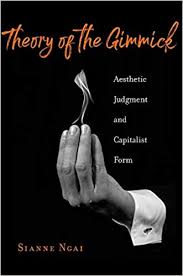 Although Ngai’s books are conceptually and philosophically dense, their appeal comes from how they tap into our ordinary use of language. Unless I collect art, or live in a many-windowed house at the edge of a westerly peninsula, where the sea is gilded by the sun and silvered by the moon, I am unlikely to have regular encounters with things I would call “beautiful” or “sublime,” and I may well find the rush and roar of such Romantic descriptions embarrassing. But not a day goes by when I do not call something—my son’s stuffed animals, a dress, a poem by Gertrude Stein—“cute,” or a novel or an essay “interesting.” And I can’t count the number of times I’ve called a kitchen gizmo my husband swears we really, really need (but we really, really don’t) or a colleague’s online persona “gimmicky.” “Theory of the Gimmick” finds in the pervasiveness of the gimmick the same duelling forces of aesthetic attraction and repulsion that shape all Ngai’s work. “ ‘You want me,’ the gimmick outrageously says,” she writes. “It is never entirely wrong.”
more here.
Celia Paul on Lucian Freud, Motherhood and a Life in Art
Jennifer Szalai at the NYT:
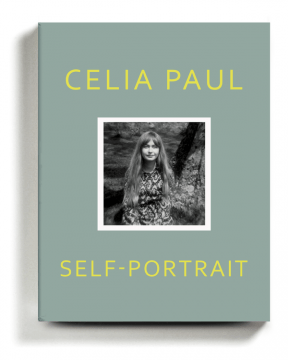 “Self-Portrait” is Paul’s account of her life and her work — or, more precisely, of her attempts to realize the possibilities of each despite the constraints thrown up by the other. She left Frank with her mother in Cambridge when he was an infant. When Paul spends time with him, she says, “I don’t have any thoughts for myself.” She lives separately from her current husband, who doesn’t have a key to her flat.
Paul writes about her struggle to love someone while dedicating herself to her painting, explaining in her prologue that she hopes her book will “speak to young women artists — and perhaps to all women — who will no doubt face this challenge in their lives at some time and will have to resolve this conflict in their own ways.” But this makes her mesmerizing book sound more helpful than it is, or than it needs to be; “Self-Portrait” is less tidy and more surprising than such a potted purpose would allow.
more here.
The Professor and the Politician
 Corey Robin in The New Yorker:
he professor and the politician are a dyad of perpetual myth. In one myth, they are locked in conflict, sparring over the claims of reason and the imperative of power. Think Socrates and Athens, or Noam Chomsky and the American state. In another myth, they are reconciled, even fused. The professor becomes a politician, saving the polity from corruption and ignorance, demagoguery and vice. Think Plato’s philosopher-king, or Aaron Sorkin’s Jed Bartlet. The nobility of ideas is preserved, and transmuted, slowly, into the stuff of action.
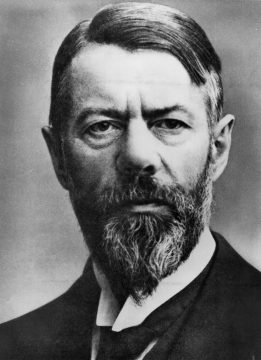
The sociologist Max Weber spent much of his life seduced by this second fable. A scholar of hot temper and volcanic energy, Weber longed to be a politician of cold focus and hard reason. Across three decades of a scholarly career, in Wilhelmine and Weimar Germany, he made repeated and often failed incursions into the public sphere—to give advice, stand for office, form a party, negotiate a treaty, and write a constitution. His “secret love,” he confessed to a friend, was “the political.” Even in the delirium of his final days, he could be heard declaiming on behalf of the German people, jousting with their enemies in several of the many languages he knew. “If one is lucky” in politics, he observed, a “genius appears just once every few hundred years.” That left the door wide open for him.
More here. And see also Patrick Thaddeus Jackson’s response over at Lawyers, Guns and Money:
1) The whole point of Weber’s “vocation” lectures was to caution his listeners against either a political or an academic “savior.” In the lecture on Wissenschaft — usually translated “science,” but the sense of the word in German is more like “systematic scholarship” — Weber takes pains to argue that other than “some overgrown children in their professorial chairs or editorial offices,” no one thinks that academic study can teach us anything about the meaning of the world. And in the lecture on politics, Weber is, if anything, more afraid of the revolutionary prophet taking over the reins of government than he is of the amoral cynic who treats politics as a means for personal enrichment:
“…people who have just preached ‘love against force’ are found calling for the use of force the very next moment. It is always the very last use of force that will then bring about a situation in which all violence will have been destroyed — just as our military leaders tell the soldiers that every offensive will be the last. This one will bring victory and then peace. The man who embraces an ethics of conviction is unable to tolerate the ethical irrationality of the world.”
More here.
The subjective turn
 Jon Stewart in Aeon:
What is the human being? Traditionally, it was thought that human nature was something fixed, given either by nature or by God, once and for all. Humans occupy a unique place in creation by virtue of a specific combination of faculties that they alone possess, and this is what makes us who we are. This view comes from the schools of ancient philosophy such as Platonism, Aristotelianism and Stoicism, as well as the Christian tradition. More recently, it has been argued that there is actually no such thing as human nature but merely a complex set of behaviours and attitudes that can be interpreted in different ways. For this view, all talk of a fixed human nature is merely a naive and convenient way of discussing the human experience, but doesn’t ultimately correspond to any external reality. This view can be found in the traditions of existentialism, deconstruction and different schools of modern philosophy of mind.
There is, however, a third approach that occupies a place between these two. This view, which might be called historicism, claims that there is a meaningful conception of human nature, but that it changes over time as human society develops. This approach is most commonly associated with the German philosopher G W F Hegel (1770-1831). He rejects the claim of the first view, that of the essentialists, since he doesn’t think that human nature is something given or created once and for all. But he also rejects the second view since he doesn’t believe that the notion of human nature is just an outdated fiction we’ve inherited from the tradition. Instead, Hegel claims that it’s meaningful and useful to talk about the reality of some kind of human nature, and that this can be understood by an analysis of human development in history.
More here.
Beyond price stability with Daniela Gabor, Christian Odendahl, Philippa Sigl-Glöckner & Adam Tooze
Conversation with a Native Son: Maya Angelou and James Baldwin
Saturday Poem
Embryo
All morning, pitting the apricots
to make marmalade. All morning
opening them to remove the swollen,
warm ovum that grows inside
the flesh: scattering of silent apricots
picked over on the antiseptic kitchen
counter. As if she were the head nurse,
grandma boils the pot
with two fingers of sugared water.
The girl runs in and pockets
the pits nobody wants. Under the white
encouragement of the myrtle tree, she rubs
the woody pit against the wall’s rough
bumps, and listens to a languid whistle
rising from the depths of the unborn embryo,
from the afternoon rising up, from the blood,
from doubt—years to come,
years to become.
by Gemma Gorga
from Plume Magazine
Embrió
Chimamanda Ngozi Adichie: ‘America under Trump felt like a personal loss’
Lisa Allardice in The Guardian:
 A few hours before Chimamanda Ngozi Adichie and I are due to speak, the result of the US election is finally called. The Nigerian novelist, who is based in Maryland but is currently in Lagos, where she spends part of the year, had been on her way back from taking her daughter to a birthday party when she heard the news. “The moment that we’ve been waiting for,” she says. “Everyone was calling: my best friend, my mum, my sister called, we were all sort of screaming down the phone.” Her husband, a hospital doctor, had returned to the US the previous week. “He and I were going crazy,” she says. “I was almost close to tears because I thought this is really about people who just want decency back. I feel it is really not ideological, it is more about wanting something human and humane. I find it so moving.”
As it is for so many, her relief is tempered by disappointment at Donald Trump’s unexpectedly strong performance. “I’ve always felt that Trump is as much America as Obama,” she says. “People on the left like to say ‘This is not America’, but actually it is. If you look at the history of America, it is not that surprising that Trump is so popular.” People feel “very threatened” both by the idea of a more inclusive, multiracial politics and women having more overt power, she says. So the victory for Kamala Harris as the first black female vice-president-elect is all the more thrilling. “It is impossible to talk about her, about what’s happened today, without thinking about what might happen in four or eight years – that she might in fact become president,” Adichie says. “Even if just for the symbolism of it, because the symbolic nature of leadership is important.”
More here.
Majority Rapport
Rafia Zakaria in Baffler:
 LAST TUESDAY NIGHT, as a plague-ridden America hunkered down for a long night, it was still too early to call the election. But it is never too early, in this race-riven nation, to begin to call out minorities—specifically minority voters. It began with the first Democratic disappointment of the evening: Cuban-Americans and Venezuelan-American communities in the once-reliably blue Miami-Dade County in Florida had broken for Donald Trump. Based on early numbers, Hillary Clinton’s thirty-point winning margin from 2016 had been whittled down to single digits. A storyline began to emerge that Florida’s Latino voters had fallen for Trump propaganda about Joe Biden being soft on socialism and communism. Someone on Twitter reminded me that the man in the Trump truck who had rammed into a Biden campaign bus is also alleged to be a Hispanic male.
Black voters were next to be scrutinized; exit polls conducted for the New York Times suggesting that 8 percent of Black women and 18 percent of Black men voted for Trump were brandished by the conservative magazine National Review, which touted that Trump had won the highest percentage of the non-white vote of any Republican President since 1960. This, despite the fact that the Democrats had repeatedly accused Trump of being a racist during the George Floyd protests—not to mention throughout the four years of Trump’s rise to power. Minority voters, you see, had missed the message. Just as pundits looked to blame African Americans in 2016 for not coming out strongly enough to support Hillary Clinton, they could now raise questions about whether Latinos had caused Biden to lose Florida. Republicans could smugly insist that Donald Trump, who called Black Lives Matter a “symbol of hate” while shrugging off threats from armed white militants, who called on the far-right group the Proud Boys to “stand back and stand by” during a presidential debate, was no racist at all.
More here.
Friday, November 13, 2020
A Game Designer’s Analysis Of QAnon
Rabbit Rabbit at Curiouser Institute:
 When I saw QAnon, I knew exactly what it was and what it was doing. I had seen it before. I had almost built it before. It was gaming’s evil twin. A game that plays people. (cue ominous music)
QAnon has often been compared to ARGs and LARPs and rightly so. It uses many of the same gaming mechanisms and rewards. It has a game-like feel to it that is evident to anyone who has ever played an ARG, online role-play (RP) or LARP before. The similarities are so striking that it has often been referred to as a LARP or ARG. However this beast is very very different from a game.
It is the differences that shed the light on how QAnon works and many of them are hard to see if you’re not involved in game development. QAnon is like the reflection of a game in a mirror, it looks just like one, but it is inverted.
More here.
Pfizer’s Stunning Vaccine Results Could Be a Real Game-Changer
Jeffrey S. Flier in Quillette:

There has been consensus in the scientific community that, notwithstanding the partial effectiveness of lockdowns, other non-pharmacologic interventions, and potential therapeutics, the development and production of a safe and effective vaccine would eventually be necessary to fully control this pandemic. But it is important to remember that some viruses resist vaccine treatment (as so far has been the case with HIV). In other cases, vaccines are developed, but only after many years of research, testing, and regulatory protocols. Attempts to produce vaccines for the two other known human coronavirus diseases—SARS, which was identified in 2002, and MERS, in 2012—were unsuccessful. So optimism has been appropriately muted in the case of COVID-19. And it’s in this context that these preliminary results are so remarkable.
More here.
What is “math without numbers”?
‘The Nine Lives of Pakistan’ Review
Tunku Varadarajan in the Wall Street Journal:
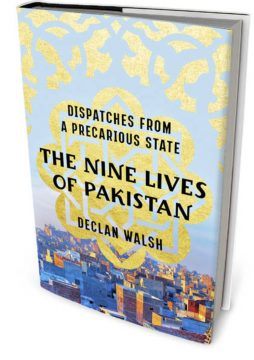 Pakistan was created in 1947 as a homeland for the Muslims of Hindu-majority India—“carved from the flanks of British India,” as Mr. Walsh puts it. Its “Great Leader” (“Quaid-e-Azam” in Urdu) was Muhammad Ali Jinnah, an unlikely agitator for a confessional Muslim state. A worldly lawyer who drank alcohol and married outside his faith, he was, Mr. Walsh tells us, “purposefully vague about his beliefs” for much of his life. In a poignant passage, Mr. Walsh parses a photograph of Jinnah taken in September 1947, a month after Pakistan was born: In it, he wears “the gaze of a man who gambled at the table of history, won big—and now wonders whether he won more than he bargained for.”
The subtitle of Mr. Walsh’s book is “Dispatches From a Precarious State,” and he opens his account on his last night in Pakistan, in May 2013. He had been given 72 hours to leave, his visa canceled by the notorious Inter-Services Intelligence (ISI) for his pursuit (it was alleged) of “undesirable activities.” It was a cruel moment for a reporter to have to depart: There was an election the next day—the first time in which a civilian Pakistani government would complete its term and hand over power to another.
This election, Mr. Walsh writes, was “stupendously good news” in Pakistan, a country of “hidden delights [and] endearing absurdities” that had endured the rule of military dictators for a hefty portion of its existence. That democracy appeared to be holding fast against daunting odds was “a blast of sweet relief to weary Pakistanis.”
More here.
Interview with Agnes Martin (1997)
Sontag & Rieff
David Mikics at Salmagundi:
 There she stands, the fortysomething Susan Sontag, at a rock ‘n’ roll show in a packed New York club, encircled by sweaty kids. “Being the oldest person in a room did not make her self-conscious,” writes Sigrid Nunez in her memoir Sempre Susan. “The idea that she could ever be out of place anywhere because of her age was beyond her—like the idea that she could ever be de trop.” Sontag gave herself a regal, Oscar-Wilde-like permission to be at the center of things. That could be charming, much of the time. Other traits were less appealing. Sontag used to forbid her son David to look out of the window during train trips because, after all, there was nothing interesting about nature. Read a book instead, or, better, talk to me! was her message.
Susan Sontag was a case, all right, as Benjamin Moser’s new biography, Sontag: Her Life and Work makes clear. But she was also interesting in ways that Moser, with his taste for the tawdry and the sensational, is ill-equipped to explore.
more here.
Sontag & Rieff
David Mikics at Salmagundi:
There she stands, the fortysomething Susan Sontag, at a rock ‘n’ roll show in a packed New York club, encircled by sweaty kids. “Being the oldest person in a room did not make her self-conscious,” writes Sigrid Nunez in her memoir Sempre Susan. “The idea that she could ever be out of place anywhere because of her age was beyond her—like the idea that she could ever be de trop.” Sontag gave herself a regal, Oscar-Wilde-like permission to be at the center of things. That could be charming, much of the time. Other traits were less appealing. Sontag used to forbid her son David to look out of the window during train trips because, after all, there was nothing interesting about nature. Read a book instead, or, better, talk to me! was her message.
Susan Sontag was a case, all right, as Benjamin Moser’s new biography, Sontag: Her Life and Work makes clear. But she was also interesting in ways that Moser, with his taste for the tawdry and the sensational, is ill-equipped to explore.
more here.
Solzhenitsyn’s Memoirs
Aleksandr Solzhenitsyn at The Hudson Review:
 But, more importantly: the artist does not in fact require too detailed a study of his predecessors. It was only by fencing myself off, and not knowing most of what was written before me, that I’ve been able to fulfill my great task: otherwise you wear out and dissolve in it and accomplish nothing. If I’d read The Magic Mountain (and I still haven’t), it might somehow have impeded my writing of Cancer Ward. I was saved by the fact that my self-propelled development didn’t get distorted. I have always been hungry for reading, for knowledge—but in my school years in the provinces, when I was freer, I didn’t have that sort of guidance or access to that sort of library. And starting from my student years, my life was swallowed up by mathematics. I’d just set up a fragile connection with the Moscow Institute of Philosophy, Literature and History when the war came, then prison, the camps, internal exile, and teaching—still mathematics, but physics too (preparing experiments for demonstration in class, which I found very difficult). And years and years of conspiring under pressure and racing, underground, to complete my books, for the sake of all those who’d died without a chance to speak. In my life I’ve had to gain a thorough grounding in artillery, oncology, the First World War, and then prerevolutionary Russia too, which by then was so impossible to imagine.
more here.
Friday Poem
Capitalist Poem #57
Like a sailor practicing knots in the darkness,
like a warrior sharpening his blade in the lull of battle,
like a blind man searching out the figure of a sleeping lover
the mind searches and eddies
through the concourse of the terminal
with its way stations and concessions
of bottled water sandwiches,
dot.com billboards trumpeting instant riches,
another gourmet coffee at the cappuccino bar,
grande decaf half-skim latte,
seeking to delimit its appetites and hungers,
as even Money magazine wonders
how much is enough?
like one returned home after years of hard travel
I call out in greeting to my familiars—
Avarice, trusted and faithful retainer,
Extravagance, mi compeñaro,
Greed, my old friend, my bodyguard, my brother.
by Campbell McGrath
from Nouns & Verbs
Harper Collins, 2019