
Enjoying the content on 3QD? Help keep us going by donating now.
Category: Recommended Reading
Inside the Rise of the Multiracial Right
Daniel Martinez HoSang in the New York Times:
 My colleague Joseph Lowndes and I have been studying the movement of nonwhite voters to the right for 15 years. When we began this work, people like Mr. Gibson — who told us they hated the establishment, who felt let down or left behind by the politics of the Democratic Party — were often disdained by liberals as dupes of the right voting against their own interests, votes they would regret once they saw their conservative beliefs in action.
But seven years later, Mr. Gibson seems to be much less of an anomaly. Mr. Trump nearly doubled his support among Black voters from 2020 to 2024, won some 40 percent of the Asian American vote, and took almost half of the Latino vote. Many of those I have spoken with recently — students, lawyers, mechanics, pastors and others — sounded strikingly similar to Mr. Gibson. Angry at a system they contend is indifferent to their lives, they express ideas that were once seen only on the far-right fringe.
The rightward drift of minority voters is not a story of just one election. It is a phenomenon years in the making, one that is reshaping the American political landscape. And to understand this movement, you must understand the transformations in the places they are happening.
More here.
Enjoying the content on 3QD? Help keep us going by donating now.
What Keeps the Lights On
Charles C. Mann at The New Atlantis:
 Put a bagel in a toaster oven and push a button. In a few seconds, heating elements inside the oven glow red and heat the bagel. The action seems simple — after all, ten-year-olds routinely toast bagels without adult supervision. Matters look different if you inquire into what must happen to make the oven work. Pushing the button engages the mechanism of an incomprehensibly vast multinational network: the North American electrical grid.
The numbers are dazzling. The United States alone has more than 6 million miles of power lines, enough to stretch to the Moon and back twelve times. An average U.S. single-family home contains almost 200 pounds of copper wire — and there are more than 80 million U.S. single-family homes. The Empire State Building alone has more than 470 miles of electrical wiring. And all these miles upon miles upon miles of wire and cable and circuit are so routinely and reliably coupled that most of us think nothing of the fact that southern California gets power from hydroelectric dams a thousand miles away in northern Washington State. Constructed over more than a century, embodying entire political and economic histories, the North American electrical grid may be the most complex object ever created by our species.
more here.
Enjoying the content on 3QD? Help keep us going by donating now.
Scientists Are Tracking Worrying Declines in Insects—and the Birds That Feast on Them. Here’s What’s Being Done to Save Them Both
Madeline Bodin in Smithsonian:
 Less than two hours after sunrise, with the shadows still blue and slanting hard in a dense growth of balsam firs and spruces, the baby bird blundered into a fine black net strung along the ridgeline of Mount Mansfield, at 4,393 feet Vermont’s tallest mountain. Desirée Narango, a conservation scientist with the Vermont Center for Ecostudies, or VCE, retrieved the rescued bird and with practiced fingers spread one of its wings like a fan. From the bird’s mottled and rumpled feathers, Narango could see that this slate-colored bird was a dark-eyed junco, a sparrow species found in various color combinations across North America. The bird was just a few weeks out from leaving its nest. It was too young to tell its sex. But she was less interested in the bird itself than in what it had been eating.
Juncos are known as seed-eating birds. They spend their days rummaging through the undergrowth searching for fallen seeds. At feeders, they prefer smaller grains, like millet. But seeds don’t provide the protein juncos, or any songbirds, need to grow a new set of feathers while they molt. And the protein this baby junco needs to molt its blotchy juvenile feathers and to grow sleek stone-gray feathers on top and white ones below would come only from bugs.
More here.
Enjoying the content on 3QD? Help keep us going by donating now.
How Do Human Egg Cells Stay Healthy for Decades?
Sahana Sitaraman in The Scientist:
 A human female is born with all the egg cells she will ever have. The possibility for the development of new oocytes is zero. Given this constraint, it is crucial that these gametes remain healthy and viable for decades until they are needed to form an embryo. Irrespective of the ‘age’ of the fertilized oocyte, the resulting embryo has the characteristics of a freshly born cell, indicating the existence of mechanisms that counteract accrued cellular damage and keep the egg fresh. What are these processes that drive the prolonged life of human egg cells?
Elvan Böke, an oocyte biologist at the Centre for Genomic Regulation, studies exactly that. A healthy cell boasts vigilant scanning for and removal of misfolded, damaged, or unnecessary proteins. A common feature associated with cellular aging is the breakdown of intracellular protein degradation machinery.1 In previous studies done in mouse oocytes, Böke and other researchers found that these cells rely on two key adaptations to keep their cytoplasm free of harmful clutter: They store and degrade of protein aggregates in vesicles and contain oocyte proteins with exceptionally long lives.
More here.
Enjoying the content on 3QD? Help keep us going by donating now.
José María Velasco: What Does It Mean To Be Mexican?
Enjoying the content on 3QD? Help keep us going by donating now.
Friday Poem
Dead Reckoning
There’s a gold weather-vane –
a galleon – catching the sun
on the sea-green copper
spire of Sankt Johannes,
not a cloud in the sky,
the ship as if becalmed.
I try to recall
the currents, compass
errors and storms that took me
off course, asking
whether, and for how long
one’s initial bearing lasts.
But on a windless day like this
the fifteen-metre waves
the broken mast
the ice-jammed pully-block
are long forgotten
and it seems one is
exactly where one planned
to be, having kept
for all these years
with sextant and calipers
dead reckoning,
and come home.
by Michael Jackson
from Dead Reckoning
Auckland University Press, 2006
Enjoying the content on 3QD? Help keep us going by donating now.
The Uncanny Persistence of the Persistence of Vision
Lawrence Weschler at Wondercabinet:
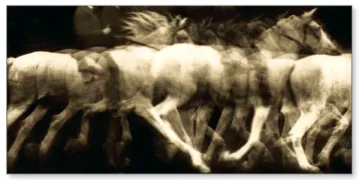 I begin this chapter with three outrageous facts:
(1) You are blind every time you move your eyeballs.
(2) You experience reality approximately 120 milliseconds (three film frames) after it has happened.
(3) You are not aware of either of these facts.
I will use these strange but scientifically well-established phenomena to urge the final abandonment of the so-called retinal persistence of vision, which is often used (still!), two hundred years after it was first proposed, as an explanation for why we see motion when we watch a motion picture – which is, after all, just a series of still images.
Using the attributes of the saccade – the jump of the eyeball from one focal point to another – I hope to provide a satisfying replacement for retinal persistence. Cutting to the chase, it will amount to this:
The neurology of saccades, which evolved over hundreds of millions of years of vertebrate sight to smooth out the shifts of attention that happen during the sudden movement of eyeballs, was hijacked and put to use when motion pictures were invented.
more here.
Enjoying the content on 3QD? Help keep us going by donating now.
Thursday, July 24, 2025
Anti-philosophy philosophy
Matt Lutz at Humean Being:
 Here’s an old paradox. The scientist declares that science is the only way to truth and that philosophy is bunk. “Over here in my department,” he proclaims, “we really learn things about reality. We poke and prod the universe and see what happens. We formulate hypotheses, design and conduct experiments to test them, analyze the data, and form justified conclusions about the way the world works on that basis. Over in the philosophy department, they don’t do any of that. They make shit up. What I’m doing is REAL and IMPORTANT and GENERATES KNOWLEDGE. Philosophers do none of those things!” And the philosopher, hearing this rant, has a ready reply: “What experiments did you do to establish the truth of that little speech? None at all! (And if you did run an experiment, I’d love to hear about the setup!) Turns out that you’re endorsing a bunch of philosophical claims. So you yourself have a philosophy all your own! Philosophy is inescapable for both of us. The only difference is that I’m honest about it.”
For those with training in philosophy, this quick back and forth is extremely well-known. (Those without philosophical training often find themselves playing the role of the scientist in that exchange; I see some version of it play out once a month or so on social media.) The lesson that follows is simple and devastatingly compelling: philosophy is not all bullshit.
More here.
Enjoying the content on 3QD? Help keep us going by donating now.
What Keeps the Lights On
Charles C. Mann in The New Atlantis:
 Put a bagel in a toaster oven and push a button. In a few seconds, heating elements inside the oven glow red and heat the bagel. The action seems simple — after all, ten-year-olds routinely toast bagels without adult supervision. Matters look different if you inquire into what must happen to make the oven work. Pushing the button engages the mechanism of an incomprehensibly vast multinational network: the North American electrical grid.
The numbers are dazzling. The United States alone has more than 6 million miles of power lines, enough to stretch to the Moon and back twelve times. An average U.S. single-family home contains almost 200 pounds of copper wire — and there are more than 80 million U.S. single-family homes. The Empire State Building alone has more than 470 miles of electrical wiring. And all these miles upon miles upon miles of wire and cable and circuit are so routinely and reliably coupled that most of us think nothing of the fact that southern California gets power from hydroelectric dams a thousand miles away in northern Washington State. Constructed over more than a century, embodying entire political and economic histories, the North American electrical grid may be the most complex object ever created by our species.
More here.
Enjoying the content on 3QD? Help keep us going by donating now.
Yuval Noah Harari: Judaism is facing a possible spiritual catastrophe
Enjoying the content on 3QD? Help keep us going by donating now.
Ezra Klein: Why American Jews No Longer Understand One Another
Ezra Klein in the New York Times:
 Zohran Mamdani’s triumph in New York City’s Democratic primary for mayor has forced, among many Jews, a reckoning with how far they have drifted from one another. Mamdani does not use the slogan “globalize the intifada,” but he does not condemn those who do. He has said that if he were mayor, Benjamin Netanyahu, the prime minister of Israel, would face arrest on war crimes charges if he set foot in New York City. Israel has a right to exist, he says, but “as a state with equal rights.”
Many older Jews I know are shocked and scared by Mamdani’s victory. Israel, to them, is the world’s only reliable refuge for the Jewish people. They see opposition to Israel as a cloak for antisemitism. They believe that if the United States abandons Israel then Israel will, sooner or later, cease to exist. To them, Mamdani is a harbinger. If he can win in New York City — a city with more Jews than any save Tel Aviv — then nowhere is safe.
Many younger Jews I know voted for Mamdani. They are not afraid of him. What they fear is a future in which Israel is an apartheid state ruling over ruins in Gaza and Bantustans in the West Bank.
More here.
Enjoying the content on 3QD? Help keep us going by donating now.
How Ozzy Osbourne & Black Sabbath’s Live Shows Defined A Genre
Enjoying the content on 3QD? Help keep us going by donating now.
The Surprising Durability Of Africa’s Colonial Borders
Alden Young at Noema Magazine:
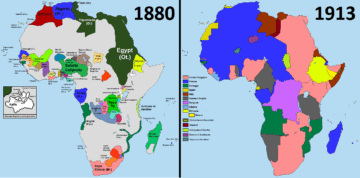 The great surprise of the first quarter of the 21st century has been the endurance of Africa’s colonial borders. The durability of Africa’s multiethnic states, most of which project power unevenly over vast territories and possess relatively small militaries, has everything to do with their tradition of multilateralism, a tradition born out of the social networks of anticolonial struggle and the Pan-African Congresses of the first half of the 20th century. Rather than a continent where “war made the state and the state made war,” one might say conferences made the state and the state held conferences.
This is not to say that 20th-century African history was peaceful. Mazrui reminds us that by 1993, nearly 2 million Africans had lost their lives defending the borders inherited from colonial regimes. Since then, millions more have died. Yet the borders have held.
Even when contemporary African borders have been modified, as in the case of Eritrea’s separation from Ethiopia or South Sudan’s independence from Sudan, much of the contestation has revolved around the accurate demarcation of colonial borders rather than primordial claims about ethnic or communal homelands.
more here.
Enjoying the content on 3QD? Help keep us going by donating now.
Remembering Historian, Poet Robert Conquest On His 108th Birthday
Cynthia Haven at The Book Haven:
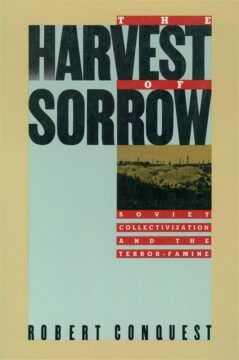 Robert Conquest is a man of contradictions: He has been called “a comic poet of genius” and “a love poet of considerable force” – but he made his mark as one of the first to expose the horrors of Stalinist communism.
Susan Sontag was a visiting star at Stanford in the 1990s. But when she was introduced to Robert Conquest, the constellations tilted fora moment. “You’re my hero!” she announced as she flung her arms around the elderly poet and acclaimed historian. It was a few years since she had called communism “fascism with a human face” – and Conquest, author of The Great Terror, a record of Stalin’s purges in the 1930s, had apparently been part
of her political earthquake.
Sitting in his Stanford campus home last week and chatting over a cup of tea, the 93-year-old insisted it’s all true: “I promise.We had witnesses.” His wife, Liddie, sitting nearby confirmed the account, laughing. Robert Conquest published his seventh collection of poems last year and a book of limericks this year, finished a 200-line poetic summa and is working on his memoirs.
more here.
Enjoying the content on 3QD? Help keep us going by donating now.
Thursday Poem
Why I Like Marriage
At breakfast I tell my wife
To bury me in my new suit.
“The gray one?” she asks,
“Yes, with the pinstripes,”
“Fine,” and she sips her tea.
This is what I like about marriage—
The not-being-surprised part of it,
As in how I can decide on my
Funeral attire, then read aloud
A Times review of a restaurant
In Paris that we will never visit,
And a moment later suggest a
Walk in the snow—why not?
…………..
By lunchtime I will have decided
Against the gray suit and burial
Altogether, having seen a billboard
For cremations—$850, complete;
“On second thought,” I begin,
And my wife will nod, and sip her tea,
And say, “I know,” and mean it.
by George Ovitt
from Rattle Magazine
spring 2014
Winning Is EVERYTHING, Right?
Enjoying the content on 3QD? Help keep us going by donating now.
Stem cell transplant without toxic preparation successfully treats genetic disease
From Medical Express:
 An antibody treatment developed at Stanford Medicine successfully prepared patients for stem cell transplants without toxic busulfan chemotherapy or radiation, a Phase I clinical trial has shown.
Their work focused on CD117, which regulates the cells’ growth and development. They found that an antibody against CD117 blocked the stem cells’ growth and eliminated the cells from mice without the hazards of radiation and chemo. Together with other Stanford scientists, they subsequently identified the clinical antibody equivalent that was used in this new clinical trial. This clinical trial also addressed a second challenge in stem cell transplants: In the past, about 35% to 40% of patients who needed the transplants for any reason did not receive them because they lacked fully matched donors. But researchers found a way to increase the chance that the transplants would work by modifying the donated bone marrow before giving it to the participants.
More here.
Enjoying the content on 3QD? Help keep us going by donating now.
Wednesday, July 23, 2025
The 800-Year-Old Mystery of a Lost Medieval Legend Is Solved
Becky Ferreira at 404 Media:
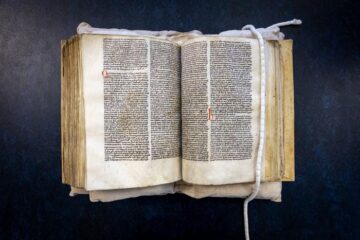 A major mystery about a long-lost legend that was all the rage in Medieval England but survives in only one known fragment has been solved, according to a study published on Tuesday in The Review of English Studies.
Roughly 800 years ago, a legend known today as the Song of Wade was a blockbuster hit for English audiences. Mentions of the heroic character showed up in the works of Geoffrey Chaucer, for example. But the tale vanished from the literature centuries later, puzzling generations of scholars who have tried to track down its origin and intent.
Now, for the first time, researchers say they’ve deciphered its true meaning—which flies in the face of the existing interpretation.
More here.
Enjoying the content on 3QD? Help keep us going by donating now.
How to avoid nuclear war in an era of AI and misinformation
Alexandra Witze in Nature:
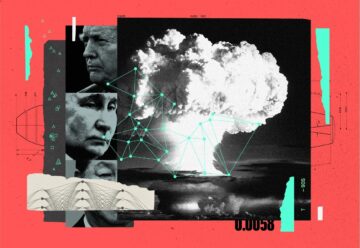 The Doomsday Clock — a symbolic arbiter of how close humanity is to annihilating itself — now sits at 89 seconds to midnight, nearer than it has ever been to signalling our species’ point of no return.
Many threats, including climate change and biological weapons, prompted global-security specialists at the Bulletin of the Atomic Scientists in Chicago, Illinois, to move the clock’s hands in January. But chief among those hazards is the growing — and often overlooked — risk of nuclear war.
“The message we keep hearing is that the nuclear risk is over, that that’s an old risk from the cold war,” says Daniel Holz, a physicist at the University of Chicago, who advised on the Doomsday Clock decision. “But when you talk to experts, you get the opposite message — that actually the nuclear risk is very high, and it’s increasing.”
From Russia’s grinding war in Ukraine and the simmering tensions between India and Pakistan that flared in May, to the US and Israeli attacks on Iranian nuclear facilities in June, the world is not short of conflicts involving one or more nuclear-armed nations.
More here.
Enjoying the content on 3QD? Help keep us going by donating now.