Frances Wilson at Literary Review:
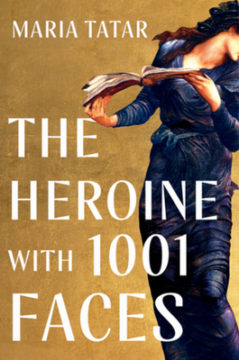 ‘We tell ourselves stories in order to live,’ said Joan Didion. Scheherazade told her husband stories in order that she might live, thus turning herself into what Maria Tatar calls ‘a storytelling transvaluation machine’. Having been cuckolded by his first wife, Sultan Shahryar resolved to marry a fresh virgin every day and enjoy with his bride a single night of pleasure before having her executed the following morning. Volunteering as his next victim, Scheherazade read all the works of all the poets and all the legends of all the antique races and monarchs. She then told the sultan a story so long and compelling that he begged her to finish it the following night. One thousand and one nights later, Shahryar’s misogyny was cured and he had learned the power of stories.
The Heroine with 1,001 Faces is written as a corrective to Joseph Campbell’s comparative mythology The Hero with a Thousand Faces (1949), a book once so revered that it was used by Hollywood directors as a guide to archetypal plot structures. ‘Nowhere does the rigidity of archetypal thinking emerge more clearly’, writes Tatar, a professor of folklore at Harvard, ‘than in the binary model of the male and female principal as it surfaced in Campbell’s study.’
more here.
 E
E Every person, every mouse, every dog, has one unmistakable sign of aging: hair loss. But why does that happen? Rui Yi, a professor of pathology at Northwestern University, set out to answer the question.
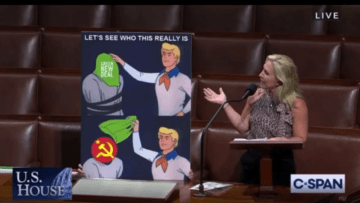 Social media have gutted institutions: journalism, education, and increasingly the halls of government too. When Marjorie Taylor Greene displays some dumb-as-hell anti-communist Scooby-Doo meme before congress, blown up on poster-board and held by some hapless staffer, and declares “This meme is very real”, she is channeling words far, far wiser than the mind that produced them. We’re all just sharing memes now, and those of us who hope to succeed out there in “reality”, in congress and classrooms and so on, momentarily removed from our screens and feeds, must learn how to keep the memes going even then. “Real-world” events, in other words, are staged by the victors in our society principally with an eye to the potential virality of their online uptake. And when virality is the desired outcome, clicks effected in support or in disgust are all the same. Thus the naive idea that AOC wore her “Tax the Rich” gown to a particular event attended by a select crowd within a well-defined physical space completely distorts the motivation behind the gesture, which was, obviously, to make waves not during, but immediately after, the event, not for the people at the event, but for all the people who were not invited.
 Topologists study the properties of general versions of shapes, called manifolds. Their animating goal is to classify them. In that effort, there are a few key distinctions. What exactly are manifolds, and what notion of sameness do we have in mind when we compare them?
 There is great emotional weight in literature. Anyone who has cried for the death of Old Yeller, laughed at the antics of Lucky Jim, or been thrilled by the adventures of Simon Templar can attest to that simple fact. What has never been simple is understanding why a string of written words can create such an emotional response, or possibly more important, why some strings achieve it so much more effectively than others.
 I’m an audiovisual translator, which means that I—and others like me—help you understand the languages spoken on screen: You just click that little speech bubble icon in the bottom-right corner of your preferred streaming service, select the subtitles or the dub, and away you go. These scripts are all written by someone like myself, sitting quietly at a computer and spending day after day trying to figure out, “What are they actually saying here?”
 H
H On the cover of her new album, Dar Williams stands on a floating platform in a lake. A breeze ripples the water so that it’s as wrinkled as elephant skin. As Ms. Williams gazes toward an unseen horizon, her scarlet shawl flutters behind her like a vapor trail. The atomistic image is metaphorical. Ms. Williams says the photo, taken by a drone, makes her look like a red dot destination marker on a map. The album, debuting Oct. 1, is titled “I’ll Meet You Here.” “Somehow we have to figure out how to continue to meet the moment and meet one another,” even when we seem to be stranded, explains the folk singer in a phone call.
 Nancy MacLean over at INET:
 James Meadway in New Statesman: