
Adam Gopnik at The New Yorker:
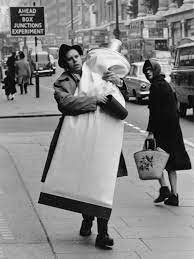 “I am for Kool-art, 7-Up art, Pepsi-art, Sunshine art, 39 cents art, 15 cents art. . . . I am for an art of things lost or thrown away on the way home from school.” When the artist Claes Oldenburg, who authored these words in 1961, died this week at ninety-three, one had a sense that it had been a long while since his vision, for good or ill, had engaged the center ring of the art world’s attention. If he had not exactly disappeared from view, he had faded a little. Examples of his outsized, monumental tributes to the sheer thingness of ordinary things, celebrated in the Whitman-esque list above, could be found in many American cities—a giant clothespin in Philadelphia, shuttlecocks in Kansas City—but, though his sculptures are often beloved, they exist by now more as local color than as visionary art. They have become, in an irony that Oldenburg would have appreciated, numbered among the vernacular eccentricities that have always dotted the American landscape: the giant elephant in Margate, the duck on Long Island, or the giant pickle that once stood at Fifth Avenue and Broadway.
more here.
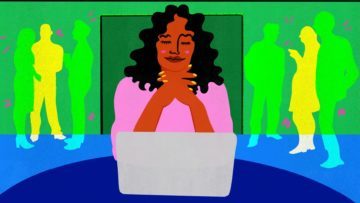 Caring less doesn’t mean negligence. To care less about inconsequential matters, you need to zero in on what is worth caring for. Consider taking stock of to-do list items and obligations and asking if these responsibilities make your day feel more spacious or more confined, Cohan suggests. Does it nourish your sense of creativity? Is it the best use of your time and talent? Does it make you feel exhausted? Do you want to spend your time and energy on this?
 One evening in his Paris flat, Édouard Louis, the French literary star who shot to fame at 21 with
  On an early autumn day in 1992, E Bruce Harrison, a man widely acknowledged as the father of environmental PR, stood up in a room full of business leaders and delivered a pitch like no other.
 Many people have strong opinions about abortion – especially in the wake of the U.S. Supreme Court decision that overturned Roe v. Wade, revoking a constitutional right previously held by more than 165 million Americans.
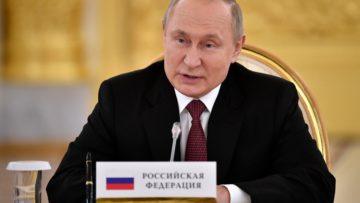 NATO traditionally maintains strong deterrence and defense, while it has also led the way toward detente and dialogue. NATO’s current commitment to deterrence and defense is clear. But to restart conversations, NATO must now also find a way to encourage détente and dialogue.
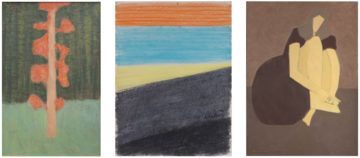 Even the critic Clement Greenberg, who had earlier dismissed Avery, came to acknowledge the unique liminal quality of his work, which hovers between representational and non-representational art. “There is the sublime lightness of Avery’s hand on the one side,” he noted, “and the morality of the eye on the other: the exact loyalty of these eyes to what they experience.” A negotiation between Avery’s instinct for “sublime lightness” and the optical exactitude of what his eyes actually experienced can be heard echoing from every canvas. Avery’s art, Greenberg poetically observed, “floats, but it also coheres and stays in place, as tight as a drum and as open as light”.
 WHEN STEVE BARNHILL moved into his dead uncle’s old room, he decided it was time to finally read the man’s mysterious book. It was the mid-1970s, in his aunt’s house in Huntington, a small West Virginia city on the border of Ohio and Kentucky. He recalls the book sitting on a shelf, a slim hardcover volume dressed in taupe cloth and stamped with bold red letters: Waiting for Nothing.
 L
L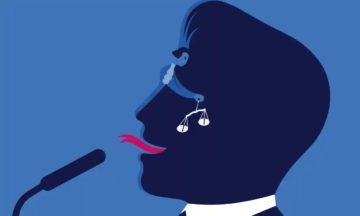 Truth is democracy’s most important moral value. We work out our direction, as a society, through public discourse. Power and wealth confer an advantage in this: the more people you can reach (by virtue of enjoying easy access to the media, or even controlling sections of it), the more likely you are to bring others round to your point of view. The rich and powerful may be able to reach more people but, if their arguments are required to conform to reality, we can at least hold them to account. Truth is a great leveller.
 It was 3 a.m. I was exhausted from taking care of my 3-month-old baby, but I couldn’t sleep. As I tried to recall the topics of the five conference calls on my calendar for the morning, I again had the haunting thought that I wasn’t good enough for my job—a director position I started shortly before my baby was born. I imagined I would make mistakes in my presentations and my team would lose respect for me. Tormented by these thoughts, I reached for a book from the pile on my bedside table to distract myself. By chance I grabbed the Bible, which I had been too busy to read since my baby was born. As I opened it to a random page and happened on the verse “For when I am weak, then I am strong,” tears filled my eyes, and I could breathe again.
 While the question of alien life is never far from our investigations of distant galactic structures, the device’s distinctive honeycomb structure seems emblematic of the organic complexity of our own planet, of what it has been capable of producing, and what it is capable of projecting out into space.
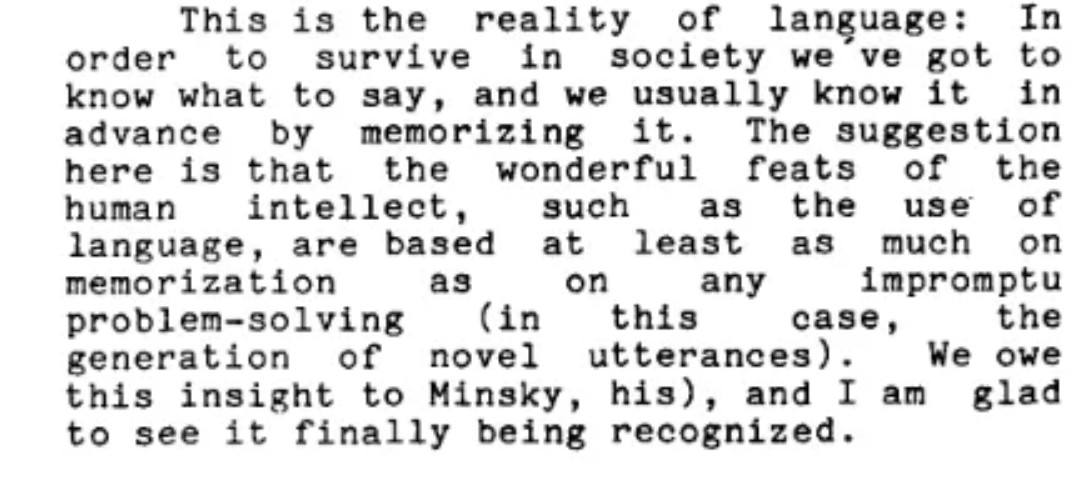 The intuition that language might simply be memorized has some superficial plausibility – but only if you restrict your focus to simple concrete nouns like ball and bottle. A child looks at a bottle, mama says bottle, and child associates the word bottle with the concept BOTTLE. Some tiny fragment of language may be learned this way. But this simple learning by pointing-plus-naming idea, as intuitive as it is, doesn’t get you very far.
 Modern politics has always been replete with issues about which people feel passionate, sometimes aggressively so. But the culture wars currently raging in the US, Canada, and across much of the industrialized West seem to be particularly fraught. In my 50-plus years, I have never seen so much anger and hostility among citizens of otherwise stable countries. Some of these people will participate in protests or engage in civil disobedience, but many more will employ the political meme to express their discontent. Given how widespread the phenomenon has become, it’s worth asking whether political memes actually advance advocacy goals and our knowledge of important issues, or if they simply feed an unconstructive cycle of anger, misinformation, and polarization.